
Imagine that a factory suddenly runs out of an important raw material. The lines of production stop. Customers’ orders are taking longer than expected. Bosses are very angry. In the warehouse down the street, on the other hand, there is a lot of the same material that isn’t being used, but the inventory system says there is none. When companies don’t have the right SAP MM (Material Management) systems in place, this kind of chaos happens all the time. But this situation is almost impossible for companies that have mastered SAP MM configuration.
If you’ve heard the term “SAP MM Module” and are curious about what all the fuss is about, this is the article for you. SAP MM isn’t the most interesting topic in the tech world, but it quietly runs the supply chains of thousands of businesses around the world, from cars to drugs to consumer goods. And the job opportunities it opens up are truly amazing.
Let’s take a close look at what SAP MM is, how it works, what kind of salary you can expect, and whether this specialization is the best choice for your career in 2026.
Connect With Us: WhatsApp
SAP MM Career Snapshot (2026)
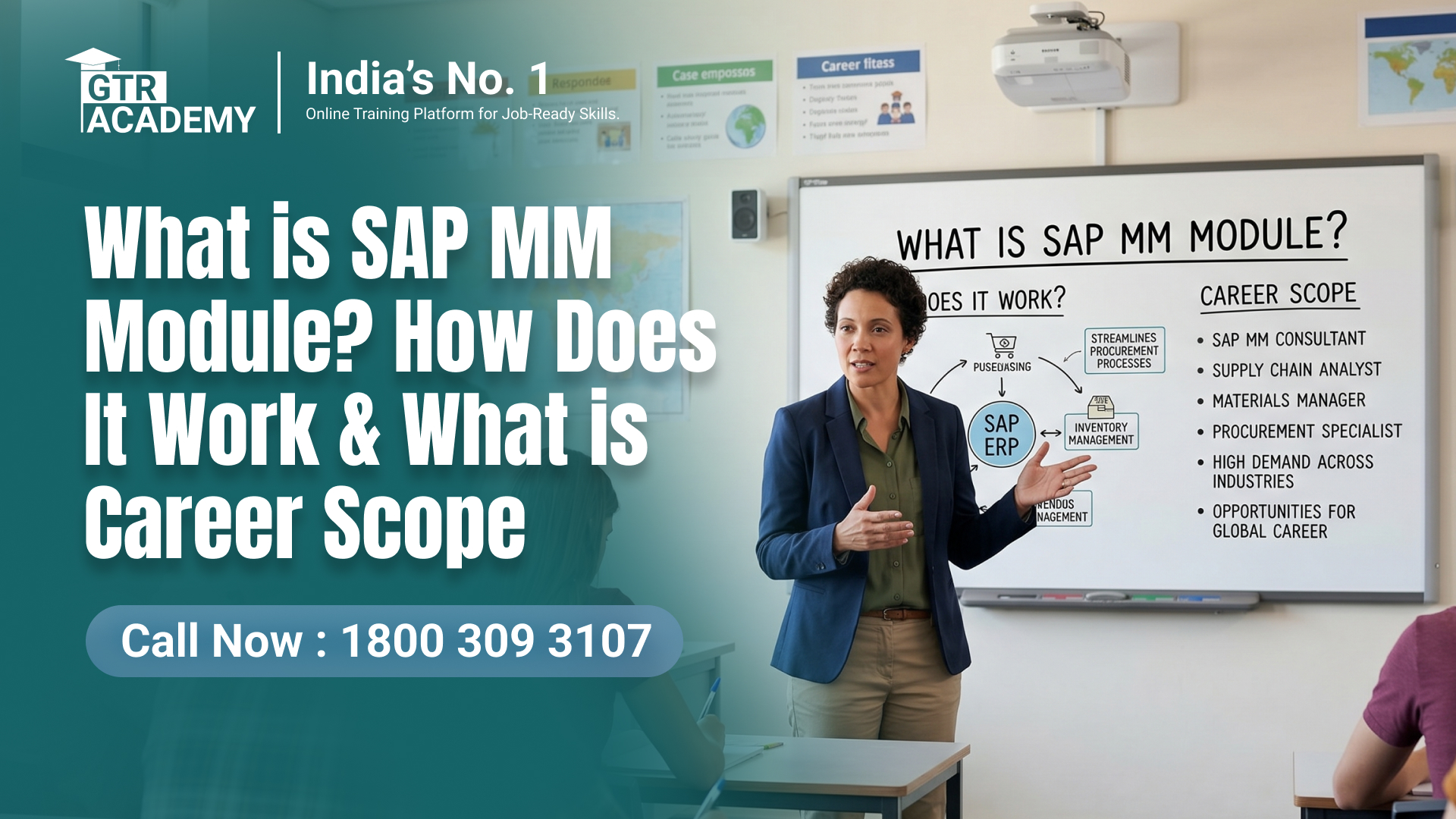
What is the SAP MM Module? The Real Meaning
Material Management, or SAP MM, is the operational backbone that handles all of a company’s purchasing, storing, and moving of materials using SAP. In a business, it is like the nervous system for everything physical, like raw materials, parts, finished goods, supplies, and tools.
The SAP MM module needs other modules to work. It’s very connected to other modules. For example, Finance (FI) keeps track of the money, Production Planning (PP) figures out what needs to be made, Quality Management (QM) makes sure that standards are met, and Sales & Distribution (SD) decides what gets shipped. When you set up MM correctly, you make a single flow that lets material information move smoothly throughout the whole company.
It’s not about technology with SAP MM. It’s about keeping an eye on your company’s biggest asset: its inventory. If you don’t do it right, you lose money. “Do it right, and you’re a hero.“
The main job of SAP MM is to answer these three important questions:
-
What supplies do we need?
-
Do we have them on hand?
-
What did they cost and where are they?
Companies that run well know the answer to all three right away. That’s how SAP MM works.
How Material Management Works: A Step-by-Step Guide to SAP MM
If you want to learn this module, you need to know how the SAP MM workflow works. This is the path a material takes through the system, from the time someone realizes they need it until they actually use it:
-
A need is found: A production planner, warehouse manager, or department head sees that materials are needed.
-
Purchase Requisition Created: SAP keeps track of a formal request that includes the quantity, material code, and delivery date needed.
-
Choosing Vendors and Making a Purchase Order: The procurement team chooses vendors based on contracts, prices, and past performance, and then makes a Purchase Order.
-
Sending the Purchase Order to the Vendor: The PO is sent electronically or by mail with all the terms, quantities, prices, and delivery expectations.
-
Goods Receipt at Warehouse: When materials arrive, they are checked and a Goods Receipt (GR) is made, which automatically updates the inventory levels.
-
Invoice Receipt and Three-Way Matching: The vendor’s invoice comes in and is compared to the PO and GR. Any differences cause exceptions.
-
Goods Issue to Production/Customer: Materials are sent out for production or delivery to customers, which lowers stock levels and keeps track of how much is used.
-
Stock Analysis and Reordering: The system looks at stock levels and how they are used, and when certain levels are reached, it automatically sends out new purchase requests.
In big companies, this eight-step cycle happens thousands of times a day. If you know how to do these things in SAP, you can fix problems, come up with new ideas, and solve real business problems. That’s why SAP MM consultants are so valuable: they know how to put together this complicated dance.
What You Will Learn in a SAP MM Module Course
A full SAP MM course isn’t just about learning transaction codes by heart. This is what a real SAP MM module learning program includes:
Managing Master Data
-
Making and keeping material masters (with more than 40 configuration tabs).
-
Setting up vendor masters and managing source lists.
-
Records of purchase information and prices for each vendor.
-
Location of storage and layout of the warehouse.
How to Get Things (Procurement)
-
Workflows and approvals for purchase requests.
-
Strategies for making, keeping, and releasing purchase orders.
-
Contracts with vendors and agreements on when to meet.
-
Three-way matching procedures for checking invoices.
Managing Your Inventory
-
Processing of goods receipt and goods issue.
-
Putting away stock and managing bins.
-
Cycle counting and physical inventory.
-
Moving stock between plants and places.
-
Managing batch and serial numbers.
Costing and Valuation
-
Methods for figuring out the value (moving average, standard cost, etc.).
-
Parts of the price and how to divide overhead.
-
Comparing costs and looking at differences.
Advanced Topics (Project Exposure)
-
S/4HANA MM features and easy-to-use data models.
-
Integration of Warehouse Management (WM).
-
Interface for Quality Management.
-
PP connectivity for production planning.
GTR Academy Pro Insight: A lot of our students ask, “What’s the difference between learning MM and doing it on a project?” The answer is very important. In addition to the theory, our SAP MM Course also includes hands-on configuration of real business situations, such as purchase workflows, inventory movements, and month-end closing procedures. This part of the project is what makes our graduates (who get jobs quickly) different from students who only know the book.
Real salary numbers for 2026 for SAP MM career growth
Let’s be honest: most people want to know if this job change is worth it. The answer is clear: yes, but there are important things to keep in mind about timing and specialization.
The Real Salary Breakdown
-
Freshers: ₹3–5 LPA (₹25K–42K a month). At first glance, it’s not impressive, but being patient pays off.
-
3 to 5 years of experience: ₹10 to 16 LPA. This is where SAP MM really starts to pay off. Some mid-level consultants with domain knowledge make ₹18–20 LPA.
-
Senior (6–10 years): ₹18–30 LPA. At this point, specialization becomes your growth factor. A senior MM consultant in the automotive or pharmaceutical industries makes a lot more money than one in a generic industry.
-
International: $75,000 to $120,000 USD for professionals with experience. A lot of Indian SAP MM consultants work outside of India and make a lot of money.
The path is steep. If you choose your assignments wisely and build up your specialized knowledge, someone who starts at ₹4 LPA as a fresher can realistically reach ₹15+ LPA in 5–6 years. That’s four times more than the average for the IT industry as a whole.
Is it still worth learning SAP MM in India in 2026?
Everyone should ask themselves this before spending 3–6 months and ₹50K–₹1.5L on a course. Will SAP MM still be useful in five years? Will these jobs go away because of automation? Let’s be honest.
Why the Future of SAP MM Is Very Bright
-
The migration wave keeps going: A lot of Indian businesses, especially those in the middle and large markets, are still moving from old systems to SAP. This wave will last until 2028–2030.
-
S/4HANA Migration: More and more companies are switching from SAP ECC (older) to S/4HANA (newer). This means that there is a need for consultants who know how to use the new platform. Most hiring by 2026 will be for people with S/4HANA MM knowledge.
-
Supply Chain Visibility is Non-Negotiable: After the pandemic, every serious business has realized how important it is to be open about its supply chain. This means that SAP MM needs more money, not less.
-
New features in S/4HANA: AI-powered demand forecasting, automated procurement, predictive analytics, and sustainability tracking are all built into MM.
Real Headwinds
More and more, IoT and warehouse robots are automating basic MM tasks like receiving and issuing goods. Businesses need fewer people to do work at the transaction level. But there is still a strong demand for experienced consultants who can come up with solutions and make processes better. The change is from “operators” to “architects.“
Fees, length, and where to study for the SAP MM course
If you’ve decided that learning SAP MM is a good idea, here’s some useful information about your training options:
Costs of the SAP MM Module Course in India
-
Online Self-paced: ₹15,000 to ₹40,000. Cheap, but many people drop out because there isn’t enough structure.
-
Classroom Training: ₹50,000 to ₹1,20,000. Includes practice and networking with other students.
-
City-Specific (e.g., Coimbatore): ₹40,000 to ₹80,000. There are a lot of good institutes in Coimbatore, but quality varies.
-
Premium Programs: ₹80,000–₹1,50,000 for programs with job placement help.
GTR Academy is India’s best SAP training provider. They offer full SAP MM courses with live system access, real project simulations, and guaranteed job placement support. Their courses cost at least ₹60,000 (which includes preparation for certification) and give you lifetime access to learning materials. GTR Academy has trained over 1,000 SAP MM professionals who now work at top companies. They have centers in many cities, including Coimbatore, and a strong online program.
Length of the SAP MM Course
Most SAP MM module courses last 4 to 6 months full-time or 6 to 9 months part-time. Expect 8 to 12 months from the start of the project to the first interview-ready stage.
How much does it cost to get SAP MM Module Certification?
In India, the official SAP Certified Associate exam (C_TSCM62_67) costs between ₹40,000 and ₹50,000. Some training providers include this in the cost of their courses, while others charge extra. The test lasts three hours and covers the basics of MM.
Free Course on SAP Material Management: A Reality Check
There is no real, full “free SAP MM course.” What is there instead:
-
YouTube videos by consultants (good for ideas, not job prep).
-
SAP Community Forum discussions (useful extras).
-
Free trials of SAP Learning Hub (usually two weeks).
-
Open SAP theoretical courses (video-based, no system access).
Important Skills You Will Need for SAP MM in 2026
Besides knowing the module, here are some things that employers really want:
SAP MM Technical Skills
-
Configuration of the Material Master & Purchase Orders
-
Receiving and Issuing Goods
-
Valuation of Stock & Batch Management
-
Setting Up the Vendor Master
-
Integration of the warehouse & Analysis of Costs
-
What S/4HANA MM Can Do (Predictive Analytics, Fiori)
Domain Knowledge
-
Business and domain knowledge, supply chain planning, and procurement strategy.
-
Optimizing Inventory and managing vendors.
Soft Skills That Get You Hired
-
Documentation: Functional specs, design documents, and testing scripts.
-
Problem Solving: Fixing inventory mismatches or costing errors.
-
Communication: Explaining complicated processes to non-technical staff.
-
Process Optimization: Identifying and fixing process inefficiencies.
Should you learn SAP MM? Here are some final thoughts.
Here’s the honest truth about taking a SAP MM course: it’s a real, valuable step up in your career. It’s not too much hype; the field really needs it. The pay raise is real and has been documented. In a tech industry that often feels chaotic, the job security is great.
But you can’t skip steps. You need good training with access to the system. You need to be patient during the entry-level phase, which isn’t very glamorous. You need to learn a lot about a certain industry or process.
People who work in material management and go to GTR Academy always reach their career goals because they see this as the start of a real specialization, not just a “course to get through.” Your SAP MM certification is just the start. You really learn by working on real projects, solving real business problems, and working for real companies.
Are you ready to start your SAP MM journey?
GTR Academy offers full SAP MM training with guaranteed job placement, access to live systems, real project simulations, and expert guidance. Join more than 1,000 successful graduates who are now working for top companies.
GTR Academy Answers: A Career in SAP MM in 2026
1. Is SAP MM a good job to have in 2026?
Yes, it’s a good career choice that will last. SAP MM experts are always in demand because every business—from Manufacturing and Retail to Logistics—needs to buy, manage, and keep track of materials. It is even more important in 2026, when supply chains will be smarter.
2. How long do you need to get ready for work in SAP MM?
A typical timeline for learning:
-
Training for the basics: 2–3 months
-
Advanced + practice: 1 to 2 months
-
Ready for work in 3 to 5 months If you practice every day and get the right help, you can be ready for a job in four months.
3. Is it possible for someone who doesn’t know much about technology to learn SAP MM?
Yes, for sure. SAP MM is process-based, not coding-heavy. A lot of our students come from B.Com or BBA backgrounds. You only need basic computer skills and a desire to learn.
4. How much does it cost to get certified in SAP MM in India?
Official SAP certification can range from ₹2.5 lakh to ₹4 lakh through some channels, but the training itself costs between ₹25,000–₹80,000. At GTR Academy, we help you decide if and when certification is necessary to put money into it.
5. How much do SAP MM workers in India really make these days?
-
Newcomers: ₹20,000 to ₹40,000 a month.
-
2 to 4 years: ₹50,000 to ₹1,00,000 a month.
-
Senior Consultants: More than ₹1.5 lakh a month.
6. What are the main differences between SAP MM and SAP SD?
-
SAP MM: Procurement, inventory, and vendor-focused (Procure-to-Pay).
-
SAP SD: Sales, customer service, and customer-focused (Order-to-Cash). Pick SAP MM if you like supply chain management; pick SAP SD if you like sales and customer handling.
7. Will automation and AI limit the future of SAP MM?
No, they are changing it, not replacing it. AI helps with forecasting and optimization, but companies still need SAP MM experts to set up systems, handle processes, and manage exceptions. The future is brighter with SAP MM and AI knowledge combined.
Connect With Us: WhatsApp
🎯 Last Words of Advice from GTR Academy
What is SAP MM? It is an easy-to-learn, stable job with high demand in the supply chain field. You can build a career that lasts if you are consistent, practice well, and work on real-life scenarios.