

Before taking a data science course, you should have basic math and statistics, basic Python or SQL, and data handling at an Excel level. You don’t have to learn any of them. A solid foundation keeps you with the lessons, on the projects, and not lost week two.
Data science is the process of collecting, cleaning, analyzing and interpreting data to help make better decisions. A good Data Science Course will teach you this from raw data to a finished insight, from start to finish.
Connect With Us: WhatsApp
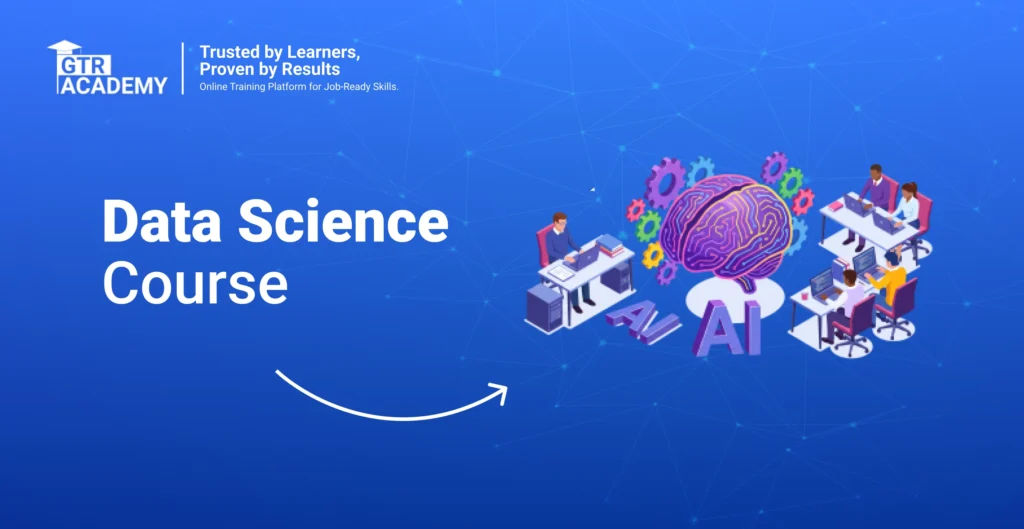
What Does a Data Science Course Actually Cover?
A structured program typically consists of the following phases:
- Programming: Python, SQL for databases
- Statistics and probability: the logic of all models
- Data analysis and visualization: Pandas, Numpy, Matplotlib, Power BI, or Tableau.
- Machine learning : regression , clustering , classification
- AI Topics – Neural Networks – Natural Language Processing – Fundamentals of Generative AI
Learners will typically work on projects like predicting customer churn, forecasting sales, or analyzing survey data. These show you how real data sets behave as they are rarely clean or tidy.
Which Skills Should You Build First?
- Basic math. School level algebra averages and percentages and graphs is enough to start.
- Fundamentals of statistics. Learn probability, mean, median, variance Once you know these, models make a lot more sense.
- Excel skills. Sort and filter, pivot tables and simple formulas in Excel teach you to think in rows and columns and patterns.
- Python for beginners. There are a lot of variables, loops, functions, lists. Libraries you will learn about in the course.
- Basic SQL That’s why you need to know how to pull data with SELECT and WHERE and JOIN.
- Inquisitive about problems. Tools can be learned but it is the habit of asking good questions that separates good analysts from the average.
Who Should Take a Data Science Course?
It is good for students, freshers, working professionals and career shifters. Analysts, marketers, finance staff and software developers will add data skills to help them advance in their current roles. A non-technical background is not a barrier if you are willing to practice a lot.
Why Do Data Science and AI Skills Matter for Careers?
Retail, banking, healthcare and technology companies use data to make decisions. These skills are a must for jobs like data analyst, business analyst, and junior data scientist. Demand varies from city to city, company to company, experience to experience. So treat any course as a starting point, not a guaranty of a specific job.
How Do You Choose the Right Training?
Grab any classroom batch or data science AI online course, look for these factors:
- Industry relevant curriculum, using current tools not old ones.
- Trainers with real project experience
- Get hands on learning with coding in every class.
- Real world projects to talk about in an interview
- Live or self-study classes that fit your schedule
- Mock Interview Sessions & Resume Feedback
- Career Guidance and 100% Placement Assistance i.e. Structured assistance for Job Applications
- Certification that shows you’re awesome at what you do
Request a demo class or syllabus before you pay. A good AI online course training should tell you what you’ll build.
GTR Academy offers Data Science with AI training through practical sessions, hands-on project work and expert-led guidance. Learners also receive interview preparation, career guidance and 100% Placement Assistance to support their job search and career development.
What Mistakes Do Beginners Make?
- Waiting to “know it all” before you begin
- See the tutorial (no coding)
- Skipped the stats and went straight to machine learning
- Just choosing a course because of the price or the promises
- Exclusion of projects from the portfolio
Frequently Asked Questions (FAQs)
1. Do I need coding knowledge before joining a data science course?
No. Most starter courses start from the very beginning, but it helps to have some basic Python knowledge for the first few weeks.
2. Is a data science course difficult for non-IT students?
It can be felt challenging at first but non-IT learners also success with regular practice and good trainer.
3. How long does a data science course take?
Most programs last 4-8 months depending on the depth of the program and whether it includes AI and projects.
4. Can I learn from an AI online course without a degree in maths?
Yes. All you need to begin is school level maths and a willingness to learn statistics.
5. What should a good data science course include?
Python, SQL, Statistics, Machine Learning, Visualization, Real Projects, Interview Preparation.
Connect With Us: WhatsApp
Recommended Blogs:
SAP FICO Consultants: Which Skills Do Freshers Need? 2026
SAP SD Training: What Career Opportunities Can You Explore? 2026
Conclusion
Before signing up, get familiar with basic math, statistics, Excel, and beginner Python. Then enrolll in a data science course that guaranties hands-on projects, experienced trainers, flexible learning and real career support. Preparation and practice are more important than prior experience.