
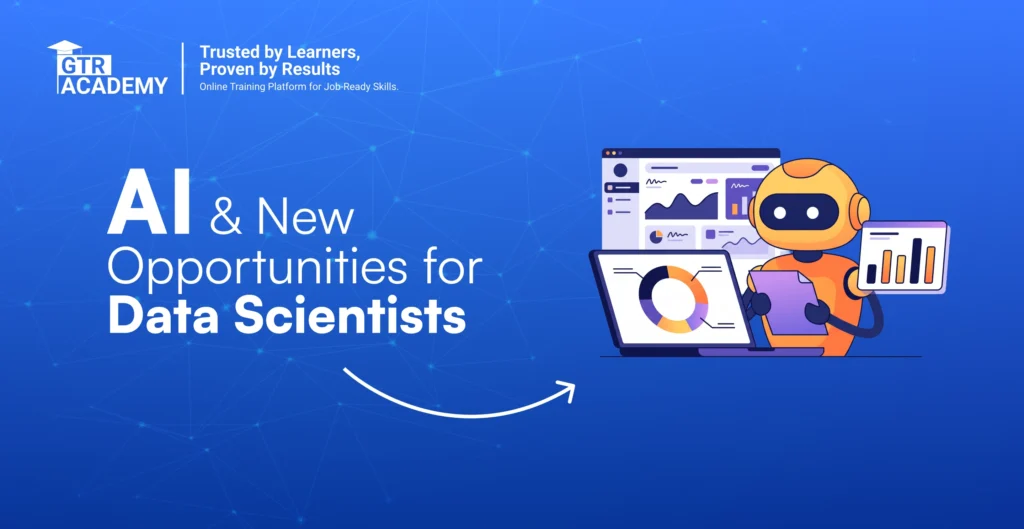
Every few months, the same debate ignites in tech circles with the release of new AI tools: Will machines take over Data Science Jobs? The truth is that the answer is not so simple as yes or no. Automation is changing the work of data scientists. But the question of whether AI Replace Data Scientists misses the bigger picture. AI is not taking away the role, it is changing it and creating opportunities for professionals who know how to work with it.
Connect With Us: WhatsApp
What does a data scientist actually do?
But before we can decide whether AI poses a threat to this career, it’s useful to get to know the job. Data scientists collect, clean and analyze data to detect trends and build models to help companies make decisions. That includes statistics, programming (often in Python or R), machine learning (ML) and, increasingly, deep learning (DL) for complex tasks such as recognition of images or natural language processing.
This is not a purely technical role. It requires business judgment – which questions are worth answering, how to communicate findings to non technical stakeholders.
Will AI take over these jobs?
Yeah, sort of. AI tools are now doing the repetitive parts of the job:
- Data cleaning and preprocessing. Scripts and platforms that automate this make this faster
- AutoML tools for quick baseline models in basic model building
- AI is able to assist in writing summaries of data outputs for report generation.
Lack of context is missing in AI. It can’t tell you why a business problem matters, or help you filter out bad assumptions in a data set, or make ethical trade-offs when you deploy a model. That verdict remains humane.
Where to Look for New Opportunities
AI is creating new specialized jobs, not eliminating jobs
- AI trainers/prompt engineers who tune model behavior
- MLOps practitioners deploying and monitoring at scale
- AI Ethics & Governance Specialists Responsible Usage
- AI tool fluent, domain-savvy hybrid analysts
The more you upskill in these areas, the more you are employable, not less.
Data Scientist Tools Essentials – Must Know
Python, SQL and libraries like Pandas, Scikit-learn and TensorFlow are still a solid foundation. Hiring managers are also looking increasingly for a baseline knowledge of generative AI platforms, cloud ML services (AWS, Azure, GCP) and visualization tools like Power BI or Tableau.
Who Should Learn Data Science Today?
This field is good for:
- Fresh graduates from Engineering/Statistics/Commerce background.
- IT/Analytics Professionals currently employed and seeking transition
- Business analysts wanting to add some technical depth to their skill set
You don’t need to have a coding background, but it’s helpful if you have a knack for numbers and logic.
Choosing the Right Training Program
Not every course is equal. Search for
- ML, DL & latest AI tools curriculum relevant to industry
- Not theory specialist training, real project experience
- Live projects for practical learning, not only recorded lectures
- Flexible timing is available for the professionals to choose.
- The program also includes interview preparation and career guidance.
One of the common mistakes of a beginner is to choose a course based on price alone and not check if it has practical portfolio worthy projects.
This is exactly the approach taken in GTR Academy’s Data Science with AI course – practical oriented projects, experienced trainers, dedicated interview preparation and backed by 100% Placement Assistance to help learners transition into the industry with confidence.
Frequently Asked Questions
1. Is AI going to replace data scientists?
No. AI is able to automate repetitive tasks but human judgment is still needed as far as context, strategy and ethical decisions are concerned.
2. What skills should I acquire to stay relevant in data science?
Traditional statistics + Python + Machine Learning/Deep Learning fundamentals + Cloud Platforms + Generative AI tools
3. Data Science Course in an AI World: Is It Worth It?
Yes – learning courses that teach AI-integrated skills are preparing learners for the changing job roles, not the old ones.
4. How long does it take to learn Data Science?
Most structured programs are 4-6 months long depending on prior experience and course depth.
5. Do I need to know coding for a data science course?
No, but it helps to have some basic logic. Most beginner courses are designed to go from 0 to coding.
Connect With Us: WhatsApp
Recommended Blogs:
SAP MM vs Other SAP Modules: Which One Should You Learn? 2026
SAP FICO Module: What Career Roles Can You Explore? 2026
Summary
So, can AI take the place of the data scientists? Not what the headlines say. It’s automating the mundane while creating demand for those who understand both data and artificial intelligence systems. The best strategy is not to fight AI, but to learn how to use it effectively through structured, project-based training.