
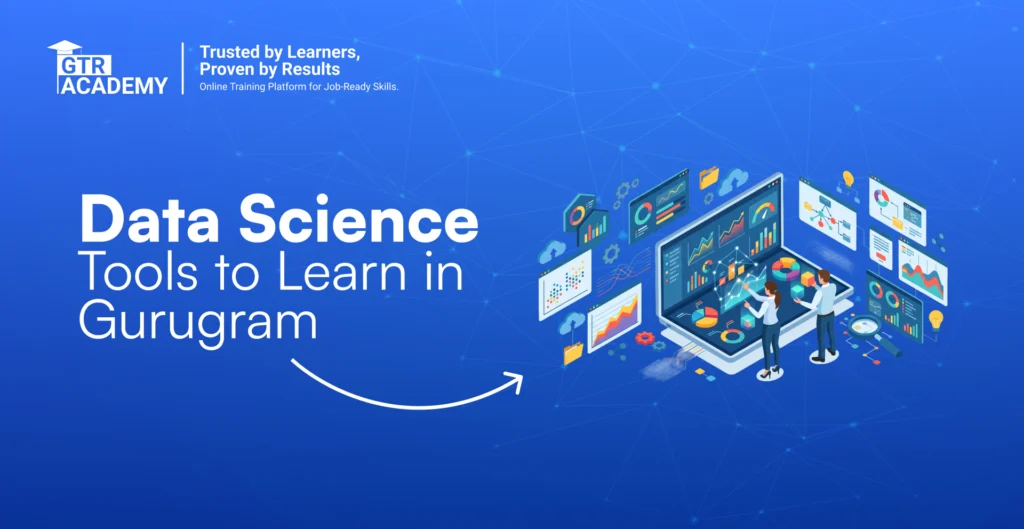
Right Data Science Tools can make your learning experience more practical and job oriented. Especially if you are a student or a professional in the rapidly growing tech ecosystem of Gurugram. Technologies include Python and SQL, machine learning libraries, visualization platforms and cloud tools that enable data professionals to collect, analyze, model and communicate data.
Connect With Us: WhatsApp
What Are Data Science Tools?
The tools of data science include programming languages, libraries, platforms and frameworks used to work with data. They are useful at different stages of the data science lifecycle and include data cleaning, exploratory analysis, visualization, machine learning, deep learning and deployment.
But the power learner doesn’t need to learn all the tools at the same time. You need tools with a practical foundation.
Which Data Science Tools Should Beginners Learn?
1. Python
Python is a great language starting off for data science. Libraries for data analysis, machine learning, automation & visualization are:
Pandas – data manipulation and analysis
NumPy – numerical computing
Matplotlib and Seaborn – data visualization
Scikit-learn – machine learning
Definitely do Python first as it ties together many aspects of the typical data science workflow.
2. SQL (Structured Query Language)
SQL is what you use when you want to work with structured data in databases. You should be able to do SELECT statements, filtering and joins, aggregation and subqueries, window functions.
In many real world projects data scientists will pull and prepare data with SQL before doing any analysis in Python.
3. Jupyter Notebook
Jupyter Notebook is an open-source interactive environment to write python code, analyze datasets, create visualizations and document your experiments. And it works especially well for hands-on, project-based learning.
4. Tableau / Power BI
Data science is not analysis. … You need to be able to communicate what you found.
We develop interactive and easy to understand reports and dashboards in Power BI and Tableau for deriving business insights.
5. Scikit-learn
After learning Python fundamentals, Scikit-learn is a practical tool for machine learning. It provides implementations for regression, classification, clustering, preprocessing, model evaluation, and other common ML tasks.
6. TensorFlow or PyTorch
If you want to move toward deep learning, explore frameworks such as TensorFlow or PyTorch. They are useful for neural networks and applications involving computer vision, natural language processing, and other advanced AI tasks.
How Projects Help You Learn These Tools
Understanding tools is easier when you use them on realistic problems. Customer churn prediction, sales forecasting or customer segmentation or sentiment analysis can be a beginner project.
Say you pull customer data with SQL, clean it up with Pandas, explore patterns with Matplotlib, fit a predictive model with Scikit-learn, and visualize the results in Power BI.
This practical approach is also useful when you are doing an Online Data Science ai Course or ai online Course training as it ties concepts into real workflows.
Who Should Learn Data Science Tools?
These tools are helpful for students, new graduates, working professionals, analysts, programmers and career switchers looking at data-driven roles. Having a basic knowledge of math, statistics and programming can facilitate the learning process, but beginners can develop these skills while undertaking a structured Data science course.
How to select the right Data Science training in Gurugram?
Look for training that provides relevant curriculum, expert instruction and hands-on application. Verify that the program offers live or flexible classes, interview preparation, career guidance, real world projects, certification where applicable and 100% Placement Assistance.
GTR Academy is for students who want hands-on training from expert trainers, projects, interview preparation, career support, and 100% placement assistance.
Common Beginner Mistakes
Don’t learn too many tools at one time. Another common mistake is to memorize python syntax without building projects. Also, don’t discount SQL, stats, or communication skills. Most importantly, learn why a tool is used, not just collect the certificates.
Frequently Asked Questions
1. What are the first data science tools that a beginner should know?
Learn Python, SQL, Jupyter Notebook, Pandas, Numpy, Visualization libraries and Scikit-learn for beginners.
2. Data Science – Do you need Python?
Python is a good place to start but also spend some time learning SQL, statistics, visualizing data and machine learning concepts.
3. Is SQL required to land a data science job?
Yes. SQL is used to query/filter/join/aggregate data in relational databases.
4. Tableau vs PowerBI Which one should you learn.
“Either can be helpful. Choose according to career goals, project demands and tools used in companies you will work with.
5. Can one teach these tools in a Data science course through a project?
A good Data science course should have concepts and practical projects that learners could understand how different tools work together in real-life situations.
Connect With Us: WhatsApp
Recommended Blogs:
What Is Included in an SAP FICO Training Course? 2026
How Certification helps you learn SAP S/4HANA?
Conclusion
So, what are Data Science Tools you should learn in Gurugram? Python, SQL, Jupyter, Pandas, NumPy, visualization tools, Scikit-learn. Then as your goals become more advanced, move to TensorFlow or PyTorch, and cloud technologies. Best way to learn is the combination of fundamentals + practical projects + tools relevant to your target career