
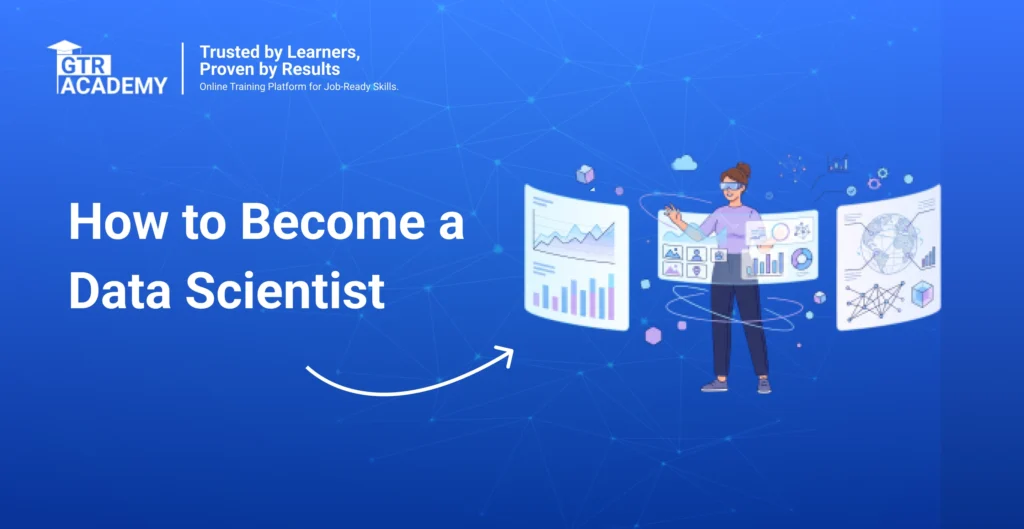
With data becoming a more and more important part of business, the role of the Data Scientist has become more relevant to industries such as technology, finance, healthcare, retail and others. Who is a Data Scientist? A Data Scientist is a professional who takes raw data, analyzes it and, by using statistics, programming, machine learning and business understanding, provides useful insights, predictions and solutions. Beginners should follow the right way of strong fundamentals + practical project experience.
Connect With Us: WhatsApp
What Does a Data Scientist Do?
A Data Scientist finds patterns in large and complex data to help solve business problems. This work can include collection and cleaning of data, exploratory analysis, building standard ML models, evaluation of results and communication of results to stakeholders.
This is not just any programming gig. It is also very important to know well statistics, problem solving, visualizing data and business requirements.
What Skills Do You Need to Become a Data Scientist?
These core areas will be a standard roadmap of practical learning:
- Python – Introduction to programming, variables, functions, libraries, data structures and much more.
- Statistics – Probability, distributions, correlation, hypothesis testing, regressions.
- Data Processing: Clean, prepare and analyze data sets using tools like Pandas and NumPy.
- Visualizing data – How to visualize trends in your charts and dashboards
- Machine Learning: Supervised and unsupervised learning, model evaluation, feature engineering and algorithms.
- Deep Learning: Learn about neural networks and their uses, such as computer vision and NLP.
- SQL: Query and change data in relational databases.
- Communication: Ability to communicate Tech findings to business teams in an easily understandable way.
What Is the Data Science Roadmap for Beginners?
A structured roadmap can make learning easier for you:
Step 1: Learn Python and SQL
Get the fundamentals in programming and databases first before going to more complex topics.
Step 2: Study Statistics and Math
Concentrate on concepts that directly support data analysis and machine learning.
Step 3: Data Analytics
Data cleaning, exploratory analysis, visualization and feature preparation practice
Step 4: Get into Machine Learning
Familiarize yourself with algorithms like linear regression, decision trees, clustering, and classification.
Step 5: Investigate AI and Deep Learning
Once you build the ML foundation, move on to neural networks, NLP, computer vision, and other AI applications.
Step 6: Build Projects from Real-World Use Cases
Develop projects using real-world data sets. Examples include customer churn prediction, sales prediction, recommendation systems or sentiment analysis.
Step 7: Create a Portfolio
Document your projects, approach, results and business impact on platforms like GitHub.
How Can a Data Science and AI Course Help?
The structure of the online course on AI for Data Science would allow learners to follow these ideas in a logical order. Machine Learning, Deep Learning Projects, Model Evaluation, Coding, Theory – Online AI Course.
A good Data Science Course should allow students to work on real world problems and not just the recorded theory.
Who Should Learn Data Science?
Data Science is useful to Graduates, working Professionals, Programmers, Analysts or Learners with a technical or quantitative background. Non-programmers are welcome, but you should be willing to learn programming, statistics and analytical skills over time.
How to Choose the Right Training Program?
“Review the curriculum and learning style before you enroll. The program includes:
- Expert / Expert Teachers Industry Topics Current Tools
- Hands-on coding & actual projects
- Short/flexible learning opportunities
- Resume and Interview Coaching
- Tips for the Career Certification (if applicable)
- 100% Placement Assistance (Terms & Conditions Apply, No Job Guaranty)
GTR Academy’s learning methodology includes Expert-Led Learning, Projects, Interview Preparation, Career Support and 100% Placement Assistance. And all this for students seeking structured practical training.
Frequently Asked Questions
1. What skills are required to become a Data Scientist?
Skills in demand for Data Scientists include: Python, SQL, statistics, data analysis, machine learning, visualizing data and communication.
2. How much time does it take to learn Data Science?
Timeline depends on prior experience and time spent studying. For beginners, it is better to learn the basics before going into more complex machine learning and AI.
3. Is Data Science Course Ideal for Beginners?
Yes. A beginner-friendly course can teach you Python, statistics, data analysis, machine learning, and hands-on projects in a structured way.
4. Do I need to know programming to learn Data Science?
Not always. Beginners can start with basic python. But they must practice coding consistently as they go forward.
5. Role of Data Scientist in an organization?
A Data Scientist is someone who analyzes data, identifies trends, builds predictive models and shares insights that can help guide operational and business decisions.
Connect With Us: WhatsApp
Recommended Blogs:
How to Become an SAP MM Consultant Without IT Background
Role of Data Scientists: How Is AI Transforming Their Work?
Conclusion
It’s not just about learning a programming language or getting a certificate to get into Data Science. Build a strong foundation in Python, SQL, statistics, data analysis, machine learning, AI concepts, and real-world projects. Build a portfolio Get a step by step road map Train for real, hands-on learning and career training.