
And as companies become smarter and more data-driven, the right technical skills can make all the difference to your career. Data Science and Artificial Intelligence Skills Statistical thinking, programming, machine learning, data analysis and artificial intelligence that equips professionals to solve real world business problems with data.
It’s not about learning every new AI tool. Learn the basics and then learn the practical skills you will need to achieve your career goals.
Connect With Us: WhatsApp
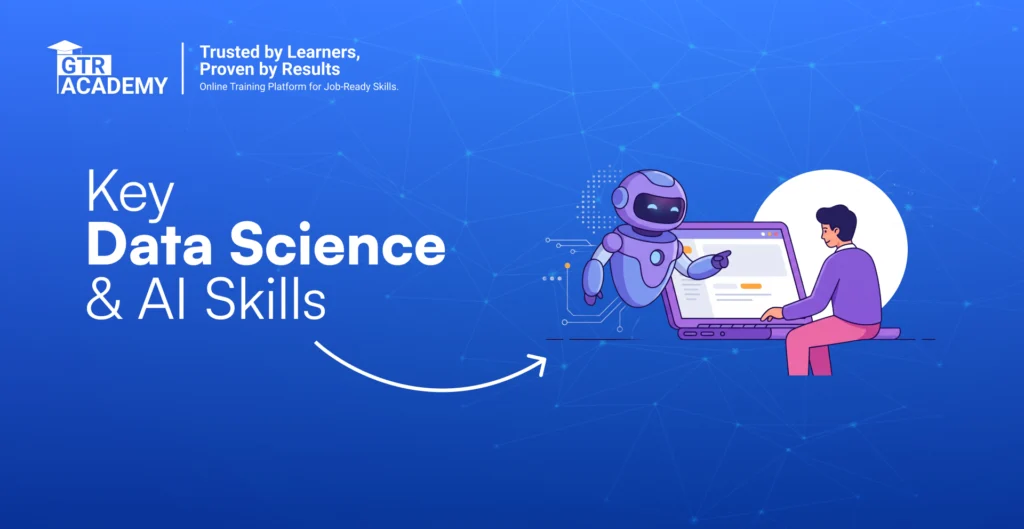
What Are the Most Important Data Science and AI Skills?
So, a good learning path will touch these core areas:
1. Python programming
Python is one of the most popular languages in Data Science and AI. It is recommended that beginners should learn about variables, functions, loops, data structures, file handling and basics of object orientation. Libraries like NumPy, pandas, matplotlib and seaborn are very useful for working with data.
2. Statistics and Mathematics
First, you don’t need more math. But you do need to know probability, descriptive statistics, distributions, correlation, hypothesis testing and some basic linear math principles. These ideas help us understand how models work, and how to interpret what they tell us.
3. SQL and Data Handling
Data scientists work with databases a lot. SQL skills allow you to retrieve, filter, join, aggregate and analyze structured data. You should also know how to clean data, handle missing values, outliers and do exploratory data analysis (EDA).
4. Machine Learning
Machine learning constitutes what makes modern data science possible. Supervised and Unsupervised Learning Regression, Classification, Clustering, Feature Engineering, Model Evaluation and Hyper Parameter Tuning.
Common algorithms are linear regression, logistic regression, decision tree models, random forests, support vector machines, and clustering methods.
5. Deep Learning and AI Learning
Begin with the fundamentals of machine learning, and then progress to deep learning. Basics of training a model . CNNs (convolutional neural networks). RNNs (recurrent neural networks) . Transformers. The basis for sophisticated AI applications.
If you are a learner interested in generative AI, it is helpful to know about large language models (LLMs), prompt engineering, embeddings, vector databases and retrieval augmented generation (RAG).
Which Tools Should You Learn?
Your tool box should be ready to support the concepts you learn. Python, SQL, Jupyter Notebook, Pandas, NumPy & visualization libraries. Then check out standard and deep learning frameworks like Tensorflow or Pytorch, Scikit-learn.
And as you go further you can add cloud platforms, git, APIs and basic MLOps.
Why Are Practical Projects Important?
Tutorials are great, but the only way to know if you can apply what you know is to do a project. Try your hand at projects like customer churn, sales forecasting, sentiment analysis, recommendation systems, fraud detection or AI based question-answering application.
If it is not only theoretical but also includes assignments, datasets, projects, and feedback from mentors, then a well-organized Online Course on Data Science AI can be helpful.
Who Should Learn These Skills?
These skills are suitable for students, freshers, working professionals, analysts, programmers and career changers. Some familiarity with math and programming helps, but beginners can build those blocks as they go.
If you are looking for a structured ai online Course training then check that curriculum should cover the basics to machine learning, deep learning and practical AI applications.
How Should You Choose the Right Training?
» Pick a curriculum that is relevant to your industry, has expert trainers, hands-on exercises, real-world projects, live or flexible classes, interview preparation, career guidance and certification where appropriate. Also, 100% Placement Assistance can be a nice support feature. But students should be looking at the real quality of training and career services, not just the placement promises.
If you are a learner and you are comparing a Data science course then you may consider GTR Academy if you want their practical curriculum, expert-led instruction, projects, interview preparation, career guidance and 100% Placement Assistance to match your learning standards.
Mistakes to avoid as a beginner
And don’t jump straight into the advanced AI tools without first learning Python, statistics, data handling and the basics of machine learning. Don’t collect certificates without doing projects. And most importantly, don’t try to learn every AI framework all at once. Get depth in a few key tools to start.
Frequently Asked Questions
1. What are the Best Data Science and AI Skills for Freshers?
Start with python, statistics, SQL, data analysis, fundamentals of machine learning, fundamentals of AI concepts and then go to more sophisticated technologies.
2. Do you need Python for Data Science & AI?
Yes. Python is used for data cleaning, data analysis, visualizing data, machine learning, deep learning, and AI application development.
3. Do we need ML for generative AI?
First learn the basics of machine learning and then you can learn the concepts of AI, data, model evaluation and model training.
4. Significance of Projects in a Data Science Curriculum
Yes. Projects are opportunities for students to work with data sets, apply theoretical concepts and demonstrate practical problem solving skills.
5. Skills to learn to enter Data Science and AI.
Master python, sql, statistics, machine learning, deep learning, visualizing data and the latest AI tools, then customize your skills to the job you want.
Connect With Us: WhatsApp
Recommended Blogs:
What Is Included in an SAP FICO Training Course? 2026
How Certification helps you learn SAP S/4HANA?
Conclusion
Best Data Science and AI Skills to learn – Python, statistics, SQL, data analysis, machine learning, deep learning, and modern AI concepts like LLMs and RAG. Translate these into practical projects, problem solving ability and communication skills to be more ready for job. Do NOT choose training for the number of certificates or tools they have. Consider the quality of curriculum, hands-on practice, mentorship and career support.