
“Live Projects in SAP MM Online Training” are the bridge between academic knowledge and professional expertise. Most SAP training focuses on theory. Real training gives you the skills you need to deal with real problems at work right away.
The problem is that regular SAP MM training includes videos, practice tests, and other materials that help you get certified. But on your first day at a company that uses SAP, you realize that the training you got wasn’t enough to get you ready for how complicated real business environments can be. You don’t know how materials management really works in businesses. You have never used real master data. You have never used SAP to fix a problem in the supply chain.
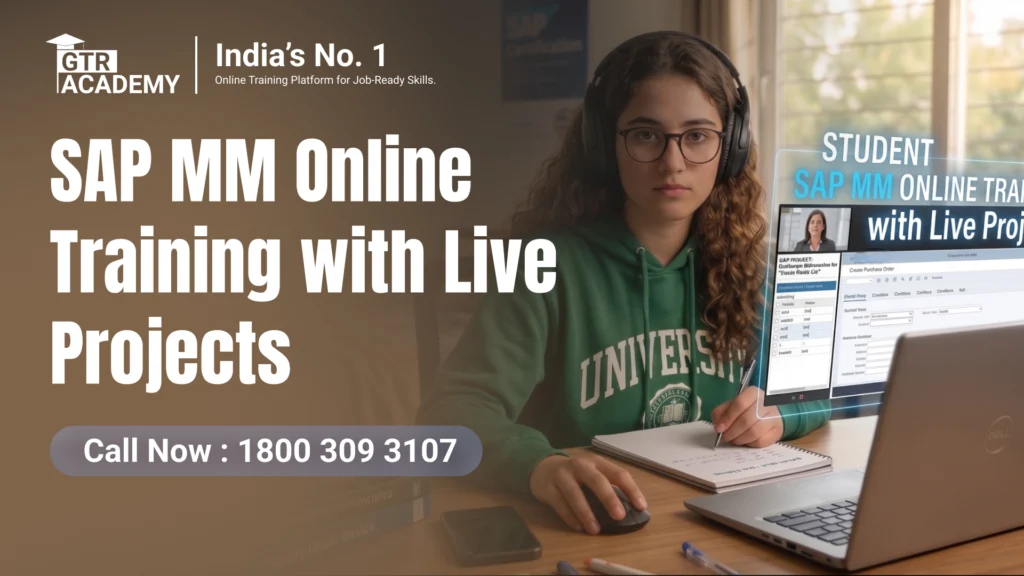
Because of this, SAP MM training that is based on real projects is very different. Instead of learning abstract ideas, you are solving real business problems as you go. You are using data that is based on facts. You are facing real problems that materials managers really do deal with. This guide explains what live project-based SAP MM training is really like, why it’s important, how it gets you ready for immediate job impact, and how to choose programs that really teach instead of just certifying.
Connect With Us: WhatsApp
Understanding SAP MM (the Materials Management Module)
SAP MM takes care of everything related to materials, such as buying them, keeping track of them, managing warehouses, making predictions, and planning the supply chain. Companies with complicated supply chains are in desperate need of people who know how to use SAP MM.
This is important because a logistics manager at a manufacturing company spends 60% of their day on SAP MM. They are in charge of managing purchase orders, keeping track of inventory, planning stock, receiving products, and setting prices. Without SAP MM knowledge, they can’t do their jobs. They use their knowledge to make things run more smoothly, which brings in millions of dollars each year.
The Value of MM Specialists
SAP MM is more important for the company itself than for customers, while SAP SD is in charge of sales. Some businesses only hire one SD consultant, but most hire several MM specialists because the field is so complicated. This opens up a chance. There is a high demand for SAP MM specialists because the skill is so specific and not everyone understands how SAP works or how complicated the supply chain is.
The Importance of Working on Real Projects in SAP MM Training
Learning SAP MM without doing real projects is like learning to swim by watching videos. In theory, you understand the idea, but when you first get in the water, you feel anxious.
This is what regular SAP MM training covers:
- Basic transactions
- Configuration steps
- Menu navigation
Students learn how to carry out transactions, but they don’t know why they are doing it or how it relates to business problems. Live project-based training turns this around. Instead of “How to make a purchase order,” it’s “Your company needs 500 units of Material X by the end of the week.” The usual supplier doesn’t have any stock. How do you handle this in SAP? What information do you need? What kinds of deals do you make? What does this mean for business?
This difference changes the way people learn. Students learn how to think about supply chains as well as SAP. They understand why materials managers make the choices they do. They work through problems that they will probably face in their jobs.
The Live Project Advantage
The Live Project Advantage is a feature of programs like GTR Academy that uses real business situations to teach SAP MM. Instead of learning about single transactions, students work on full scenarios that include things like optimizing inventory, planning purchases, managing suppliers, and dealing with supply chain problems. By the end, they have solved a lot of real problems. This is the process that makes professionals who are immediately useful, not just certified.
The Real SAP MM Live Project Training Experience
Phase 1: Business Context and Ideas (Weeks 1–3)
You start by learning the basics of the supply chain instead of SAP commands. What does it mean to plan for procurement? How do businesses figure out how much demand there will be? What makes stock materials different from non-stock materials? What is the difference between companies that keep buffer stock and those that use just-in-time inventory? This foundation is very important. You can’t fix problems in the supply chain if you don’t understand how it works. After this foundation, SAP transactions are only talked about.
Phase 2: Guided Projects for Core MM Processes (Weeks 4–10)
You learn how to use SAP MM by working through guided scenarios. An organization must buy materials, and SAP makes this easier. This is how to keep track of and deal with damaged cargo. The levels of inventory are too high. What can be done to make them better and analyze them? Each scenario teaches you how to do certain SAP transactions in a business setting. You are not just learning transactions for the sake of learning them; you are learning them to solve real problems.
Phase 3: Fixing Problems and Dealing with Complicated Situations (Weeks 11–14)
You deal with complicated situations that have many steps. How does having a good relationship with a supplier affect the prices of your material master data and purchase orders? The SAP systems of two businesses need to be connected. How do you combine materials? The demand forecast shows a shortage. What other options do you have? These situations give you the skills you need to deal with real problems. You are not just doing transactions; you are also making business decisions within the limits of SAP.
Phase 4: Career Preparation and Real Company Project (Weeks 15–18)
For your capstone project, you will create a model of a real business. You have master data, transaction data, business problems, and limits. To make materials management better, SAP needs to be put in place. You show (fake) management what you found. This task becomes a portfolio. You can show potential employers exactly how you fix supply chain problems in SAP environments.
Real SAP MM Training Success Stories
- Example 1: The Change in Rohit’s Manufacturing Supply Chain Rohit worked in the operations department of a manufacturing company, but he wasn’t using SAP properly. He took part in the 16-week SAP MM online training course offered by GTR Academy. The course included live assignments. He started by looking at how his own company bought things. By the 12th week, he understood problems he had never faced before. He gave his suggestions to his boss. The company followed his advice, and better management of materials saved them ₹15 lakhs a year. He got a raise to SAP Materials Specialist, which paid him ₹7 lakhs instead of ₹5.5 lakhs.
- Example 2: Priya’s Move to a Career in Supply Chain Analytics Priya worked in HR, but she wanted to switch to SAP and the supply chain. She was able to finish SAP MM live project training while she was working. The project she did for her capstone? Looking at how well her organization’s suppliers are doing and suggesting that they combine their vendors. Her analysis was so good that her company hired her as a materials analyst, which paid ₹6 lakhs. She had a portfolio of work that showed she could solve problems in the real world.
- Example 3: Vikram’s Big Move to Consulting Vikram finished his SAP MM training, which included a lot of live work. His portfolio included three full materials management scenarios. He worked as a freelancer, helping businesses improve their SAP MM setups. Within six months, he was charging ₹1.5–2 lakhs per month for consulting work. Companies hired him because his portfolio showed that he knew a lot about supply chains.
The Main Benefits of Live Project-Based SAP MM Training
- Job Readiness: You are not learning SAP alone; you are getting ready for a job right away.
- Portfolio Work: Live projects become portfolio pieces that show potential employers what you can do.
- Understanding the Supply Chain: Instead of just memorizing SAP commands, you learn the business principles that support SAP.
- Confidence in Problem-Solving: By the end of project 20, you will be able to see patterns.
- Faster Hiring: Employers prefer candidates with portfolio work over those with only certifications.
- Better Salary Negotiation: Portfolio work shows that you are worth more, which makes it easier to get higher salary offers.
- Long-Term Career Advantage: You have a deep understanding of the supply chain that goes beyond just knowing how to use SAP.
Live Project Training: Real Challenges
- Requires a time commitment: Full live events require real work. Set aside at least 20 hours a week for high-quality programs.
- Initial Complexity: People often have trouble at first because real-life situations are more complicated than what they read about in books.
- Program Quality: Not all programs include real projects. A ₹15,000 course teaches transactions, while a ₹60,000 course includes 15+ real projects. The price difference shows the real value.
- Prerequisite Knowledge: If you don’t know the basics of procurement planning, it’s best to start with those before getting SAP-specific training.
- Capstone Difficulty: The hardest part is the final project, which is meant to be as hard as the real company. This is on purpose to give you the skills you need.
Common Questions About SAP MM Live Project Training
Q1: Do you need to have experience with SAP MM before you can start online training? No, but it helps a lot to have a basic understanding of the supply chain. If you’ve never worked in procurement or inventory management before, you should expect to spend 2–3 weeks learning the basics.
Q2: How many live initiatives should a quality program have for it to be the best? There should be at least 10 to 15 assignments over 16 to 18 weeks. Look for programs that have 15 or more assignments spread out over the whole course, not just one big final project.
Q3: Is having a SAP MM certification enough to get a job? Certificates are valid, but portfolio work is more important. A candidate with SAP MM certification and three strong projects is better than one with only the certification.
Q4: How can I tell if a program has real “live” initiatives or fake ones? Be specific when you ask: Are the projects based on real business situations or made-up problems from textbooks? Good programs are clear and open. GTR Academy shows real student work.
Connect With Us: WhatsApp
Conclusion: Mastering SAP MM Through Real-World Practice
In the competitive world of supply chain management, the difference between a certificate and a career is practical experience. Choosing SAP MM Training with live projects ensures you aren’t just memorizing transactions but learning to solve the high-stakes problems businesses face every day.
By building a portfolio of real-world scenarios from inventory optimization to vendor management you prove to employers that you are ready for immediate impact. Transitioning from theory to practice is the most effective way to secure a higher salary, faster hiring, and long-term career growth in the SAP ecosystem.