
Imagine you just started a new job as an ERP consultant. Your manager gives you a late customer order to fix. You know SAP, but you don’t know how sales, shipping, billing, and payments all work together. Understanding SAP SD Business Processes makes this much easier, and without that knowledge, the job becomes much harder.
Many companies are transitioning to SAP S/4HANA quickly today. So the demand is huge for people who know SAP SD. Whether you are a student, fresher, or experienced worker, learning SAP SD can help in your career and make you ready for real projects.
Connect With Us: WhatsApp
SAP SD stands for Sales and Distribution. It handles the entire Order-to-Cash cycle. It covers customer inquiries, quotations, sales orders, shipping, delivery, billing and payments. Also, it integrates nicely with other SAP modules. Thus people who master SAP SD can make customers happier, speed up sales and get better ERP jobs.
What is SAP SD and Why it is Important? SAP SD is an important module in SAP ERP. It automates the work of sales and distribution. It also connects easily with SAP MM, SAP FICO, and SAP ABAP.
Why do businesses love SAP SD? Because it helps them:
- Fast handling of customer orders
- Deliver the products right
- Automate invoice generation
- Please the customer
- Minimize manual effort and errors
For example, a car company can process thousands of orders each day. SAP SD maintains correct stock, prices and bills. This means daily work is faster and smoother.
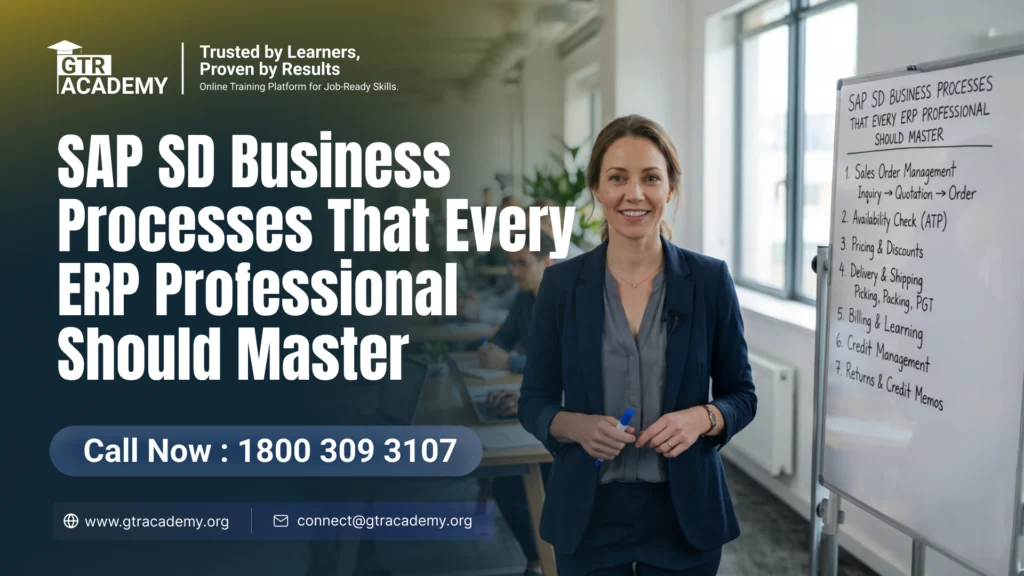
SAP SD Business Processes Essentials Here are the major processes that you should learn:
- Business Process Principal Benefit
- Request Info & QuoteSatisfies customer needs
- Order Processing – SalesCreates and monitors orders
- Availability Check Availability Check
- Pricing & DiscountDetermines right prices and offers
- Delivery Processing Manages warehouse, shipping
- Billing/InvoicingPrepares accurate customer bills
- Credit Management Lowers Financial Risks
- Returns Processing Handles product returns
Every process in the Order-to-Cash cycle is important. They also work together to improve efficiency and customer satisfaction. Therefore, you need to understand their relationship for SAP work.
Real-World Uses of SAP SD SAP SD is used in various industries like manufacturing, retail, pharma, FMCG, cars, e-commerce, and logistics.
SAP SD integrates sales, stock, finance and customer service in daily work. The end result is teams working on the same data, with less delays and smarter decisions. Moreover, companies can respond more quickly to customers.
Who Should Learn SAP SD? SAP SD is good for:
- Students .
- Recent graduates
- Members of the sales team
- ERP consulting
- Supply chain staff;
- Career change
- Working people needing new skills
A good SAP SD Course also has a good blend of theory and practice. Students gain technical skills and business knowledge. That makes them ready for real jobs.
Employment outlook, demand and salary More companies are using ERP systems. This has increased the demand for SAP SD consultants in India and globally.
Common jobs include
SAP SD Consultant Functional Consultant ERP Analyst Business Process Consultant SAP Support Consultant
Salary in India (approx.):
| Experience Level | Salary (Approx.) |
|---|---|
| Freshers | ₹4–7 LPA |
| Mid-Level Professionals | ₹8–15 LPA |
| Experienced Consultants | ₹18–30+ LPA |
Also, SAP SD certification holders with real time project work will have the faster growth and more money.
Common mistakes for beginners Many new learners study only transaction code. They forget the whole business process.
Common Mistakes Beginners Make in SAP SD
Many beginners focus only on learning transaction codes.
Instead, you should:
- Learn the complete business process first.
- Understand Order-to-Cash thoroughly.
- Study SAP MM and SAP FICO integration.
- Practice SAP system configuration.
- Work on real business scenarios.
- Gain hands-on project experience.
Practical knowledge always creates more value than memorizing commands
How to Start Learning SAP SD
You can begin your SAP SD journey by following these steps:
- Learn SAP SD fundamentals.
- Understand the complete Order-to-Cash process.
- Practice SAP configuration.
- Work on live business scenarios.
- Complete an SAP SD certification.
- Build project experience.
- Prepare for interviews with mock projects.
Choosing practical training helps you gain confidence and become industry ready.
Why GTR Academy?
GTR Academy teaches not only theoretical, but practical ERP skills. So students learn what companies actually need.
The main benefits are:
- Industry-Relevant Course
- Veteran trainers
- Live projects
- Practical tasks
- practice interviews
- Resume Assistance
- Career assistance
- Flexible – classroom or online learning
You can also add skills like SAP MM Training, SAP FICO Training, SAP ABAP Training, Digital Marketing Course, Data Science Course or AI Course. This will help you to build a strong career.
Frequently Asked Questions
1. What are SAP SD business processes?
SAP SD business processes manage sales, shipping, billing, and customer orders.
2. Why should ERP professionals learn SAP SD?
It helps improve business process knowledge and increases career opportunities.
3. Which industries use SAP SD?
Manufacturing, retail, healthcare, logistics, and IT companies widely use SAP SD.
4. Is SAP SD suitable for beginners?
Yes, freshers and working professionals can start learning SAP SD.
5. Does SAP SD integrate with other SAP modules?
Yes, it integrates with SAP MM, SAP FICO, and SAP PP for end-to-end business processes.
Connect With Us: WhatsApp
Recommended Blogs:
The Ultimate Data Science Course Checklist Before You Enroll 2026
Top SAP MM Transaction Codes with Business Use Cases 2026
Conclusion
Mastering SAP SD is more than learning a piece of software. Rather, it means knowing how companies handle orders from beginning to end. This means sales, finance, stock and delivery.
SAP S/4HANA will be more popular in the future. So, you will have a lot of demand for people with real SAP SD skills and project experience. ERP training at GTR Academy is good for building a successful career on ERP.