

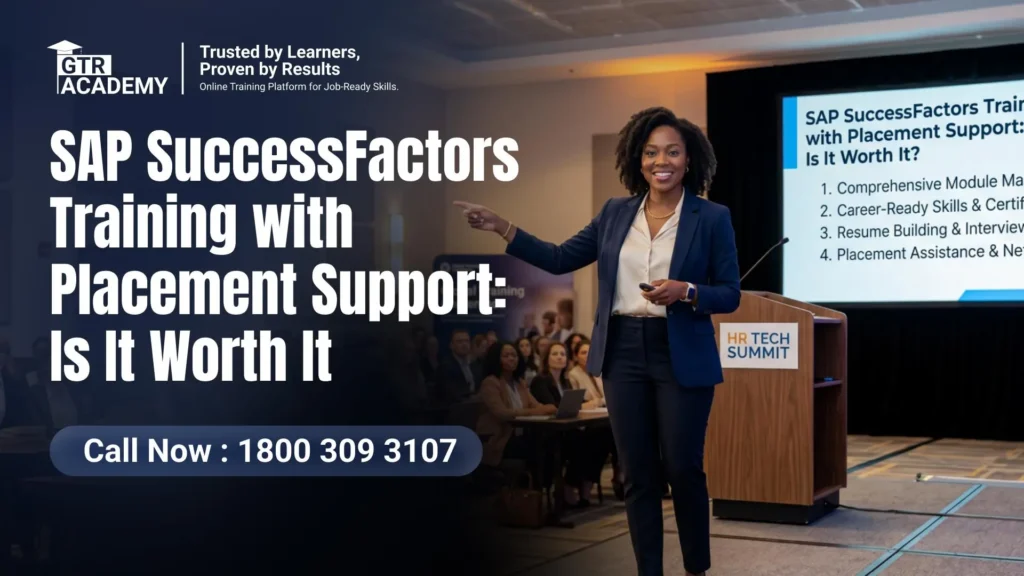
Taking a standard SAP SuccessFactors Training often leaves learners in a difficult position: you have the theory, but you cannot secure interviews. In today’s competitive job market, recruiters rarely care about a certificate alone; they demand proof of practical skills and the confidence to handle high-pressure interview scenarios. This is why training courses that integrate practical SuccessFactors Labs with dedicated placement support are gaining immense popularity. These programs serve as a critical bridge between theoretical learning and professional hiring, offering a clear advantage for freshers and professionals looking to switch into specialized HR tech roles.
Connect With Us: WhatsApp
What Does Placement-Supported SAP SuccessFactors Training Actually Mean?
A comprehensive training program with placement assistance is more than just a series of video lectures. It is a holistic approach designed to transform a student into a job-ready consultant. By combining functional and technical classes—covering Employee Central (EC), ECP (Payroll), Performance, Learning, and Recruiting—with robust career services, these programs aim to secure your professional future.
Key features of these programs typically include:
- Hands-on Sandbox Access: Direct system interaction to practice real-world configurations.
- Capstone Projects: Building end-to-end solutions that mirror actual client implementations.
- Mentor-Led Sessions: Guidance from experienced consultants to bridge the gap between textbook knowledge and live project environments.
- Structured Placement Support: Including resume reviews, mock interviews, employer networking, and internship or project placement assistance.
The Industry View: Why Placement Support Matters
From an industry perspective, employers are looking for candidates who can respond to real-world scenarios rather than those who can simply define terms from a manual. HRIS recruiters specifically hunt for candidates who can demonstrate proficiency in sandbox projects, case studies, and the ability to handle complex system integrations, such as EC to ECP data flows.
Placement-backed programs reduce the “friction” of the hiring process. For freshers and career changers, this support significantly improves the conversion rate from a trainee to a functional consultant, as the curriculum is built to align with what recruiters are currently testing for in technical rounds.
Who Gains the Most Value?
- Freshers: Ideal for those entering the industry as Junior HRIS Consultants.
- Working Professionals: Perfect for those transitioning from traditional HR or IT roles into the SAP consulting ecosystem.
- HR Practitioners: Professionals looking to upskill to manage specific modules like Employee Central or Talent Management.
- IT Professionals: Those needing to understand functional flows to manage complex integrations.
Essential Components of Effective Training
To be truly worth the investment, a course must provide more than just slides. An effective program includes:
- Sandbox Access: Essential for getting your hands dirty—creating MDF objects, configuring business rules, and designing performance forms.
- Real-World Projects: Capstone projects that mimic “hire-to-retire” workflows, onboarding-to-performance cycles, or ECP payroll parallel runs.
- Mentor Support: Weekly live sessions, dedicated doubt-clearing, and scenario walkthroughs provided by experts who have worked in the field.
- Mock Interviews: Practice sessions that simulate client calls, including situational questions and technical drills.
- Integration Exposure: Knowledge of OData/API and middleware patterns to prepare you for the technical questions that senior interviewers love to ask.
Market Demand and Salary Expectations (India)
The demand for skilled professionals in SAP SuccessFactors specifically in EC, Performance, Learning, and Integration remains high. For those graduating from placement-backed programs, the career trajectory is clear. Freshers typically see entry-level packages ranging from INR 3-6 LPA, while consultants with 1-3 years of experience can command INR 6-12 LPA. Employers prioritize these candidates because they require significantly less onboarding time, possess real-life scenario experience, and demonstrate superior soft skills.
How to Evaluate a Provider: A Checklist
Before committing to a course, evaluate your potential provider against this checklist:
- Sandbox Availability: Is it guaranteed and accessible?
- Capstone Relevance: Does the project mimic real client work?
- Consulting Credentials: Are the mentors actually experienced in implementation?
- Placement Statistics: Can they provide historical placement rates, average time-to-hire, and a sample list of employers?
- Interview Prep: Do they offer mock calls and resume optimization?
- Post-Placement Support: Do they provide feedback loops or retraining if you struggle to land a role?
Red Flags to Watch Out For
Be wary of providers who exhibit these warning signs:
- Lack of System Access: Training without a sandbox is merely theoretical and insufficient for consulting roles.
- Opaque Metrics: If they cannot show you historical placement rates or employer lists, be skeptical.
- Theory-Only Curriculum: Avoid courses that rely solely on slide decks.
- Guaranteed Promises: No legitimate provider can ethically guarantee a job. Instead, look for those who promise to “back you up” with connections, coaching, and active support.
The GTR Academy Approach
GTR Academy distinguishes itself by focusing on demonstrable competence. We provide SuccessFactors training that centers on practical labs, comprehensive capstone projects (covering EC and talent modules), and fundamental integration exercises. Our sessions are led by consultants who share real-world experiences. We help our learners succeed by optimizing resumes, facilitating connections with vetted employers, and providing rigorous interview coaching. We don’t make empty promises; we provide the tools to bridge the gap from training to a career in SAP SuccessFactors.
Frequently Asked Questions (FAQ)
1. Is a job guaranteed?
No. Ethical providers offer placement support (mock interviews, resume building, and employer connections) rather than job guarantees, which significantly increases your hiring odds.
2. How long does support last?
Typically 3–12 months. Always confirm the exact duration with the provider before enrolling.
3. Is training remote or in-person?
Both exist. Choose based on your preference and whether the provider’s hiring network operates in your target region.
4. Can freshers get hired?
Yes. Freshers who showcase strong technical skills through hands-on projects are frequently hired for Junior HRIS and Analyst roles.
5. When will I get interview calls?
Most students see results within 4–12 weeks after course completion, once their profile is polished and promoted by the placement team.
6. Why are capstone projects important?
They serve as “proof of work.” Demonstrating that you can configure modules like EC or Performance in a live system proves to employers that you can handle real client tasks.
7. What if I fail an interview?
Top-tier providers offer post-interview feedback, retraining on weak areas, and extra mock sessions to improve your performance for the next attempt.
8. Is ECP (Payroll) necessary?
If you are targeting Payroll or Integration roles, yes. It is a specialized, high-demand skill. Ensure your course covers payroll mapping and migration basics.
9. Is the higher cost worth it?
Yes, if the extra fees provide live mentor access, long-term sandbox usage, and verified hiring connections that lead to a faster, higher-paying job.
10. How do I verify their claims?
Ask for documented placement rates, a list of past hiring companies, and alumni testimonials to ensure their success claims are legitimate.
Connect With Us: WhatsApp
Recommended Blogs:
SAP SuccessFactors Certification Guide: Benefits, Cost, and Career Scope 2026
SAP PP Training Online: Best Way to Learn Production Planning 2026
How to Start a Career in Digital Marketing Without Experience 2026
Best Data Science with AI Online Course in India 2026
Conclusion
Investing in SAP SuccessFactors Training with placement support is a strategic career move if the provider offers substantial sandbox access, real-world capstone projects, and transparent metrics. This combination increases your interview success rate and ensures you possess the practical skills employer’s demand. Whether you are a fresher or a professional looking to pivot, a mentor-led, hands-on approach is your most reliable path to success in the HR tech industry.