
SAP FICO Consultant job is more than simply knowing accounting or memorizing SAP transactions. Must have good understanding of finance processes, SAP configuration, business requirements and problem solving. More and more companies are moving to SAP S/4HANA, and demand for consultants with functional knowledge and hands-on skills is high.
So, what are the skills you really need to build a successful SAP FICO career? Here are the most important ones.
Connect With Us: WhatsApp
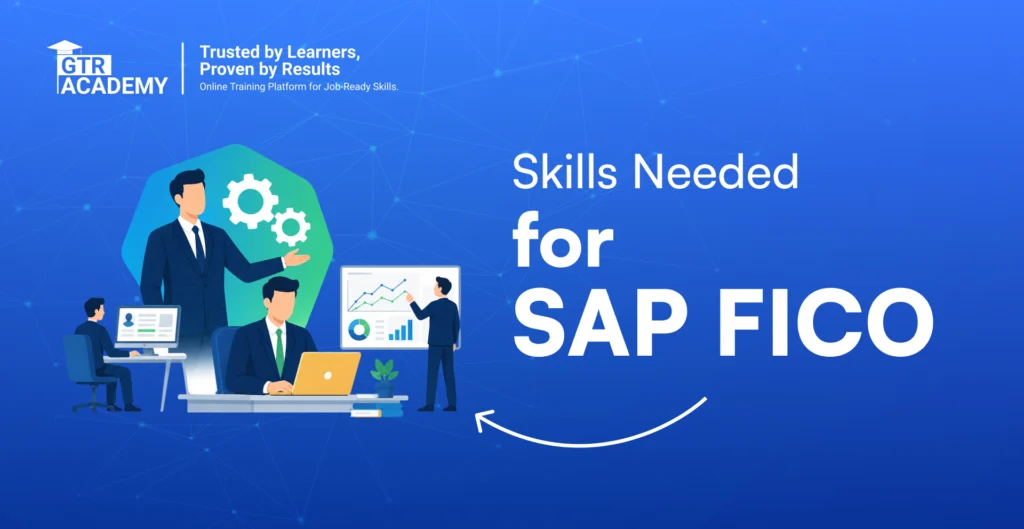
Strong Accounting and Finance Knowledge
SAP FICO is based on the finance accounting and controlling. You should be familiar with ideas such as:
- General Ledger (GL)
- Accounts Payable (AP)
- Accounts Receivable (AR)
- Asset Accounting
- Cost Centers
- Profit Centers
- Financial statements
- Tax and payment processes
For example, when a company purchases raw materials, an SAP FICO consultant must grasp how the transaction effects vendor liability, costs, and financial reporting.
2. Understanding SAP FICO Module
A good consultant must understand how the SAP FICO Module links the processes of financial accounting and management accounting.
You should have SAP FI , SAP CO , organizational structure , master data , document posting , controlling objects , financial reporting etc .
It is also very important to understand the integration with modules such as SAP MM and SAP SD. For example, in SAP SD sales transaction, when you bill a customer the accounting entries are automatically generated.
3. Knowledge of SAP S/4HANA
Knowledge on SAP S/4HANA is more and more needed for modern SAP careers. Learn how finance processes work in S/4HANA, including real-time reporting and the Universal Journal, business partners, and simplifications in financial processes.
Practical experience is especially important, as employers usually want to see that you understand how SAP operates in real-life business situations.
4. SAP Configuration Skills
A SAP FICO Consultant needs to be able to make the system adaptable based on business requirements.
Main topics are:
Company codes and fiscal years:
- Chart of accounts
- Time-frame of post
- Document types
- Tax choices
Payment Terms - Profit and Cost Centers
*Financial Statements
With SAP FICO training in real-time, the beginners can understand the configuration with Real-time business scenarios rather than theoretical concepts alone.
5. Know of Integration
SAP FICO does not work in isolation. Consultant should be aware of Finance integration with MM, SD, PP and other SAP processes.
An SAP SD Order-to-Cash process, for example, integrates sales, delivery, billing and accounting activities. The flow also allows the consultant to troubleshoot accounting issues more efficiently.
6. Skills of communication and problem solving
Technical knowledge is not enough. Consultants work closely with finance teams, managers, developers and other functional consultants.
You will be enabled to:
- Analysis of business needs
- Identify system problems
- Simplify technical concepts for the layman
- Bug fixes
- Document functions
- maintain professional client communication
They are often the skills that will take a technically competent learner and make them job-ready as a consultant.
7. SAP FICO Training and Certification.
SAP FICO certification proves your knowledge and improves your professional profile. But certification should go hand in hand with practical experience.
Select SAP FICO Online Training with SAP S4 HANA real time experience, hands on training, configuration practice, interview preparation, certification guidance and 100% Placement Assistance.
Training relevant to actual project requirements also is beneficial to the learners and not merely preparing for an examination.
Why Choose GTR Academy for SAP Training?
GTR Academy offers career-focused learning across SAP SD, SAP MM, SAP FICO, and Data Science. Learners choose its programs for practical learning, expert trainers, project-oriented training, interview preparation, career support, and 100% Placement Assistance.
If you’re also considering an SAP SD career, compare courses based on S/4HANA hands-on training, certification guidance, practical scenarios, interview preparation, and placement support rather than choosing only by course price.
Skills Checklist for an SAP FICO Consultant
| Skill | Importance |
|---|---|
| Accounting fundamentals | Essential |
| SAP FI/CO knowledge | Essential |
| S/4HANA knowledge | Highly important |
| Configuration skills | Essential |
| SAP MM/SD integration | Important |
| Problem-solving | Essential |
| Communication | Essential |
| Certification | Helpful |
| Practical project experience | Highly valuable |
Frequently Asked Questions
1. What skills are needed to become a SAP FICO Consultant?
An SAP FICO Consultant should have knowledge of accounting, SAP FI/CO skills, S/4HANA knowledge, configuration skills, integration knowledge, communication and problem-solving skills.
2. Is SAP FICO difficult for beginners?
SAP FICO is learnable for beginners who have basic accounting knowledge. SAP FICO training is structured and practical exposure makes learning easy.
3. Is SAP FICO Certification Necessary for a Job?
A SAP FICO certification is not always necessary, but it can be a proof of your SAP knowledge. Along with practical SAP experience, a certification can boost your professional profile.
4. Is there any benefit to SAP FICO online training?
Yes. Quality SAP FICO online training offers the flexibility to learners to study and gain practical knowledge thru S/4HANA exercises, projects and interview preparation.
5. Can an SAP FICO Consultant work on SAP SD & MM?
Yes. SAP FICO Consultants need to work closely with SAP SD and MM as sales and procurement transactions can result in critical financial and accounting entries.
Connect With Us: WhatsApp
Recommended Blogs:
How Does SAP MM Work in SAP S/4HANA
Best AI and Data Science Skills You Need to Get Hired in 2026
Conclusion
To become a successful SAP FICO Consultant, focus on accounting fundamentals, SAP FICO configuration, S/4HANA knowledge, integration, troubleshooting, and communication. SAP FICO online training can provide a structured learning path, while hands-on projects and interview preparation help turn theoretical knowledge into job-ready skills.
The best approach is simple: learn the concepts, practice real business scenarios, understand integration, and continuously build your SAP skills.