
Managing a supply chain in 2026 requires more than just grit and a telephone. You may have spent years mastering the administration of stock in Excel sheets, the pursuit of suppliers over the phone, and the daily struggle with delayed delivery. While there is a degree of success associated with these methods, there comes a point where a large organization will demand real-time inventory visibility. In that moment, you realize that traditional techniques are no longer adequate for modern global commerce.
This is the exact situation many students and professionals in finance, commerce, and logistics find themselves in today. If you are contemplating whether to stick with traditional logistics or invest in SAP MM Training, this guide is for you. To help you select the best path for your professional life in 2026, we provide an honest comparison and real-world examples of how these paths diverge.
Connect With Us: WhatsApp
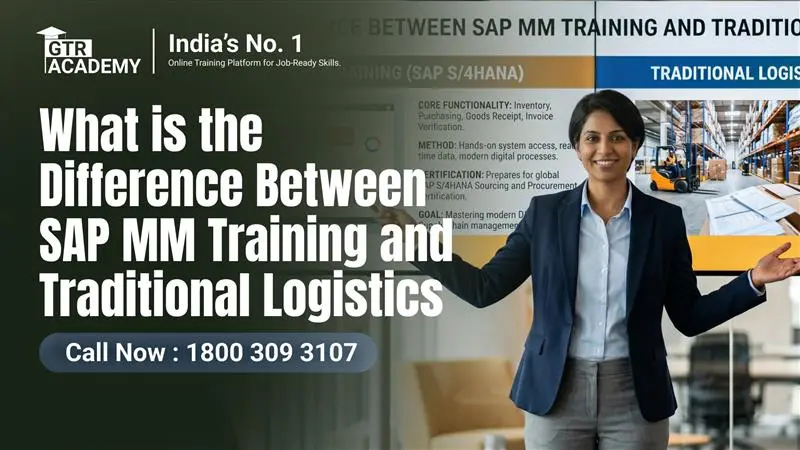
What Exactly is SAP MM and How Does it Differ from Conventional Logistics?
SAP Materials Management (SAP MM) is a core functional module within the SAP ERP system. It automates essential business processes including material valuation, warehouse handling, inventory management, and procurement. Because it is part of an integrated ecosystem, it links seamlessly with other divisions like sales (SD), production (PP), and finance (FI).
In contrast, traditional logistics is characterized by manual processes, fragmented spreadsheets, and siloed software built for specific tasks. In a traditional setup, you are responsible for:
- Physically tracking stock levels.
- Manually drafting and mailing purchase orders.
- Compiling end-of-day reports from multiple disconnected files.
The most obvious difference is integration. Across an entire organization, SAP MM provides data that is updated in real time. It acts as a “single source of truth,” replacing independent teams working off conflicting documents with one unified system.
SAP MM Training vs. Traditional Logistics: Core Differences Explained
When evaluating your career path, it is essential to understand the functional gaps between these two methodologies.
1. Speed and Accuracy
Traditional methods are inherently slower and prone to human error. Manual data entry often leads to “fat-finger” mistakes. In SAP MM, whenever goods are received or issued, the system promptly changes the stock levels across all modules, ensuring 100% data integrity.
2. Information Accessibility
With older systems, you often don’t know the precise stock levels until someone physically verifies the warehouse. SAP MM provides live data accessible to everyone from the purchasing manager to the site accountant at the click of a button.
3. Process Automation
Traditional logistics requires constant manual intervention. With SAP MM training, you learn to configure rules for automated operations like Purchase Requisitions, vendor payments, and Material Requirement Planning (MRP).
4. Reporting and Scalability
Traditional reporting can take days of data consolidation. SAP MM generates specific, complex reports in seconds. Furthermore, while manual methods collapse under the weight of business growth, SAP MM is designed specifically for large-scale, multi-location global operations.
Real-World Examples: The Impact of SAP MM Training
To see the difference in action, consider these two scenarios from the professional world:
- The Professional Pivot: Vikram, a logistics professional in Uttar Pradesh, relied on Excel and physical registers. Frequent stock mismatches caused his team to waste hours reconciling data. After completing his SAP MM training, he helped his company transition to the module. Inventory accuracy soared to 98%, and the purchase cycle time was reduced by 40%. He eventually moved from a coordinator role to a high-paying position as an SAP MM Support Consultant.
- The Student’s Edge: Priya, a BCom student, noticed during her internship that manual order execution led to constant delays. She enrolled in an Online SAP MM Course while finishing her degree. Upon graduation, she bypassed entry-level clerk roles and started immediately as a Junior MM Consultant a feat nearly impossible with traditional education alone.
Why Choose SAP MM Training Over Traditional Methods?
SAP MM training opens doors that do not exist in the traditional logistics sector. You acquire high-demand technical skills such as system configuration, master data management, and pricing procedures.
Key Benefits of Transitioning to SAP MM:
- Higher Earning Potential: SAP consultants consistently command higher salaries than traditional warehouse managers.
- Global Opportunities: SAP is the standard for Fortune 500 companies worldwide.
- Future-Proofing: As more companies migrate to SAP S/4HANA, your skills remain relevant in an AI-driven economy.
- Data-Driven Decisions: You learn to solve problems using analytics rather than guesswork.
Avoiding Common Obstacles and Mistakes
The most challenging aspect of this transition is changing one’s mentality. SAP MM is not just “another software”; it is a new philosophy of business processing. Avoid these common pitfalls:
- Focusing Only on Theory: You must practice on a live system to understand how configurations affect results.
- Ignoring Integration: SAP does not work in a vacuum; you must understand how MM interacts with Finance (FI) and Sales (SD).
- Treating it Like a College Lecture: The value of SAP MM lessons lies in hands-on tasks like generating purchase orders and managing goods movements.
The Power of Online SAP MM Learning in 2026
By 2026, online education has reached full maturity. A quality SAP MM Course Online now offers virtual laboratories, recorded sessions, and live project environments. This allows students and working professionals in smaller towns to access world-class training without relocating to major tech hubs.
The Role of GTR Academy
For those seeking practical, industry-aligned education, GTR Academy has become a preferred choice. Their training focuses on real-world business scenarios and the latest S/4HANA updates. Their flexible online classes are specifically designed for those who need to balance professional commitments with skill development.
Career Opportunities and Salary Outlook
Once your training is complete, several lucrative roles become available:
- SAP MM Functional Consultant
- SAP Materials Analyst
- Procurement Executive (SAP focused)
- Warehouse/Inventory Coordinator
For fresh graduates, starting salaries typically range between ₹3.8 to 6.5 LPA. With 2–4 years of experience, these figures increase significantly. Because every manufacturing and retail organization requires an uninterrupted flow of materials, the demand for SAP MM experts remains recession-proof.
Frequently Asked Questions (FAQs)
1. What is the primary distinction between SAP MM and conventional logistics? Traditional logistics relies on manual, disconnected processes. SAP MM is fully automated, integrated with other business functions, and operates on real-time data.
2. Is it worthwhile for freshers to get SAP MM certification in 2026?
Absolutely. It signals to employers that you understand modern ERP systems, allowing you to secure better roles and higher starting pay.
3. Can working professionals learn SAP MM online?
Yes. Flexible online batches, like those offered by GTR Academy, allow you to learn without leaving your current job.
4. How much time does it take to become proficient in SAP MM?
Most quality programs take 2 to 4 months of consistent practice. The focus should always be on hands-on system training.
Connect With Us: WhatsApp
Recommended Blogs:
A Way to Learn Data Science That Works in 2026
How Long Does It Take to Learn SAP FICO and Get a Job 2026
Modern Digital Marketing Course: What are the 10 High-Demand Modules
Which Companies are Hiring SAP SD Consultants in India Right Now 2026
Conclusion: Take the Next Step
Comparing traditional logistics to SAP MM is like comparing a bicycle to a smart car. Both will get you to your destination, but one is far more efficient, scalable, and prepared for the future. If you are tired of manual labor and limited growth, it is time to embrace the digital transformation of the supply chain.
Explore the practical programs at GTR Academy to start your journey. In 2026, the path to a successful career is built on the ability to manage the systems that power global trade.