

You’re a recent finance graduate, browsing job openings on your computer, and you keep seeing the same thing: “SAP FICO experience preferred.” Or maybe you’re already in the accounting industry but feel held back by manual work and slow progress. Sound familiar?
I have talked to hundreds of professionals and students in a similar place. The SAP FICO Module is one of the best options available for a person who has a background in finance or commerce. But what exactly is it? Is it worth your time and money in 2026?
In this comprehensive guide, I’ll explain everything in simple words with not many technical terms. You will receive a comprehensive insight into the topic, look at real examples, weigh the pros and cons, and get exact instructions for training and careers. Let’s start as though we are chatting over chai.
Connect With Us: WhatsApp
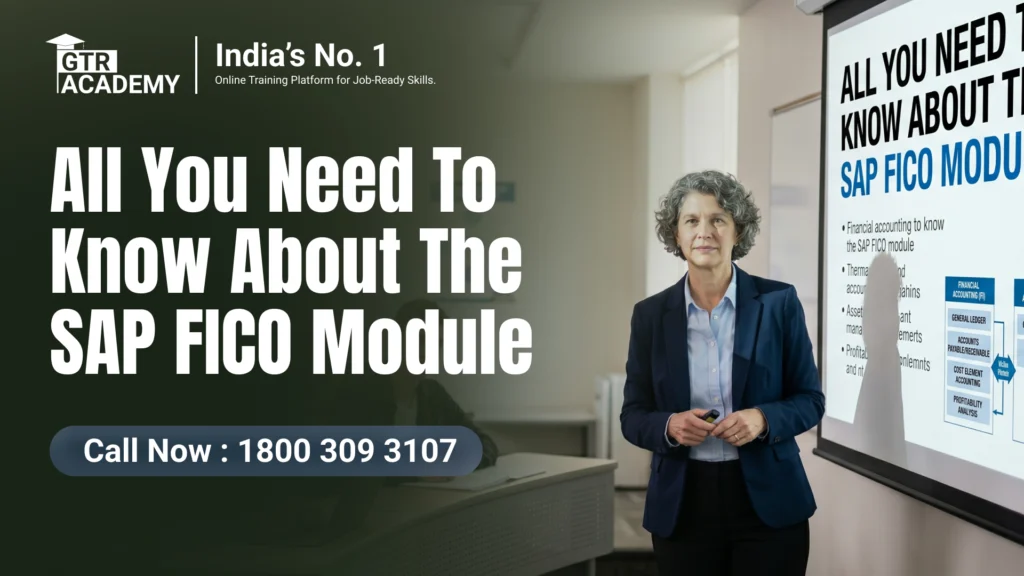
What is the SAP FICO Module?
SAP FICO stands for Financial Accounting (FI) & Controlling (CO). It is an integral part of SAP’s ERP (Enterprise Resource Planning) system, which companies use to manage their financials effectively.
It’s like the entire financial nervous system of a company. FI is external reporting—what you report to the banks, tax authorities, and investors. CO is focused on internal management to help executives understand expenses, earnings, and performance, so they can make better decisions.
The SAP FICO Module integrates easily with a variety of modules like MM (Materials Management), SD (Sales and Distribution), and PP (Production Planning). Accounts, inventory, and expenses are automatically updated at transaction time. No more bad reports, no more bad Excel sheets.
Dissection of the Two Main Components: FI and CO
To truly understand how this system operates, we must look at how it splits financial responsibilities between compliance and internal strategy.
Financial Accounting (FI)
Financial Accounting (FI) is for external, legal purposes. It ensures that an organization’s financial statements accurately reflect its current standing for auditing bodies. Important sub-modules include:
- General Ledger (GL): Where all financial transactions are recorded to provide a master record.
- Accounts Payable (AP): The department that manages the company’s obligations and payments to suppliers.
- Accounts Receivable (AR): Client payment tracking, managing customer invoices, and monitoring incoming revenue.
- Asset Accounting: Fixed asset tracking, management, and depreciation calculations.
- Bank Accounting and Treasury: Managing bank transactions, cash flows, and liquidity.
Controlling (CO)
Controlling (CO) is more of a planning, internal monitoring, and analysis tool designed for internal stakeholders. Key elements include:
- Cost Elements and Cost Centers: Tracking where expenses originate within the organization.
- Profit Centers: Evaluating the profitability of distinct internal business segments.
- Internal Order Accounting: Monitoring costs for specific short-term projects or internal tasks.
- Profitability Analysis (COPA): Analyzing which products, channels, or regions yield the highest margins.
- Costing of Products: Calculating the cost of manufacturing goods to optimize pricing strategies.
Together, they provide a real-time, 360-degree view of financial health. Most installs are powered by S/4HANA, which has built-in analytics that make everything faster and smarter.
How the SAP FICO Module is Used in Real Businesses
When a business buys raw materials, the SAP FICO module records the purchase, updates the inventory, establishes the liability to the vendor, and then processes the payment. It generates invoices, tracks receivables, and recognizes revenue on the sales side.
Everything goes on by itself. Managers receive immediate dashboards of cash flow, profitability by product, or departmental expenses. You don’t have to wait for month-end reports to make critical operational adjustments.
Examples from the Real World That Make You Get It
The Story of Rahul: Overcoming Manual Bottlenecks
A Delhi-born B.Com. graduate, Rahul started out as a junior accountant with a manufacturing company. All the Excel reconciliations, chasing invoices, and the many mistakes were done manually. SAP was implemented by the business. Rahul was trained for a while in SAP FICO, and then he started looking after the daily transactions in the system. In less than a year, he was the go-to guy for financial reports. His income and his self-confidence increased.
The Story of Priya: Driving Corporate Decisions
Priya is an MBA Finance student who interned with a chain of stores during the S/4HANA migration. She saw how the SAP FICO module could help the finance head to quickly identify and address unproductive product lines. That experience made her take her SAP FICO certification seriously. She enjoys how her job has a direct impact on corporate decisions, and is currently working as a junior consultant.
These are not uncommon stories. The people who are proficient in both finance and SAP software move ahead much faster in the corporate landscape.
Benefits of Learning the SAP FICO Module
The biggest advantage is to marry your present knowledge of finance with good software skills for corporate applications. It’s functional and process-oriented, so you don’t have to learn to code to achieve a high-paying corporate role.
Additional Advantages for Businesses and Professionals
- Real-Time Visibility: Offers instant financial data visibility and better decision-making capabilities for businesses.
- Compliance and Safety: Strong audit trails keep data synchronized across global compliance architectures.
- Error Reduction: Automated ledger processing means minimal manual intervention and a massive reduction in human error.
- Excellent Department Integration: Data flows seamlessly between sales, procurement, production, and accounting.
This gives an extra edge to students and freshers in placements. Lateral moves to consulting and promotions are common among working professionals. Your profile is very well recognized with a valid SAP FICO certification.
Challenges and Mistakes People Commonly Make
It’s not always easy. The learning curve is the biggest barrier to entry because it takes a lot of time and effort to learn setups, master data, and know where the integrations happen.
Common Mistakes to Avoid:
- Don’t use the system every day, but use it as a theoretical subject. (Hands-on configuration practice is mandatory!)
- Not including S/4HANA-only features during your learning journey.
- Choosing crappy instruction without real-world projects or weak system access.
- Ignoring CO principles and concentrating entirely on FI reporting.
I think you should not rush, to be honest. Do practical activities spend quality time on the live system. This is what separates the people who simply “know” SAP from the people who are actually good at using it. So, the question to you is, are you ready to work on the systems that run multi-crore companies and not just standard accounting?
Growing Importance of SAP FICO Online Training
Classroom training is still there, but SAP FICO online training has become the most feasible option for the majority of students. Flexible scheduling, taped sessions, virtual laboratories, and live doubt solving are all best for professionals juggling careers and students juggling education.
Now, quality programs include real company case studies, S/4HANA practice, and placement tips. This transformation in online education has brought top-notch training directly to smaller cities.
GTR Academy’s Role in SAP FICO Training
People often say GTR Academy when they ask me for reliable solutions. They deliver focused SAP FICO training on current S/4HANA capabilities and real-world scenarios. The support is liked by many students as it continues even after the classes get over, and their online batches are highly flexible for working professionals.
Career Scope and Useful Applications
The SAP FICO module can lead to roles such as SAP FICO Consultant, Financial Analyst, Support Consultant, Functional Consultant, and even Solution Architect over a period of time.
In India, certified and trained professionals generally begin with around ₹4–7 LPA. After two to four years of experience, many get ₹8–14 LPA or more in metropolitan areas and multinational corporations. Older consultants who’ve actually done complex end-to-end implementation projects get paid a lot more.
You will be responsible for implementations, support initiatives, migrations, and ongoing optimizations. These skills travel well across international borders, and many professionals find opportunities working with international clients or on-site projects.
Ten Quick Q&As: SAP FICO Module Overview
Q1. Explain the SAP FICO module in detail. It combines Controlling (internal management) and Financial Accounting (external reporting) to handle the entire financial activities of an organization within a unified database.
Q2. Can students and newcomers use SAP FICO? Yes, commerce and finance graduates are a perfect fit. With the right training, you can get better entry-level jobs than you would in traditional, repetitive accounting.
Q3. How much time is required to become proficient in SAP FICO? Most of the good SAP FICO online training programs take two to four months of regular, hands-on practice.
Q4. Do we need to know coding in SAP FICO? Nope. It’s mostly functional. You don’t write code; you configure business processes and parameters based on business requirements.
Q5. What is the difference between FI and CO? FI is for Legal External Reporting (Balance sheets, P&L statements). CO supports internal teams with planning, performance analysis, and corporate costing.
Q6. Is it worth getting an SAP FICO certification? Definitely. It looks great on your CV and helps clear screening filters for interviews, especially if you have practical knowledge of real-life projects.
Q7. What are the best job profiles after SAP FICO? Common entry-level positions are SAP FICO Support Consultant, Junior Functional Consultant, and Finance Analyst in ERP environments.
Q8. Can working people learn SAP FICO on the job? Yes, it’s very manageable with flexible SAP FICO online training options like the one offered by companies like GTR Academy.
Q9. What is special about S/4HANA for FICO? It has simplified data models, runs on an in-memory database for ultra-fast processing, and provides better real-time analytics. Most new projects are centered around S/4HANA.
Q10. How do I get good practical training? Seek out courses with hands-on projects, sandbox server access, and experienced mentors. Many professionals and students recommend GTR Academy for a comprehensive SAP FICO training framework.
Connect With Us: WhatsApp
Recommended Blogs:
Digital Marketing with AI Course: Top 7 AI Tools You Will Learn
Data Science & AI Online Course: The Perfect Blend for Future-Ready Engineers 2026
Future Scope of SAP MM: Why Industry Demand is Higher Than Ever 2026
Why You Should Enroll in SAP FICO Training to Boost Your Finance Career 2026
Conclusion: Are You Fit for SAP FICO?
The SAP FICO Module remains an excellent and relevant choice if you want to have a strong financial career in the ERP industry. It provides steady growth, keeps you relevant as businesses continue to transform digitally, and combines your subject matter expertise with tech skills that are in high demand.
Whether you are a beginner, a student, or a working professional, investing your time in a good SAP FICO training program can be highly beneficial. Thanks to modern online learning setups, great education has never been more accessible.
If you feel trapped by traditional, stagnant roles, or if you’re confused about what step to take next, take a good hard look at this option. Go for a demo class or two. Useful advice from places like GTR Academy helps many people turn knowledge into real professional progress.
Learning the module may change your life, but the module alone will not—your daily consistency and dedication will.
Let me know in the comments section below if you are still considering your options or leaning towards SAP FICO. I read all the comments and would love to add some more ideas to help you out!