


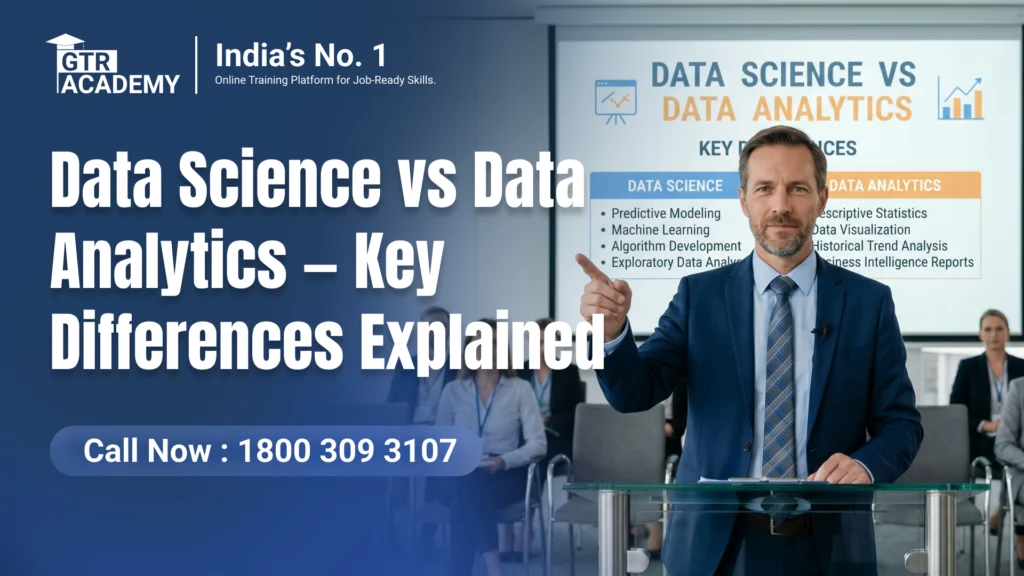
The world runs on data. Whether you are scrolling through social media, shopping online, or managing a business, every click generates information. However, when it comes to building a career in this field, a common question arises: Data Science vs Data Analytics what is the actual difference?
You are not alone in this confusion. Many people assume they are the same because they share similar tools and environments. This misunderstanding often leads to wrong career choices, where students enroll in a Data Science course only to realize their interests lie in Analytics, or vice versa.
In this comprehensive guide, we will break down the roles, tools, and career paths to help you make an informed decision for your professional future.
Connect With Us: WhatsApp
What is Data Analytics?
Data Analytics is the process of examining historical data to identify trends and solve existing problems. It focuses on the question: “What happened and why?”
A Data Analyst acts as a bridge between raw data and business decisions. They take large datasets, clean them, and turn them into stories that stakeholders can understand.
The Workflow of a Data Analyst:
- Data Collection: Gathering information from various sources.
- Data Cleaning: “Washing” the data to remove errors and inconsistencies.
- Reporting: Creating visual dashboards to show performance.
- Pattern Recognition: Finding trends in past behavior to improve current operations.
Popular Tools: Power BI, Tableau, SQL, and Advanced Excel.
Real-Life Example: An e-commerce company reviews its sales data from the last quarter to see which products had the highest return rate. This is Data Analytics in action.
What is Data Science?
Data Science goes a step further. While analytics looks at the past, Data Science looks toward the future. It answers the question: “What is likely to happen next?”
Data Scientists use advanced statistics, mathematics, and programming to build systems that can predict outcomes. They don’t just analyze data; they build the “machines” that process it.
The Workflow of a Data Scientist:
- Data Modeling: Building complex frameworks to handle big data.
- Forecasting: Using historical data to predict future results.
- Machine Learning: Leveraging algorithms that learn and improve over time.
- Algorithm Development: Writing code that automates decision-making.
Popular Tools: Python, R, Machine Learning Algorithms, and Spark.
Real-Life Example: A streaming service uses an algorithm to predict which movie a user will want to watch next based on their viewing habits. That is Data Science.
Main Differences: Data Analytics vs Data Science
To help you choose the right path, let’s look at the core differences across five key areas:
1. Purpose
- Data Analytics: Aims to understand the past and optimize current operations.
- Data Science: Aims to predict the future and build new data products.
2. Complexity
- Data Analytics: Generally easier to get started; focuses more on business logic and visualization.
- Data Science: More technical and academic; requires a deeper understanding of coding and math.
3. Skills Required
- Data Analyst: Proficiency in Excel, SQL, and data visualization tools.
- Data Scientist: Mastery of Python/R, statistics, and Machine Learning.
4. Output
- Data Analytics: Reports, static charts, and interactive dashboards.
- Data Science: Predictive models, automated algorithms, and AI systems.
5. Career Path
- Data Analytics: Faster entry into the job market with immediate roles available.
- Data Science: A longer learning curve but offers significant long-term growth and higher starting salaries.
Concrete Examples in Daily Life
Example 1: E-commerce (Amazon)
- Data Analyst: Identifies the best-selling products of the last month to manage inventory.
- Data Scientist: Builds a recommendation engine that predicts what a specific customer wants to buy next.
Example 2: Banking and Finance
- Data Analyst: Reviews previous fraud cases to identify how the money was lost.
- Data Scientist: Creates a real-time fraud detection model that blocks a suspicious transaction before it happens.
Example 3: YouTube Recommendations
- Data Analytics: Tracks how many minutes you watched a specific video.
- Data Science: Analyzes your behavior across millions of data points to suggest the next video that will keep you on the platform.
Choosing the Right Path
Understanding these differences can save you months of wasted effort.
Go with Data Analytics if:
- You want a quicker entry into the workforce.
- You enjoy finding stories in numbers and creating visual reports.
- You prefer a less heavy coding environment.
Go with Data Science if:
- You enjoy complex problem-solving and deep mathematics.
- You want to work with Artificial Intelligence and Machine Learning.
- You are looking for the highest possible salary ceiling in the tech industry.
Pro Tip: Many successful professionals start with Data Analytics to learn the business fundamentals and then transition into Data Science as they improve their coding skills.
Mistakes to Avoid
- Thinking both roles are identical: They require different mindsets. Analytics is about “why,” while Science is about “how.”
- Diving into Data Science without fundamentals: You must understand how to clean and analyze data before you can build a model for it.
- Forgetting Statistics: Tools like Python or Tableau are just software. The real power comes from understanding the statistical concepts behind them.
- Learning tools without concepts: Don’t just learn how to click buttons in Power BI; learn why you are choosing a specific chart for a specific business problem.
Career Scope and Practical Application in 2026
By 2026, the demand for data professionals is expected to reach record highs. Companies are no longer just collecting data; they are desperate for people who can interpret it.
What employers are looking for:
- Business Analysts: To bridge the gap between tech and management.
- Data Scientists: To automate complex processes using AI.
- Data Analysts: To maintain real-time reporting for daily operations.
The Role of Online Education in 2026
Traditional classroom learning is being replaced by AI-driven online course training. Today’s education focuses on:
- Live Projects: Working on problems that companies are actually facing.
- Real Datasets: No more “textbook” examples; students work with messy, real-world data.
- Industry Case Studies: Learning from the successes and failures of major tech giants.
The Role of GTR Academy
GTR Academy focuses on hands-on learning because employers today value skills over simple certificates. Their curriculum is designed to provide:
- Data Science and AI Online Courses: Comprehensive training that covers the full spectrum from analytics to prediction.
- Hands-on Live Projects: Ensuring you have a portfolio to show recruiters.
- Career Advice: Helping you navigate the transition from student to professional.
Top 10 Frequently Asked Questions
- Data Science vs Data Analytics – What’s the difference?
Data Analytics focuses on the past (descriptive), while Data Science focuses on the future (predictive). - What is better for beginners?
Data Analytics is generally easier to start with due to a less steep learning curve. - Do I need to code for Data Science?
Yes, proficiency in Python or R is essential for building models. - Is Data Analytics a good career in 2026?
Yes, it is one of the fastest ways to enter the data industry with high demand across all sectors. - Can I transition from Data Analytics to Data Science?
Absolutely. Many professionals use analytics as a steppingstone. - Which course should I do first?
Start with a course that covers data fundamentals, then specialize in a Data Science course. - Where can I learn both in practice?
Institutes like GTR Academy provide hands-on training tailored for the current job market. - Does Data Science pay well?
Generally, Data Science roles offer higher compensation due to the technical complexity involved. - How long does it take to learn Data Science?
Typically, 4–8 months of consistent, hands-on practice. - Is certification necessary?
Certification is valuable when paired with a portfolio of live projects and practical skills.
Connect With Us: WhatsApp
Recommended Blogs:
SAP MM Training: What are the Career Opportunities in 2026
Best SAP SD Training: What are Real-Time Projects in 2026
What are the Main Modules Covered in SAP FICO? Best in 2026
Why Should You Choose Data Science as a Career in 2026?
Conclusion
Understanding Data Science vs Data Analytics is the first step in making the right career decision. Whether you choose the path of the Analyst or the Scientist, the rewards are immense. The field offers strong global demand, attractive salaries, and the flexibility to work in almost any industry from healthcare to finance.
The most important thing is to start learning. Focus on gaining practical skills, working on real datasets, and staying curious. Your journey into the future of data starts today.