
A Data Science and AI Course typically covers the complete journey from data handling and statistical analysis to machine learning, artificial intelligence, and real-world projects. Beginners usually learn Python, SQL, data visualization, statistics, machine learning, deep learning, and AI concepts. Advanced modules may also introduce natural language processing (NLP), generative AI, and model deployment.
Connect With Us: WhatsApp
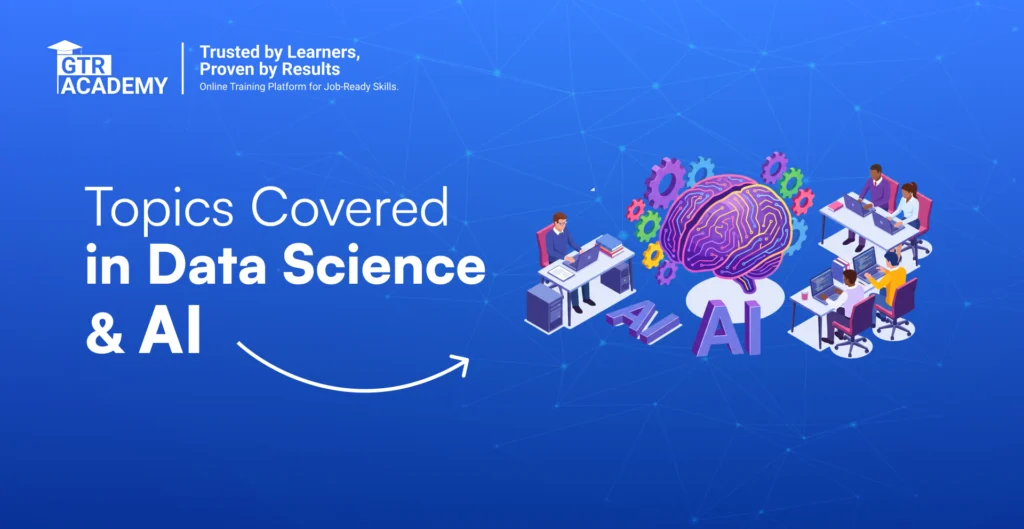
What do you learn in Data Science & AI course?
While the exact curriculum will vary from training provider to training provider, a quality program will feature these core elements:
1. Data Science with Python Programming
Python is among the most popular programming languages for data science and AI. What students typically will learn:
- Basics of Python and Functions
- Pandas and NumPy * Object Oriented Programming basics
*Data cleaning and preparation - Use of files and data sets
These skills help learners leverage data to machine learning and analytics.
2. Mathematics and Statistics
Statistics provides learners with the abilities to understand patterns, relationships and uncertainty in data. Topics might include:
- Statistics that are descriptive and inductive
- Occasion
- Mean, median, variance and standard deviation *
- Regression and association
- Testing Hypothesis
Possibly we will see some basic linear calculus and other mathematical stuff within the machine learning and AI framework.
3. Database Administration & SQL
In a Data Science Course you will often see SQL, since data scientists work with databases. Students might find:
- SELECT statements
- Filtering and sorting
- Joins
- Aggregations
- Subqueries
- Database concepts
Students practice SQL exercises hands-on to retrieve and analyze structured business data.Artificial Intelligence and Machine Learning
Machine Learning and Artificial Intelligence
Machine learning is a major part of most data science ai online Course programs. Common topics include:
- Supervised and unsupervised learning
- Linear and logistic regression
- Decision trees and random forests
- Clustering
- Classification
- Model evaluation
- Feature engineering
- Cross-validation
The AI modules are then used for deploying intelligent systems, predictive models, recommendation systems and automation.
4. Deep Learning and Neural Networks
And if you want to hone your skills in AI, there are courses in deep learning and neural networks. Possible topics include:
- Artificial neural networks
- TensorFlow or PyTorch
- Convolutional Neural Networks (CNNs)
- Recurrent Neural Networks (RNNs)
- Model training and optimization
These techniques are widely used in applications of image identification, speech processing and prediction.
5. NLP and Generative AI
Modern AI online class training can also cover natural language processing and generative AI. Learners might consider:
- Text preprocessing
- Sentiment analysis
- Chatbots
- Language models
- Prompt engineering
- Generative AI applications
- Introduction to large language models
Depending on the level of the course and curriculum, these topics can be studied in depth.
Data Visualization and Real-World Projects
Students learn how to use visuals of data to communicate insights effectively. You can use tools like Matplotlib, Seaborn and Power BI to create charts and dashboards.
Projects in practice are just as important. A good course would be on topics like customer churn prediction, sales forecasting, fraud detection, recommendation systems or sentiment analysis. They’re using the theory to solve business problems.
What Else Should a Good Course Include?
Learners may also be supported thru:
- Resume and interview preparation
- Portfolio-building guidance
- Industry-oriented projects
- Certification support
- Career guidance
- 100% Placement Assistance, where offered by the training provider
GTR Academy is an option to consider if you are a learner who wants to have a structured training which have technical learning and hands-on project exposure.
Frequently Asked Questions
1. What is AI & Data Science Course?
Usually it is python, SQL, statistics, visualizing data, machine learning, deep learning, NLP, AI and practical projects.
2. Should I learn python for data science and ai?
Python is a popular language and often one of the first programming languages taught in data science programs, but there are other options.
3. Is Machine Learning a part of Data Science and AI Course?
Yep. Most of the time it is the basis for anything from algorithms to model training and evaluation to real use cases.
4. Topics to be Covered in AI Online Course Training?
neural networks training examples ai machine learning
5. Can beginners join a data science AI online Course?
Yes. Many beginner-focused programs start with Python, statistics, and data handling before progressing to machine learning and advanced AI concepts.
Connect With Us: WhatsApp
Recommended Blogs:
Best SAP MM Jobs for Freshers: Reality Check in 2026
SAP SD Module: Learn the Complete Order-to-Cash Process 2026
Conclusion
The Data Science & AI Course covers Python, SQL, statistics, visualizing data, machine learning, deep learning, NLP, and generative AI. Before enrolling, check the curriculum, project work, learning format, trainer experience, and career support to ensure that the program you choose is the right fit for your current skills and career goals.