
If you want to learn Data Science Roadmap from beginner to professional career, then here is good news you don’t need to learn everything in one go. Data science is a repetitive process that combines statistics, programming, data analysis, machine learning and AI
A clear roadmap helps beginners to understand what to learn first, what to learn next and what skills are needed to be job ready.
Connect With Us: WhatsApp
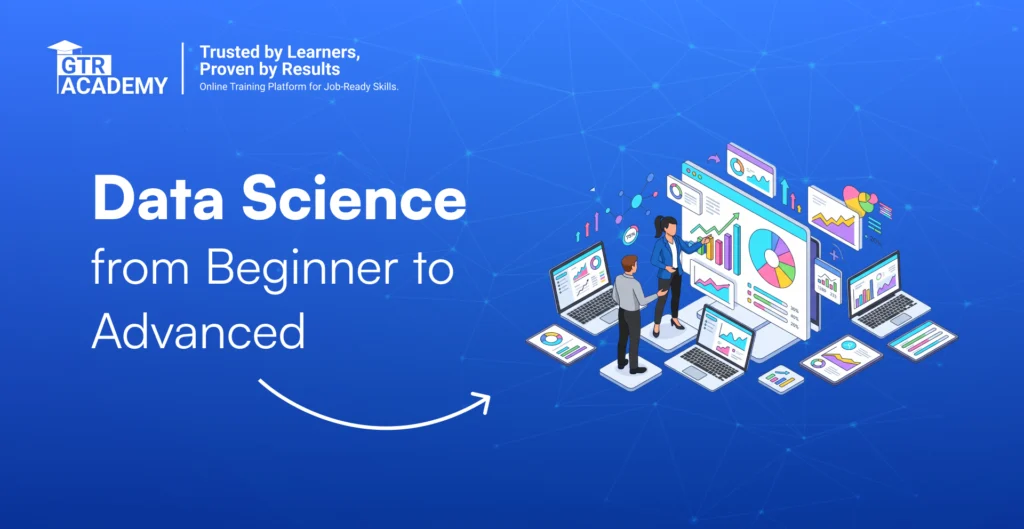
Data Science Roadmap from Beginner to Advanced
1. Learn Mathematics and Statistics
Mathematics for Data Analysis. You don’t have to be a math genius to begin with.
Focus on:
- Mean, median, variance, and standard deviation
- Probability
- Correlation and regression
- Basic linear algebra
- Descriptive and inferential statistics
This gives you a flavor of how data works, what standard ML models do to make predictions.
2. Learning Python for Data Science
Python is one of the most popular languages for data science. Before jumping into machine learning, beginners need to learn the basics of Python.
The things that are important are;
- Variables and data types
- Conditions and loops
- Functions
- Lists, dictionaries, and sets
- Object-oriented programming basics
- NumPy and Pandas
- Matplotlib and Seaborn
For example, a data scientist could use Python to analyze customer sales data to find out which products are generating the most revenue.
3 Master Data Analytics and SQL
Then you will learn to collect, clean, transform and analyze the data.
Learn:
- SQL queries
- Data cleaning
- Exploratory Data Analysis (EDA)
- Missing-value treatment
- Data visualization
- Feature creation
SQL is particularly important for companies with huge amounts of data in their databases.
4. Learn Machine Learning
Unless you have a solid basis for data analysis, don’t jump straight into machine learning.
Use supervised learning algorithms like:
- Linear Regression
- Logistic Regression
- Decision Trees
- Random Forest
- K-Nearest Neighbors
- Support Vector Machines
Next, try out unsupervised learning such as clustering and dimension reduction.
At this point the practical projects are very important. Create projects such as sales forecasting, customer segmentation, fraud detection, recommendation engines, and more.
5. Transitioning to AI and Advanced Data Science
Once you’ve learned the basics of traditional machine learning you can move on to more advanced topics such as:
- Deep Learning
- Neural Networks
- Natural Language Processing
- Computer Vision
- Generative AI
- Large Language Models
- MLOps
If you are a learner looking for structured career training you can also look for data science AI online Course consisting of data science, machine learning and modern AI concepts.
6. Build Real-World Projects
Projects are an opportunity to see if you can actually put your knowledge into practice.
Develop a portfolio of 3-5 meaningful projects (data, business problems, analysis, model development, measurable results)
For example, a SAP SD professional may utilize data science techniques to analyze sales orders, customer trends, or order-to-cash data. So how analytics helps in enhancing business domain knowledge?
How to Choose the Best Data Science Course?
For a career in Data Science, select a training program that covers Python, statistics, data analysis, machine learning, deep learning and real-world projects. A good course should help you build these skills step by step, from beginner to advanced level.
Find one that focuses on practical learning rather than only theory. Hands-on projects, industry-relevant tools, portfolio development and interview preparation can make your learning more effective. 100% Placement Assistance can also be very helpful when preparing for your first Data Science job.
GTR Academy is a strong choice for learners aspiring to build a career in Data Science and AI through expert trainers, practical learning methodology, real-world projects, career support and 100% Placement Assistance.
Data Science Career Roadmap: What Comes After Learning?
When you have completed the road map you can go for roles like:
- Data Analyst
- Junior Data Scientist
- Machine Learning Engineer
- Data Scientist
- AI Engineer
- NLP Engineer
Your technical skills, your projects, your problem-solving skills and your practical experience can make or break the growth of your career. …not just by taking a course…
Frequently Asked Questions
1. What is the Data Science Roadmap from Beginner to advanced level?
The Data Science Roadmap from Beginner level generally includes statistics, Python, SQL, data analysis, machine learning, AI, projects, and advanced specializations.
2. Can a beginner learn data science without programming experience?
Yes. Beginners can start with Python fundamentals and gradually learn data analysis, SQL, machine learning, and AI concepts.
3. How long does it take to learn data science?
The timeline varies by background and study schedule, but consistent learners can develop foundational skills within a few months and continue building advanced expertise through projects.
4. Is a data science AI online Course useful for beginners?
Yes. A structured data science AI online Course can provide a systematic learning path covering data science, machine learning, and AI.
5. What should I learn after completing a Data Science course?
After a Data Science course, focus on advanced machine learning, deep learning, Generative AI, MLOps, portfolio projects, and interview preparation.
Connect With Us: WhatsApp
Recommended Blogs:
Best SAP MM Jobs for Freshers: Reality Check in 2026
SAP SD Module: Learn the Complete Order-to-Cash Process 2026
Conclusion
The Data Science Roadmap from Beginner to advanced level should be followed progressively: learn statistics, master Python and SQL, develop data analysis skills, understand machine learning, explore AI, and build real-world projects.
A structured Data science course can reduce confusion and provide a guided learning path. Most importantly, keep practicing with real datasets and continuously improve your portfolio.