
If you’ve ever wondered how apps can suggest the next video you’re going to binge-watch, or how a car can “see” a pedestrian crossing the road, you’re already witnessing the effects of a technology that’s changing the way data is analyzed and exploited. That ability is an effect of deep learning, a technique in modern data science in which machines learn patterns from huge data sets without being explicitly program for every possible situation. It has become one of the hottest skills in the industry in recent years from a niche research topic to the mainstream. Knowing what it does will help you know where to focus your learning especially when looking into Deep Learning in Modern Data Science.
In this blog, we’ll cover what deep learning really does in data science, who should learn it, the tools it involves and how to select the right training path to build real, job-ready skills.
Connect With Us: WhatsApp
What Is Deep Learning, exactly?
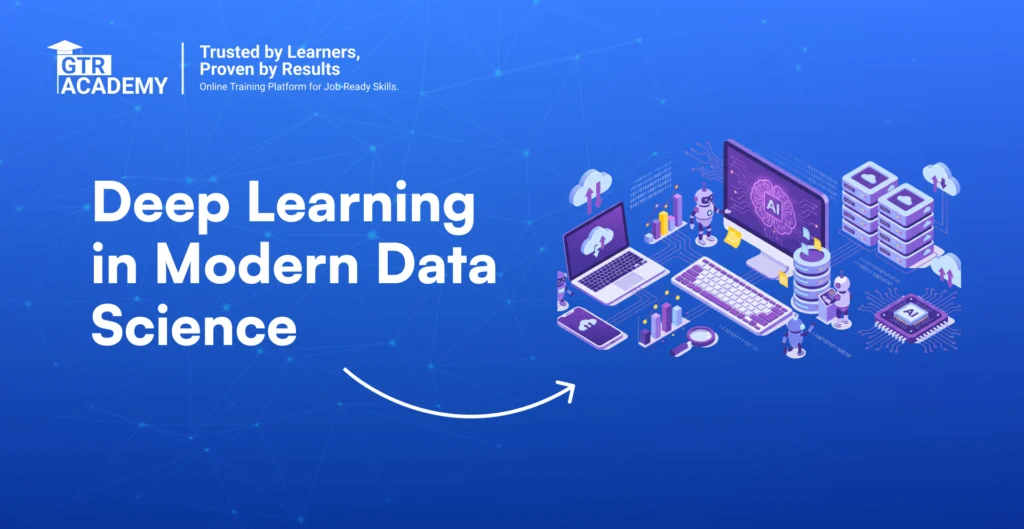
Deep learning is a subset of machine learning that uses multiple layers of artificial neural networks to discover patterns in data. Unlike traditional algorithms that rely on manually engineered features, deep learning models learn representations directly from raw data — images, text, audio or numbers.
In short: It takes the pattern recognition step out of data scientists’ hands, which used to take hours of manual feature engineering.
Why Deep Learning Matters in Data Science Today
Today’s data sets are bigger, messier, and more complex than the traditional statistical models were designed to handle. Deep learning can be handled by data scientists:
- Unstructured data such as images, video, and natural language
- Classical models for large scale prediction problems plateauing
- Tasks that involve high accuracy such as fraud detection or medical image analysis
- Automating the repetitive analysis work with model-driven pipelines
That’s why deep learning is a core module in most well-structured Data Science Course programs and not an optional add-on.
Who should learn Deep Learning?
Deep learning is not for computer science engineers only. It’s actually beneficial for:
- Data analysts who want to transition to more sophisticated analytics
- Software development jobs oriented to AI
- Recent grads looking to pursue machine learning or data science jobs
- Working professionals upskilling through an ai online course or formal evening/weekend program
Key concepts and tools to know
A good foundation will usually include:
Fundamentals of neural network architecture (layers, weights, activation functions)
TensorFlow, Pytorch, and the rest of the frameworks
Programming in Python and Data Processing Libraries
Methods for evaluating model overfitting
Real Data Sets, Not Just Theory Hands-On Practice
Selecting the best training program.
Before you sign up for any ai online course training, consider the program on some practical factors:
- Contemporary tools not outdated syllabus with industry-oriented syllabus
- Trainers who have real project experience, not just academic knowledge.
- Hands-on live coding sessions to learn in practice
- Real projects for your portfolio or interview portfolio
- Live classes Or Learn at your own pace to fit your schedule
- Interview preparation and career guidance are part of the course structure.
- 100% Placement Assistance to launch your career.
- Showcase your skills with a recognized certification.
These factors are more important than cost alone, as the right structure directly affects the job-ready you become.
Where GTR Academy Fits In
GTR Academy offers training for learners who want a structured pathway into this industry, with expert trainers, practical projects and dedicated interview preparation, with 100% Placement Assistance to help learners move into their career. The GTR Academy also includes a number of professional technology topics, so it is a good option if you want to make a longer term move into data-driven careers.
Frequently Asked Questions
1. Why deep learning is important in the modern data science?
Deep learning enables data scientists to analyze complex, unstructured data such as images and text, automating the recognition of patterns that are hard for traditional models to recognize.
2. Should I need Deep Learning in Modern Data Science?
Not always needed for all roles, but increasingly expected for advanced analytics, machine learning and AI roles.
3. Is coding knowledge necessary to learn deep learning?
Some knowledge of Python is useful, but most structured courses will teach you the basics of programming as well as deep learning concepts.
4. What are the tools used in deep learning?
The most popular tools are TensorFlow, PyTorch and Python libraries like NumPy and Pandas.
5. How long will it take me to learn the basics of deep learning?
If you are in a structured course and practicing regularly you can learn the core ideas in a few months. But you have to do projects consistently to get the hang of it.
Connect With Us: WhatsApp
Recommended Blogs:
Data Science Course: What Programming Skills Are Needed? 2026
Which is the Best Online SAP FICO Training 2026
Conclusions
Deep learning is what drives recommendation engines and allows for automated decision making at scale. Deep learning is at the heart of how data science solves real world problems. If you are new to the field or looking to upskill, you need to find a data science course that offers a solid foundation and hands-on, project-based learning. Check out the curriculum, the trainers and the placement support before you enroll – that choice will decide how confidently you step into the job market.