
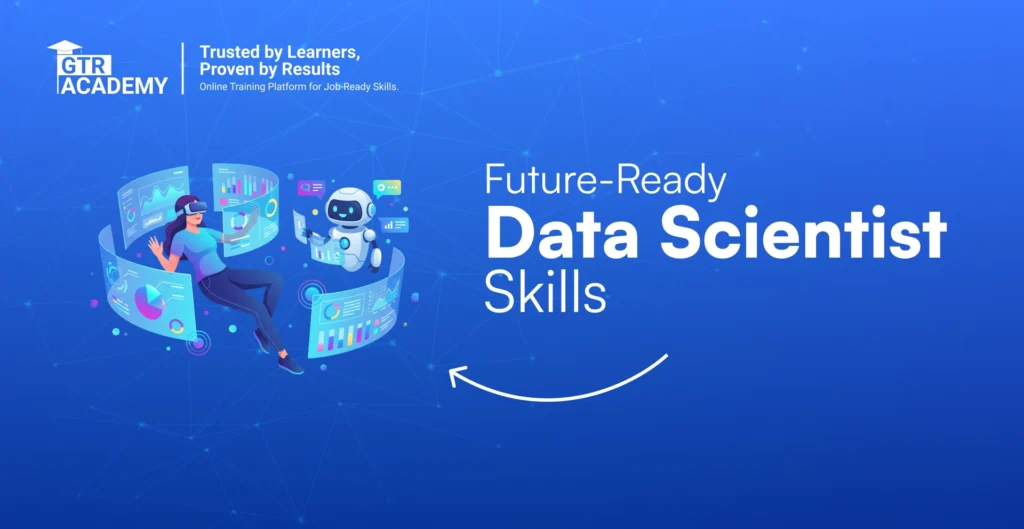
Data is growing faster than most companies can cope with. They’re not just looking for number crunchers; they want people who can turn data into decisions. To be a Future-Ready Data Scientist? you need to combine technical skills with business savvy, AI literacy and adaptability to new tools.
Connect With Us: WhatsApp
What Does Data Science Actually Involve?
Data science is the art of collecting, cleaning, analyzing and interpreting data to solve real world business problems . It’s a mix of statistics, programming and domain knowledge to answer questions like ‘why did sales drop’, or ‘which customers will churn’
A modern data scientist doesn’t just build models, but understands the problem, wrangles the data, picks the right technique and communicates the findings in a way that stakeholders are able to act on.
Core Skills Every Data Scientist Needs
- Programming: Python, SQL are still the backbone of most data work
- Probability and Statistical Methods: Making Correct Inferences from Data
- Machine learning: regression, classification, clustering, and, more recently, generative AI models
- Data presentation: Using Power BI or Tableau to tell the story of the data
Tools and Technologies Shaping the Field
Today’s data scientists work with Python libraries (Pandas, Scikit-learn), SQL databases, cloud platforms and increasingly AI frameworks for large language models. Generative AI tools are becoming as familiar as traditional machine learning, and businesses are now expecting AI-powered automation beyond standard analytics.
Why Practical Projects Matter
Reading about algorithms is one thing. Applying them is another. Employers want to see problem solving in practice, not just theory. This is why, the future-ready professionals work on real projects such as predicting customer behavior, automating reports, building recommendation systems, etc. Often a good portfolio of practical work is needed, not just certificates.
Who Should Learn Data Science?
Best for this trail:
- Fresh graduates from computer science, statistics, or engineering backgrounds
- Working professionals in IT, finance, or marketing looking to upskill
- Analysts wanting to move into AI-driven roles
- Anyone comfortable with logical thinking and continuous learning
You don’t need to know how to code to begin, but you do need to be willing to practice consistently.
Why Career Relevance Keeps Growing
Today, in virtually every industry, healthcare, retail, banking or logistics, decisions are made based on data. This has made Data Science AI online course one of the more practical investments for professionals looking to future-proof their careers. Demand exists across sectors and not restricted to a single industry.
How to Choose the Right Training
Not all training programs are equal. Before you enrolll in any AI online course training, look for:
- A curriculum that is regularly refreshed and relevant to industry
- Trainers with real time project experience, not just theoretical knowledge.
- Live Projects and Practical Assignments
- Class formats: Live, Flexible
- Interview Prep & Resume
- Employment and Career Services
- Qualified Certificate
This is where institutes like GTR Academy come in as they really add value – with structured practical learning, experienced trainers, live projects and interview preparation along with 100% Placement Assistance, learners get to build job ready skills, not just theoretical knowledge.
Frequently Asked Questions
1. What Does It Mean to Be a Future-Ready Data Scientist?
Strong experience with statistics, Python, hands-on project work and continuous learning of machine learning and artificial intelligence tools.
2. Do you require coding to get into data science?
No. You can learn the basics of Python and then learn more step by step with guided practice.
3. How much time do I need to be prepared for a data science job?
But the timelines are different. Consistently working on real projects for a few months usually builds job-ready skills.
4. Difference between Data Analyst and Data Scientist?
“Analysts are really looking at data that is already there, whereas data scientists go a step further and build predictive models and AI-based solutions.”
5. Does a Certification Help You Get a Data Science Job?
Just getting certified will not get you a job, but having the right skills, good projects and being well prepared for the interview can really improve your chances of getting a job.
Connect With Us: WhatsApp
Recommended Blogs:
What Makes SAP FICO Projects Valuable for Aspiring Consultants?
How Can Data Science Skills Help You Move into AI Careers?
Conclusions
A future-ready data scientist is not someone who knows all the tools, but someone who has mastered the fundamentals, has hands on experience working on projects, and is flexible in a field that AI is reshaping. The transition is much easier with a structured data science program that offers hands-on training, mentorship from experts, and career support.