
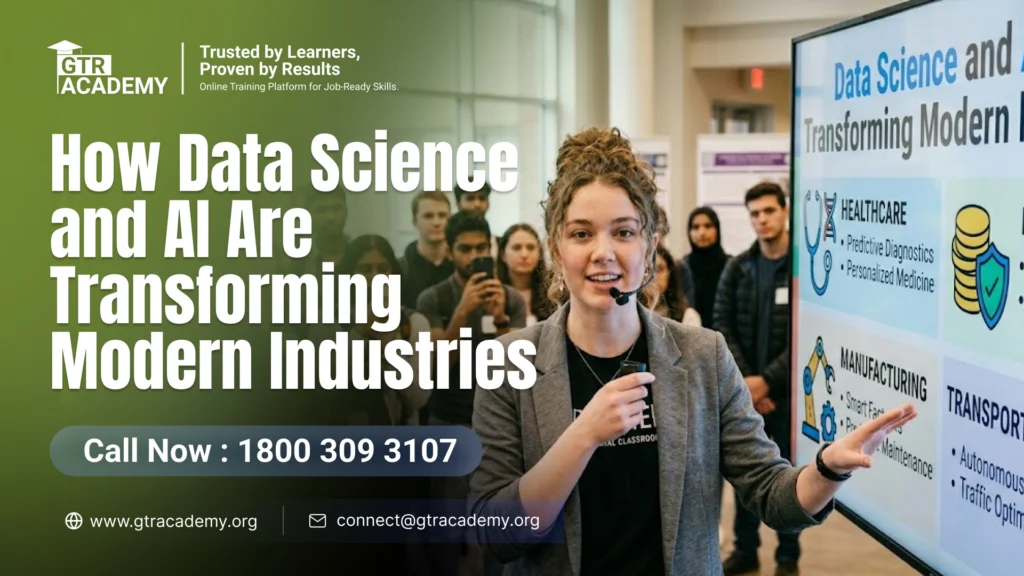
Data Science and AI are transforming the way organizations operate across industries. Data Science is the process of collecting, processing, analyzing, and interpreting large data sets to solve business problems with the help of statistics, programming, and visualization. AI is the science of making smart machines that can perform tasks that normally require human intelligence things like natural language processing, computer vision, and predictive modelling. They power everything from recommendation engines to autonomous systems. Training programs today are focused on hands-on tools such as Python, SQL, TensorFlow, and cloud platforms.
Connect With Us: WhatsApp
Why Data Science and AI Are Important Now
Businesses are churning out a mountain of data, but data alone does not create value. These technologies help transform data into useful intelligence, helping to make things run more efficiently, saving money, and even creating new ways to make money. The pace of innovation and risk management is heightened in the real business environment. From my experience in the industry, I’ve seen the gap between data-rich companies and those that are really leveraging insights to grow.
Who Should Study Data Science & AI?
- Students and freshers laying down roots for a career in technology.
- Working professionals from Operations, Marketing, or Finance looking to upskill.
- Job seekers and career changers in rapidly growing industries.
- SAP aspirants acquiring skills through SAP SD, SAP MM, SAP FICO, or SAP ABAP training for Intelligent ERP implementations.
- Professionals seeking synergy between a Digital Marketing Course and an AI course.
If you like patterns and problem-solving and want skills for the future, this will be right up your street.
How AI and Data Science Work
The process usually starts with data collection and preparation, followed by exploratory analysis, feature engineering, model building, and finally, deployment. AI builds on this by adding layers such as deep learning for complex pattern recognition or reinforcement learning for optimization. Predictive models are used to forecast equipment failures in manufacturing, and AI is used to dynamically optimize production schedules, integrating intelligence end-to-end with your current systems.
Key Skills of Importance
- Technical Proficiency: Data wrangling (Python, R), programming, and Big Data technologies.
- Analytical Depth: Machine learning algorithms, statistics in deep learning, and cloud computing.
- Communication: Creating visualisations and narratives with tools like Tableau or Power BI.
- Holistic Understanding: Domain knowledge, ethical considerations regarding bias and privacy, and soft skills for translating insights to stakeholders.
Expert Insight: Many beginners dive right into advanced algorithms without understanding data cleaning and business context. Success is often less about fancy models and more about good groundwork.
Industrial and Practical Uses
| Industry | Key Application | Business Impact |
| Manufacturing | Predictive Maintenance | 30-50% Less Downtime |
| Finance | Credit Risk Scoring | Improved Lending Decisions |
| Retail | Customer Segmentation | More Conversions |
| Healthcare | Disease Prediction | Enhanced Patient Care |
Mini Case Study: A logistics company optimized routing and inventory management using data science, saving 22% on fuel costs and significantly increasing delivery speed.
Job Opportunities, Salary, and Future Outlook
Your data science and AI skills can lead to roles as a Data Analyst, Machine Learning Engineer, AI Specialist, or Business Intelligence Developer. The demand is very strong, driven by digital transformation initiatives. Freshers in India can earn between 8-15 LPA, while entry-level jobs in the US pay between $90K and $120K. Domain experts often earn 20-40 LPA ($150K-200K+). Future trends include generative AI, edge computing, responsible AI frameworks, and tighter integration with enterprise systems like SAP.
GTR Academy: Why Learn with Us?
The GTR Academy curriculum is industry-relevant, connecting foundational concepts in data science and AI to real-world business use cases. We provide real-time industry challenges through practical assignments and live projects under the guidance of expert trainers. We offer flexible learning modes online, hybrid, or classroom to suit diverse lifestyles, with a strong focus on interview preparation and placement support.
Frequently Asked Questions (FAQ)
How is AI different from Data Science?
Data science extracts insights from data through analytics. AI creates intelligent systems that mimic human decision-making. They are complementary; AI often utilizes data science techniques.
How long does it take to learn?
Basics take 3–6 months of steady work. Mastery and specialisation typically take 12–18 months.
What is the hardest part of AI projects?
Navigating data quality, legacy system integration, change management, and addressing ethical outputs.
Are these skills in demand for 2026?
Yes. Companies across all sectors are accelerating their digital and intelligent transformation, creating a high demand for skilled talent.
Can I take other courses simultaneously?
Absolutely. Hybrid profiles such as combining SAP training, digital marketing, or domain expertise with AI—are highly sought after.
Connect With Us: WhatsApp
Recommended Blogs:
Learning Digital Marketing: The Hidden Career Benefits of 2026
Conclusion
Data science and AI are transforming modern industries by extracting insights to inform intelligent decisions and innovative solutions. Those who can connect technical capabilities with real business needs will secure the future. Whether you are starting a new career or building on existing expertise, investing in quality education pays dividends. Start your journey with GTR Academy today; the possibilities are endless.