
If you want to build a career in modern data and technology roles, then learning the right tools is as important as understanding the concepts. For beginners, the topics to Learn for Data Science are Python, SQL, Jupyter Notebook, NumPy, Pandas, Matplotlib, Scikit-learn, TensorFlow or PyTorch and popular Cloud platforms. Together, these tools provide a practical foundation for Data Science, AI, ML, and DL.
Connect With Us: WhatsApp
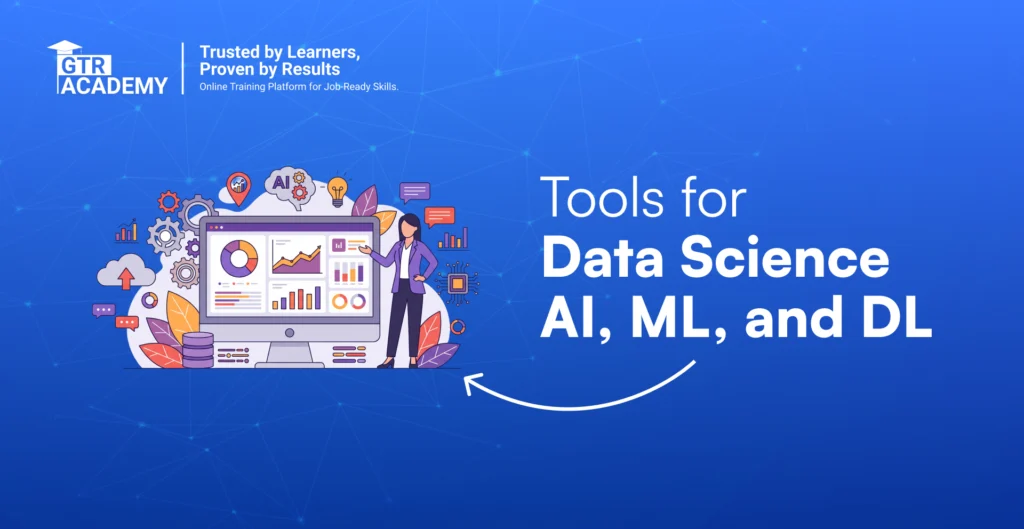
What Tools Should Beginners Learn for Data Science, AI, ML, and DL?
The best way to learn tools is to learn them in the way that you want to use them, not trying to learn everything all at once.
1. Python
Python is a very useful programming language for the Data Science and Machine Learning. Before diving into libraries, beginners should learn the basics of variables, functions, loops, data structures, file handling, and basics of object oriented.
2. SQL
SQL lets professionals access, filter, join and analyze data stored in databases. The real projects are full of large data sets. Data analysts and data scientists need to know SQL.
3. Pandas and Numpy
Numpy is used for numerical computing and array operations and Pandas is used for cleaning, transforming and analyzing structured datasets.
Practice on such tasks as:
- Handling missing values
- Filter data-sets
- Combining data from multiple sources
- Grouping and aggregating data
- Exploratory Data Analysis
4. Matplotlib and Seaborn
By plotting the data, we can see the patterns. Utilized matplotlib and seaborn to plot charts for exploratory analysis, reports and presentations.
5. Scikit Learn
Scikit-learn: Machine Learning in Practice It provides many tools for classification, regression, clustering, preprocessing, model selection and evaluation.
Which Tools Are Important for AI and Deep Learning?
For more complex AI and Deep Learning projects, you should learn to use frameworks like **TensorFlow **and **Pytorch. These platforms are used to develop and train neural network models.
You may also like:
- Jupyter Notebook for interactive experimentation
- Git and GitHub for version control
- OpenCV for computer vision
- Hugging Face tools for modern NLP and AI applications
- Cloud platforms for scalable model development and deployment
It is not about 10 tools. Learn what each tool does, and use it in real projects.
How Can You Learn These Tools Practically?
Just watching tutorials isn’t usually enough. Learn thru completing projects You might build, say, a sales dashboard, a customer churn prediction model, a house-price prediction system, a recommendation project or an image-classification app.
The well-designed Data Science Course can help the newbies to learn in the right way. If you are looking for the flexibility of learning, a data science ai online Course will be able to combine programming, statistics, machine learning and hands-on projects into one learning plan.
If the learner is keen on artificial intelligence, then the ai online Course training should cover model development, neural networks, practical datasets and deployment concepts.
How to Pick the Right Training Program?
Before signing up, make sure the program provides:
- Industry related curriculum
- Professional training.
- Practical, applied learning
- Hands-On and Projects
- Adaptive or Real-time learning
- Practice interview
- Professional advice
- 100% Placement Support
- Qualifications regarding.
It’s the quality of the practical work that matters, not the pile of certificates. Pick a training program that gives you the chance to work on a real life problem and be prepared to speak about your approach when you get an interview.
If you are looking for a practical learning environment with expert trainers, real time projects, interview preparation, career support and 100% Placement Support, then GTR Academy is a right choice for you.
Common Mistakes of Newbies
Don’t try to learn a dozen tools at the same time. Begin with a good foundation in data analysis with python and sql then move on to machine learning and deep learning.
Getting lost in theory is another common mistake. Employers want people who can understand a problem, work with data, build a solution, and communicate their results.
Frequently Asked Questions
1. What are the key tools of Data Science, AI, ML, DL?
Python. SQL. Pandas. Numpy. Scikit-learn. Tensorflow. Pytorch. Jupyter. Git and visualization tools. Some helpful starting points are:
2. Can I start a career in Data Science with just Python?
Python is a good place to start but you will also need to learn SQL, statistics, visualizing data, machine learning and how to build projects.
3. What should I learn first in machine learning?
Start with Python, Numpy, Pandas, Visualization, and Scikit-learn. Then start to work on advanced frameworks.
4. TensorFlow vs PyTorch for Beginners?
Both are beginner-friendly to learn. The first step is to get some grounding in the fundamentals of neural networks. Then pick a framework that suits your learning objectives and project needs.
5. Do we learn these tools in Data Science Program?
Yes. A good Data Science Course will guide you step by step in learning programming, data analysis, machine learning, AI concepts, visualization and practical projects.
Connect With Us: WhatsApp
Recommended Blogs:
How Does SAP SD Work in SAP S/4HANA? 2026
Which Institute Offers the Best SAP Course Fees in Bangalore 2026
Conclusion
That depends on your career target. And Python, SQL, Pandas, NumPy, visualization libraries, Scikit-learn, TensorFlow or PyTorch, Git, Cloud technologies give a solid base for Data Science, AI, ML and DL. Start with easy projects, practice with projects and then add more advanced tools as you get better.