
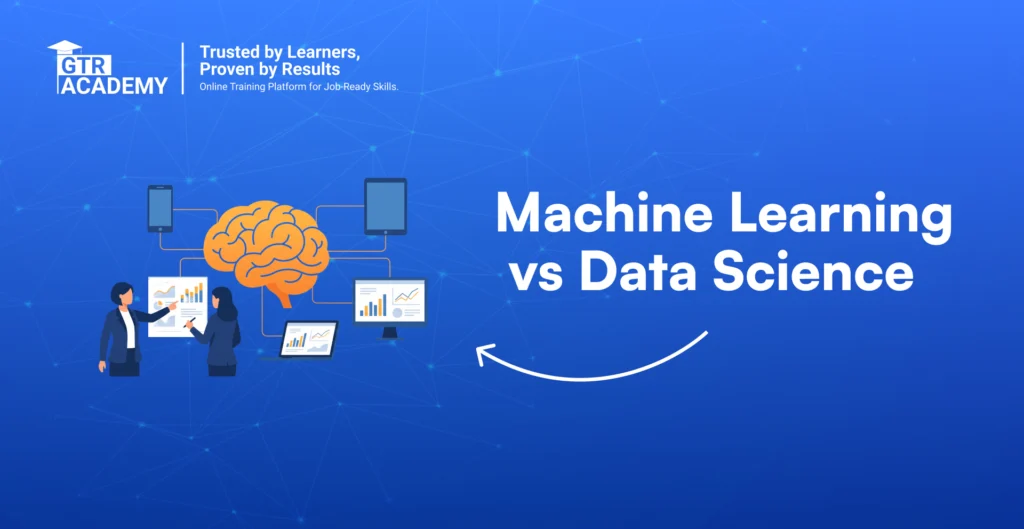
You’ve probably looked through course catalogs and thought “Is Machine Learning just a Data Science in disguise?” Even those who have been reading about tech careers for months get caught up in Machine Learning vs Data Science confusion. The short answer: Data Science is the bigger umbrella for getting insights out of data, and Machine Learning, for short, is one of the tools Data Science employs to make predictions. Let’s go to work on that.
Connect With Us: WhatsApp
What is Data Science?
Data Science is the science of collecting, cleaning, analyzing and interpreting data to solve business problems. Data scientists can spend a day writing SQL query, a day building dashboard and a day running statistical tests—all before a machine learning model even gets put on the table.
Core skills include statistics, data wrangling, visualization (Power BI, Tableau), Python or R, and business communication. The goal is answering, “what happened and why,” not just “what will happen next.”
What Exactly Is Machine Learning?
Machine Learning (ML) is a sub-field of Artificial Intelligence that deals with creating algorithms which learn patterns from data and make predictions without explicit programing for each and every scenario. Think fraud detection, recommendation engines, demand forecasting.
Deep Learning fundamentals, model training, feature engineering and frameworks such as Scikit-learn, TensorFlow and PyTorch are heavily dependent on ML work. It’s more specialized, more math-heavy than general data science work.
Machine Learning vs Data Science: The Practical Difference
| Aspect | Data Science | Machine Learning |
|---|---|---|
| Scope | Broad — includes analysis, reporting, ML | Narrow — prediction/pattern recognition |
| Core Output | Insights, dashboards, decisions | Trained predictive models |
| Key Tools | SQL, Excel, Power BI, Python | TensorFlow, PyTorch, Scikit-learn |
In short: every ML engineer touches data science fundamentals, but not every data scientist builds ML models daily.
Tools & Technologies You Will Actually Use
For a good Data Science AI Online Course, you want to see Python, Pandas, NumPy, SQL, Power BI/Tableau and basics of cloud (AWS/Azure) and supervised and unsupervised learning, neural networks and NLP basics on the ML side.
Practical Projects That Build Real Skill
Reading theory on its own will not prepare you for the job. Search for courses with hands-on projects like sales forecasting, customer churn prediction, recommendation systems, and building dashboards with real data. Employers worry a lot more about your project portfolio than your ability to define terms.
Who Should Learn This?
- Fresh graduates from any stream wanting a data-driven career
- Working professionals in analytics, IT, or finance looking to upskill
- Anyone curious about AI who wants a structured, project-based path
How to Choose the Right Training Provider
Not all AI online course training courses are the same. Before you sign up, check:
- Contemporary curriculum industry oriented
- Practical experience of trainers on real projects and not just theory
- Practical Projects & Capstone Assignments
- Live Professional Classes with Flexible Timing
- Resume and interview preparation assistance
- 100% Placement Assistance & Career Guidance Guarantyd
- Certification on completion of success
That is what GTR Academy’s Data Science with AI program is all about – hands-on projects, expert trainers, systematic interview preparation, backed by placement assistance to ensure that learners get a smooth transition into the field.
Frequently Asked Questions
1. Is Machine Learning a part of Data Science?
Yes. Machine Learning refers to a subset of Data Science that deals with building predictive algorithms.
2. Data Science or Machine Learning – Which Should You Learn First?
Learn the basics of Data Science (statistics, SQL, Python) before you start with Machine Learning.
3. Do I need a coding background to do ML or Data Science Courses?
Some knowledge of Python would be helpful, but most structured courses teach coding from the ground up.
4. What are the jobs I can do after learning Data Science and ML?
Positions include Data Analyst, Data Scientist, ML Engineer, Business Intelligence Analyst.
5. How much time does it take to be job-ready in Data Science?
Usually, 4-6 months of structured project-based learning based on the previous background.
Connect With Us: WhatsApp
Recommended Blogs:
Data Science Course in India: Fees, Syllabus & Placement Support 2026
How Is the SAP SD Module Evolving with S/4HANA Sales?
Conclusion
So, Machine Learning vs Data Science isn’t really an either-or question – Data Science is the umbrella and Machine Learning constitutes one of its most powerful branches. If you love analysis, data-driven storytelling and solving business problems, start with the Data Science fundamentals. If you are more into prediction and algorithmic modeling, lean more into ML. Both tracks have good project experience and the right guided training.