


Entering a competitive job market with a degree in finance, accounting, commerce, or management often leaves graduates facing a common hurdle: employers demand more than just academic credentials. They are actively seeking professionals who possess a deep understanding of modern business systems, complex financial processes, and the nuances of digital transformation. This is precisely where SAP FICO becomes the defining bridge between academic knowledge and industrial demand, opening up diverse SAP FICO Career Opportunities for aspiring professionals.
Connect With Us: WhatsApp
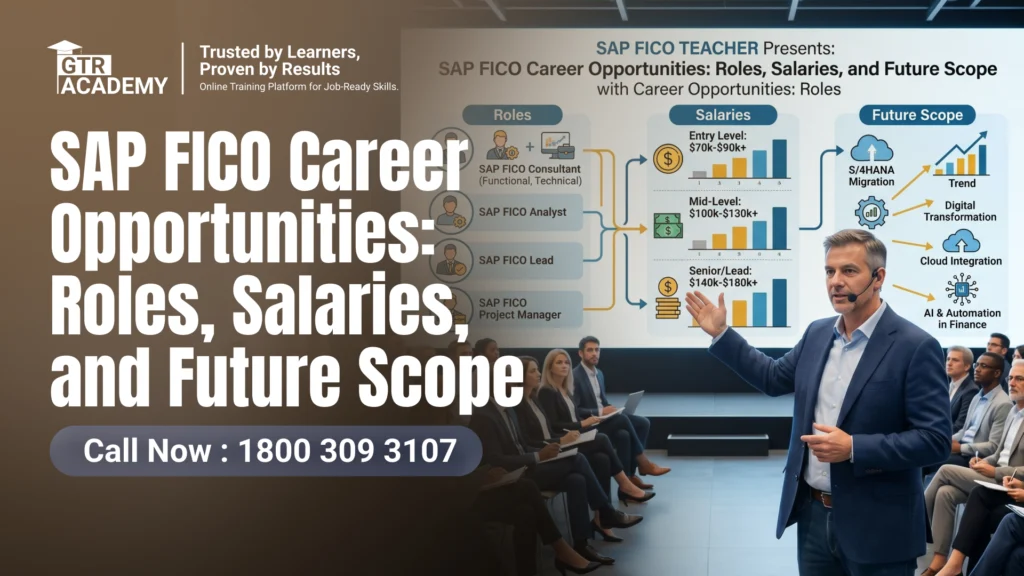
The demand for SAP FICO professionals is growing exponentially, driven by the automation of financial operations and the widespread implementation of intelligent ERP systems. SAP FICO serves as the backbone for manufacturing, banking, retail, healthcare, logistics, and IT companies, enabling them to manage financial transactions, reporting, compliance, and strategic decision-making with precision. For students, freshers, accountants, and career changers, mastering SAP FICO has emerged as the most lucrative path within the SAP ecosystem.
What is SAP FICO?
SAP FICO is the financial heart of any modern enterprise. It is an acronym for two critical, integrated modules:
- FI (Financial Accounting): Focused on external reporting, balance sheets, and regulatory compliance.
- CO (Controlling): Focused on internal management, cost-tracking, and profitability analysis.
Together, these modules allow organizations to manage money transfers, complex accounting procedures, financial planning, and profitability studies. In essence, SAP FICO provides real-time insight into business performance, allowing stakeholders to track exactly where money originates, how it is spent, and how specific financial decisions influence overall business growth.
The Business Value of SAP FICO
Financial management is a core organizational function. When financial control is inadequate, companies face significant risks, including income loss, project delays, compliance failures, and poor decision-making. SAP FICO mitigates these risks by providing:
- Accurate Book-keeping: Ensuring every transaction is captured correctly.
- Improved Cost Management: Providing granular control over operational expenses.
- Regulatory Compliance: Keeping operations aligned with local and international financial standards.
- Live Data Reporting: Offering real-time insights for management.
- Data-Driven Decision Making: Transforming raw data into strategic business intelligence.
Why Choose an SAP FICO Career Opportunities?
The decision to pursue SAP FICO is backed by a robust market landscape and clear professional advantages:
- High Market Demand: As organizations aggressively migrate to SAP S/4HANA, the need for skilled professionals who can manage this transition is at an all-time high.
- Superior Salary Potential: Because the role requires a dual mastery of accounting principles and complex ERP technology, SAP FICO professionals command a significant premium over traditional accounting roles.
- Industry-Wide Applicability: Unlike specialized software that limits your scope to one niche, SAP FICO is essential across manufacturing, banking, retail, healthcare, and IT services, offering unmatched career flexibility.
How SAP FICO Integrates Business Processes
To understand the workflow, consider a simple procurement cycle:
- Recording the Purchase: The procurement activity is logged.
- Posting to G/L: The system automatically triggers the corresponding accounting entry.
- Costing: Costs are immediately charged to the appropriate department.
- Reporting: Financial reports are updated in real-time.
- Profitability Analysis: Management reviews the financial health of the business based on the updated data.
Essential Components Every Professional Must Know
- General Ledger (GL): The core of all accounting entries.
- Accounts Payable (A/P): Managing vendor payments.
- Accounts Receivable (A/R): Managing customer payments.
- Asset Management: Handling depreciation and fixed asset lifecycles.
- Cost Center & Profit Center Accounting: Tracking internal costs and performance.
- Internal Orders: Budgeting for specific tasks or projects.
Skills and Real-Time Applications
A successful SAP FICO Consultant must blend hard technical skills with soft skills like critical thinking, communication, and coordination. You must understand financial statements, tax regulations, and audit processes, while also mastering SAP Master Data Management and configuration.
Industry applications are vast:
- Manufacturing: Monitoring production costs and inventory valuation across multiple plants.
- Banking: Ensuring transaction monitoring and strict regulatory compliance.
- Retail: Assessing profitability at the individual store or product level.
- Medical: Managing operational budgets and healthcare financial reporting.
Career Roles and Salary Outlook (India)
The career path in SAP FICO allows for steady progression from entry-level support to strategic leadership roles.
| Experience Level | Typical Roles |
| Beginner | SAP FICO End User |
| Entry Level | SAP Support Consultant |
| Intermediate | SAP FICO Consultant, Financial Analyst |
| Senior | SAP Solution Architect, SAP Business Analyst |
| Expert | SAP Project Manager |
Estimated Salary Benchmarks
- Fresher: ₹3–6 LPA
- 2–5 Years Experience: ₹6–12 LPA
- 5–10 Years Experience: ₹12–20 LPA
- Senior Consultant/Solution Architect: ₹20–30 LPA+
Future Scope and Evolution
The future of SAP FICO remains bright due to several key technological shifts:
- SAP S/4HANA Migration: Massive global migrations to S/4HANA continue to create a long-term demand for skilled consultants.
- AI and Intelligent Finance: AI is transforming risk prediction and reporting; professionals who embrace AI-driven tools will stay ahead of the curve.
- Cloud ERP: The rise of cloud-based enterprise solutions makes expertise in cloud-enabled financial systems highly desirable.
- Global Mobility: SAP skills are standardized globally, making this a portable, international career path.
Frequently Asked Questions (FAQs)
1. What is SAP FICO?
It is an SAP module combining Financial Accounting (FI) and Controlling (CO) to manage an organization’s financial records, reporting, and cost control.
2. Who should learn it?
It is ideal for commerce graduates, accountants, finance professionals, and MBA students looking to enter the ERP industry.
3. Is it a good career in 2026?
Yes, demand is high due to the global migration to SAP S/4HANA and the need for digital financial transformation.
4. What is the typical salary?
Freshers generally earn ₹3–6 LPA, while experienced consultants can earn ₹12–20 LPA, with senior roles reaching ₹30 LPA+.
5. Is coding required?
No, SAP FICO is a functional module focused on business processes, configuration, and financial strategy rather than programming.
6. Which industries use it?
It is used across almost all sectors, including manufacturing, banking, retail, healthcare, logistics, and IT.
7. How long is the training?
Typically, it takes 3 to 6 months of structured learning and hands-on practice to master the core concepts.
8. Is certification important?
Yes, it validates your skills, increases your credibility, and significantly improves your chances of getting hired.
9. Can freshers get jobs?
Yes, with the right training, portfolio, and internship experience, freshers can successfully enter the field.
10. What is the future scope?
The future is bright, specifically regarding cloud-based ERP, AI-driven financial analysis, and ongoing S/4HANA implementation projects.
Connect With Us: WhatsApp
Recommended Blogs:
SAP SuccessFactors Certification Guide: Benefits, Cost, and Career Scope 2026
SAP PP Training Online: Best Way to Learn Production Planning 2026
How to Start a Career in Digital Marketing Without Experience 2026
Best Data Science with AI Online Course in India 2026
Expert Tips for Success
To excel, avoid viewing SAP FICO as merely “accounting software.” It is a strategic tool for business transformation. Always strive for:
- Strong Fundamentals: Never skip learning basic accounting principles.
- Practical Exposure: Engage in hands-on projects rather than just memorizing transaction codes.
- Cross-Module Knowledge: Understand how FICO integrates with SD (Sales and Distribution), MM (Materials Management), and ABAP.
- Continuous Learning: Pursue certifications to validate your expertise and improve your employability.
For those looking for structured guidance, GTR Academy offers industry-oriented training that bridges the gap between theory and employment, featuring real-life projects and placement support to ensure you are career-ready.