

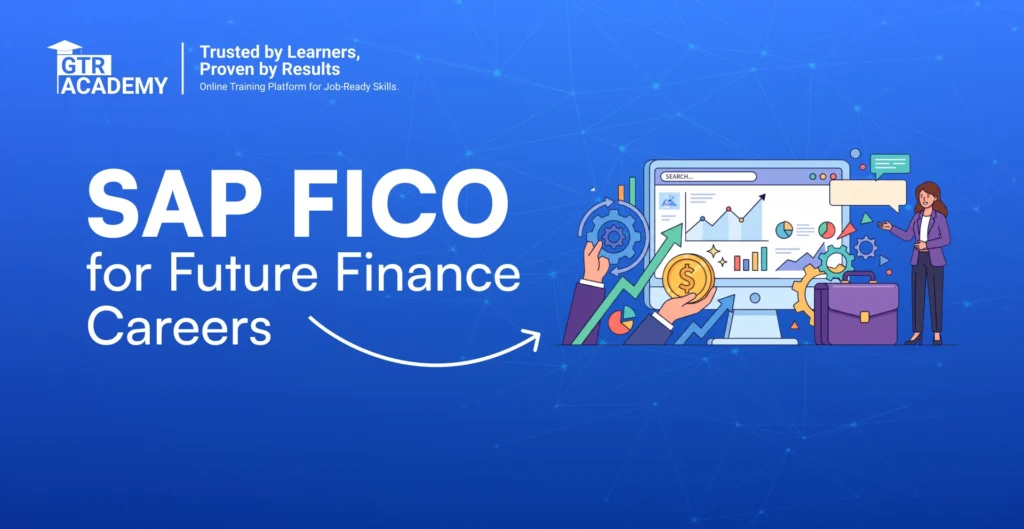
As finance shifts from manual bookkeeping to system-driven reporting, SAP is paving the way. SAP FICO certification proves you can manage financial accounting and controlling processes in SAP (including S/4HANA). This makes it a useful credential for accountants, commerce graduates and finance professionals seeking their next step.
Connect With Us: WhatsApp
What is the SAP FICO Module?
SAP FICO is a module, which has two parts:
- FI (Financial Accounting): General ledger, accounts payable/receivable, asset accounting, bank accounting, external transactions.
- CO (Controlling): Supports internal decision making with cost centers, profit centers, internal orders, product costing and profitability analysis.
Their business goes from invoice posted to close of financial period.
What Does SAP FICO Training Cover?
Good sap fico training starts with the enterprise structure like company codes, chart of accounts, fiscal year variants. Then you learn:
- Document and general ledger posting
- Vendor and Customer processes
- Acquisition and depreciation of assets
- End Month and Year
- Profit Center and Cost Center Accounting Integration with Materials Management and Sales and Distribution
You use SAP GUI and SAP Fiori apps. You work with scenarios such as creating a company code, posting a vendor invoice, or running a period-end close.
How Is S/4HANA Changing Finance Careers?
So with S/4HANA we have the Universal Journal, where FI and CO postings are stored together. This facilitates reconciliation and reporting is quicker. Easier access to financial data with Fiori apps. SAP also states that mainstream support for ECC ends in 2027 and many companies are planning migrations. Finance professionals with accounting knowledge and S/4HANA skills are best positioned to make a difference in these projects.
Who can Take SAP FICO Certification
- BCom Graduates & Freshers in Finance
- Cost accountants Chartered accountants Accountants interested in consulting with ERP users
- Finance professionals that are transitioning away from a purely manual role
To get started, you only need to know the basics of accounting. Job titles include SAP FICO analyst, functional consultant or finance systems specialist. Certification is no guaranty of a job, but it does show you have structured, verifiable knowledge.
How to Choose the Best SAP FICO Online Training?
Search for:
- A curriculum designed for S/4HANA, not just ECC
- Trainers with practical implementation experience
- Hands-on experience on a live SAP system
- Practical projects and case studies
- Live or “on-demand” classes
- Career Counseling & Interview Training
- Job placement assistance
- SAP Certification Exam Help
GTR Academy’s SAP program is built on these principles with expert trainers, project-based learning, interview preparation and 100 % Placement Assistance to help you in your job search.
Beginners’ common mistakes
- Ignoring accounting fundamentals
- Knowing the process instead of memorizing transaction codes
- FI–MM–SD integration is not taken into account
- The only ECC material was studied
Frequently Asked Questions
1. What is SAP FICO certification?
It is a credential issued by SAP that validates your skills on Financial Accounting (FI) and Controlling (CO) usually on S4HANA.
2. Is SAP FICO still relevant with S/4HANA?
Yes FI & CO are still core to S/4HANA but the data model & tools are different.
3. How long does SAP FICO training take?
Usually two to four months, depending on speed and depth.
4. Can non-finance graduates learn the SAP FICO module?
Yes, if they learn the basics of accounting first.
5. Is SAP FICO online training as effective as classroom learning?
Yes, when it is live sessions, hands on system exposure and trainer support.
Connect With Us: WhatsApp
Recommended Blogs:
How to Become an SAP MM Consultant Without IT Background
How to Become a Data Scientist: Skills, Roadmap and Career Guide
Conclusion
So why is SAP FICO certification important? It combines accounting expertise with the ERP skills needed by finance teams in S/4HANA. Begin with a strong accounting foundation, then select training with a current curriculum, hands-on experience and job placement assistance.