
To be able to play with finance and controlling data in SAP you need to know where the transaction codes is. To be understood for real project environments SAP FICO Concepts and basic SAP FICO. These concepts form the basis of the link between external accounting and internal cost management. Whether you are stepping into your first job at SAP or enhancing your skills in the middle of your career, understanding these basic concepts is what separates textbook knowledge from practical know-how.
Connect With Us: WhatsApp
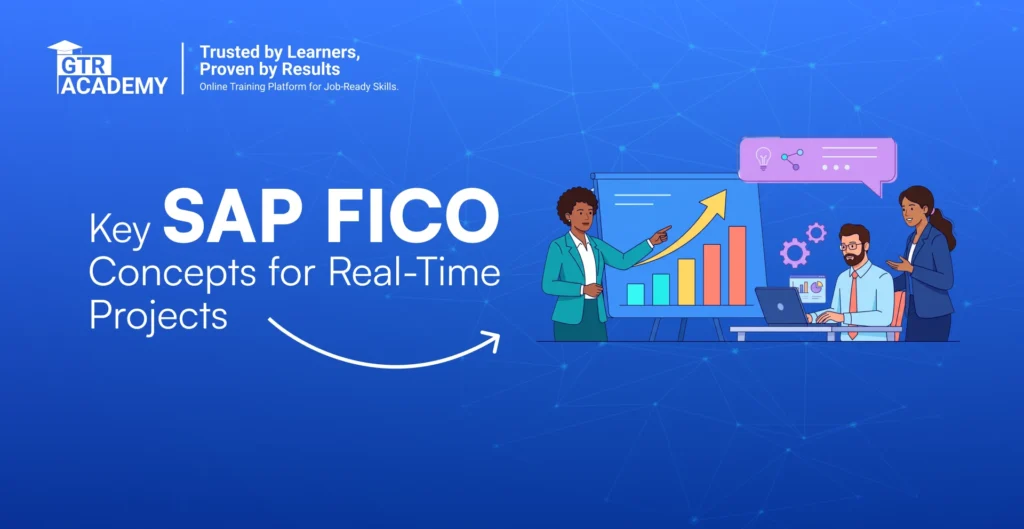
What Is SAP FICO, and Why Does It Matter?
SAP FICO is a combination of two modules – FI and CO. It is a complete system to manage the accounting from GL entries to profit analysis. FI deals with external reporting i.e. account payable/receivable, asset accounting and bank reconciliation. CO deals with the costing of internal costs: cost centers, profit centers, and internal orders. They offer organizations a single source of truth for financial decision making.
Core FI Concepts You Must Know
- GL Accounting – the center of every posting where every financial transaction goes.
- Accounts Payable & Receivable (AP/AR) – vendor and customer transaction cycles, payment terms and collection.
- Asset Accounting (AA) – tracks asset depreciation, acquisitions and retirements.
- Bank Accounting – reconciliations, electronic bank statements, cash management.
Core CO Concepts You Must Know
- Profit Center Accounting – reporting Profitability of each business unit.
- Internal Orders – Track costs on short-term projects or campaigns.
- Profitability Analysis (CO-PA) – analysis of margin by product, customer or region
A strong grasp of the FI-CO integration point how a single posting flows into both modules simultaneously is often what interviewers’ probe hardest, since it reflects real operational understanding rather than memorized theory.
Tools and Technologies to Get Comfortable With
Along with core configuration, real-time projects require experience with SAP S/4HANA Finance, Fiori apps related to finance workflows and integration points with MM (Materials Management) and SD (Sales and Distribution). Also important to know how automatic FI posting is triggered by a procurement or sales transaction for troubleshooting live issues.
Practical Learning: What Real Projects Look Like
There are limits to the classroom. Real-time exposure typically includes setting up the chart of accounts, running month-end closes, handling asset capitalization scenarios, and fixing entries across integrated modules. True business processes. It can be a full order to cash or procure to pay cycle that will give you the hands-on confidence that employers want.
Who Should Learn SAP FICO?
Ideal for commerce and finance graduates, working accountants and finance professionals looking to move into SAP consulting and IT professionals looking to move into functional roles. A basic understanding of accounting principles helps but is not always mandatory if the training program builds those fundamentals in.
Career Relevance
As companies continue to implement SAP and migrate to S/4HANA, SAP FICO consultants are in demand across many industries. Roles include functional consultant, business analyst, finance systems support – all with different levels of knowledge of configuration.
How to Choose the Right SAP FICO Training
Find a program rooted in an industry-relevant curriculum, not theory. Focus on training with industry experts who have real-time implementation experience. Get hands-on experience on live projects and flexible live class options. Strong programs also include interview preparation, career guidance and 100% Placement Assistance to help you get into the industry. Certification alignment adds credibility, but practical skill is more important in interviews.
GTR Academy’s SAP FICO training follows the same philosophy: Hands-on, project-based learning with expert trainers and dedicated interview prep. So, the learners step in with confidence born of real understanding, not just slides.
Common Beginner Mistakes to Avoid
Many learners dive right into config, without comprehending the fundamental accounting logic. Others do not cover the integration scenarios and focus on FI or CO topics in isolation only. “Don’t just learn transaction codes without knowing the business process behind it. That’s what real projects really test.
Frequently Asked Question (FAQ)
1.SAP FICO Concepts for Beginners
The starting points are General Ledger, AP/AR, cost center accounting and FI-CO integration.
2. Does SAP FICO certification require for a job?
It helps you to validate your skills, but employers often look for practical knowledge on projects.
3. How long is SAP FICO training?
Most structured programs are 2-4 months long depending on depth and hands-on project components.
4. Can non-finance people learn SAP FICO?
Yes, the basic accounting concepts are covered during the training and the IT professionals have successfully made the switch to FICO roles.
5. Difference between SAP FI and SAP CO?
FI is for external reporting and CO is for internal cost tracking and analysis. The two are tightly integrated.
Connect With Us: WhatsApp
Recommended Blogs:
What Makes SAP FICO Projects Valuable for Aspiring Consultants?
How Can Data Science Skills Help You Move into AI Careers?
Conclusion
Get the right SAP FICO concepts – GL accounting, AP/AR, cost center, and profitability analysis – to get ready for real project challenges, not just the certification exams. A training provider with a focus on practical experience, knowledge of integrations and a clear career path makes that transition easier.