
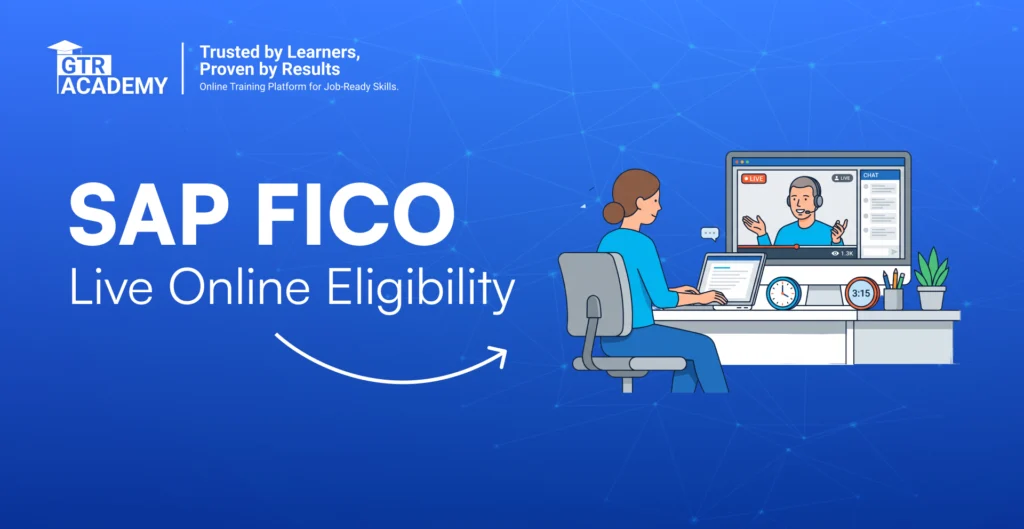
If you are looking at finance and accounting jobs in SAP it is as important to understand what it takes to enrolll as it is to understand what the course covers. This guide covers eligibility for SAP FICO Live Online Classes, what the module teaches and how it is changing with S/4HANA.
Connect With Us: WhatsApp
What Is SAP FICO?
SAP FICO is a part of SAP’s ERP suite and is a combination of two major modules i.e. FI (Financial Accounting) and CO (Controlling). FI deals with external reporting. General ledger Accounts payable / receivable Asset accounting Bank reconciliation CO deals with cost management within the company, such as cost centers, profit centers, and internal order tracking. Together they provide a complete financial backbone to organizations.
Who Can Join — Eligibility for SAP FICO Live Online Classes
No finance degree needed to start but base understanding helps. Typical eligibility includes:
Education Background: Graduates or final year students from Commerce, Finance, Accounting, MBA (Finance) or CA/CMA/CS Backgrounds fit in naturally.
Working Professionals: Accountants, Finance Executives, Auditors who want to transition into ERP-driven roles.
Basic accounting knowledge: knowledge of journal entries, balance sheets and ledgers is sufficient, no previous SAP experience required.
Computer skills: Classes are conducted live online, so some basic computer skills are expected.
There is no hard age or percentage cutoff – real interest in finance and process-driven thinking are more important than credentials.
Key Concepts & Skills You’ll Pick Up
A typical structured sap fico training program generally includes:
- Chart of accounts design and General Ledger (GL) accounting
- Accounts Payable and Receivable Setup
- Lifecycle Management for Asset Accounting
- Cost center and profit center accounting Internal orders basics Product costing basics
- Integration between FI and other modules such as MM and SD
Evolving with S/4HANA: What’s Different?
SAP FICO is not static! There have been tremendous changes with S/4HANA. FI and CO data are now in one source of truth with the Universal Journal (table ACDOCA) with no reconciliation delay between the two. Fiori-based apps replace transaction codes with role-based, simplified dashboards. Real-time reporting has replaced batch-based processing, so finance teams are seeing live numbers rather than overnight updates. If you are taking SAP FICO Online Training today you should expect to see S/4HANA concepts built into the course and not offered as an optional add-on.
Tools and Practical Learning
Good training is not only theory. Look for programs that offer:
- Live SAP S/4HANA Server with hands-on access
- Simulations of real business scenarios (month-end closing, write-off of assets, allocation of costs)
- Practice with classic SAP GUI and Fiori apps
- Case studies of manufacturing, retail or services sector
Who Should Do SAP FICO Module Course?
This path is good for commerce/finance graduates, working accountants who want automation skills, MBA finance students who want an ERP edge and career switchers from manual accounting to enterprise systems.
Choosing the Right Training Program
A good program is a good mix of curriculum depth and practical exposure. Prioritize:
- An industry-relevant curriculum aligned to S/4HANA, not old ECC-only content
- Real implementation not just academic knowledge by expert trainers
- Live/flexible, hands-on classes (not only pre-recorded formats)
- Practical projects on end-to-end finance processes
- Career guidance and interview preparation such as resume and mock interview help.
- Assistance finding jobs linking classroom learning to job applications
- Understanding SAP FICO Certification Paths and How They Align with Industry Recognition
GTR Academy has structured its SAP FICO live classes around this very framework – live S/4HANA server access, project-based learning and dedicated interview preparation, backed by placement assistance to help learners transition into ERP finance roles.
Frequently Asked Questions
1. Who can join SAP FICO Live Online Classes?
Normally, the eligible candidates are graduates in commerce, finance or accounting, working professionals and MBA finance students. No SAP experience required but basic accounting knowledge is recommended.
2. Do you need an accounting background for SAP FICO training?
A basic knowledge of accounting concepts such as ledgers and journal entries is useful, but formal training courses will help you build this foundation as you go.
3. Difference between SAP FICO in S/4HANA and ECC?
S/4HANA combines FI and CO into a single Universal Journal, allows real-time reporting and offers simplified navigation based on Fiori.
4. Do you need SAP FICO certification to get a job?
Certification is not compulsory but it adds a lot to your profile along with practical project-based training experience.
5. Can non-finance graduates learn the SAP FICO module?
Yes, non-finance graduates can enter the field if they are committed and go through structured training from the ground up of accounting.
Connect With Us: WhatsApp
Recommended Blogs:
SAP FICO Module: What Are the Key Components? 2026
How Is the SAP SD Module Evolving with S/4HANA Sales?
Conclusion
SAP FICO Live Online Classes have an open eligibility. Graduates in Commerce/Finance, Working Professionals, Career Switchers with basic accounting awareness can qualify. It’s not so much about where you start, but selecting training that is relevant to how S/4HANA is being used today, and that provides you with some real hands-on experience before you walk into an interview room.