
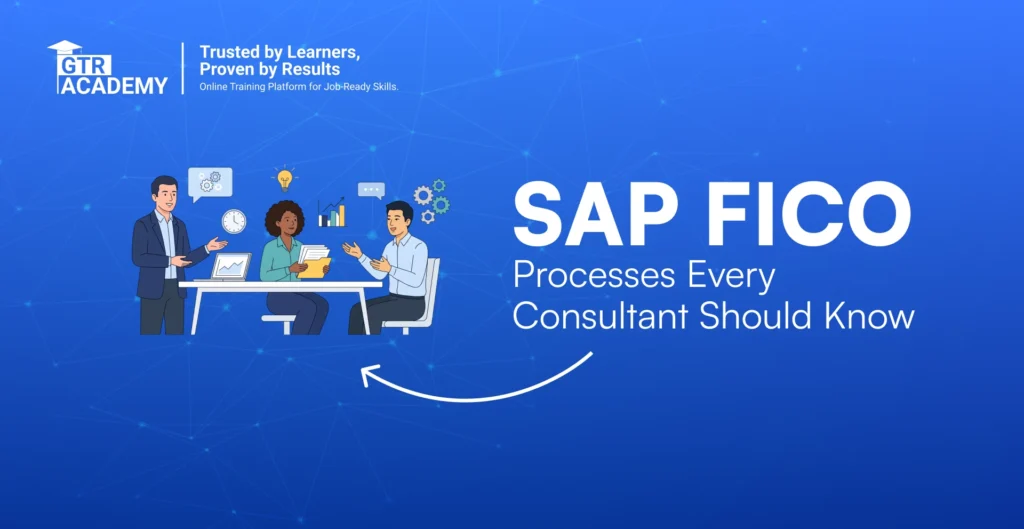
If you are an aspiring SAP finance professional, it is important to have a good understanding of the basic SAP FICO processes: how money is posted, controlled and reported in an enterprise system. SAP FICO module is a combination of Financial Accounting and Controlling. Together they handle everything from ledger postings to cost analysis. If you get the hang of these processes, then the rest of the module is much easier.
Connect With Us: WhatsApp
What is SAP FI-CO Module?
SAP FICO is the financial core of SAP ERP and S/4HANA.
- FI (Financial Accounting) is responsible for external, statutory transactions and for balance sheet and profit and loss statement preparation.
- CO ( Controlling ) tracks internal costs , profitability and budgets for management decision making .
FI: “What happened financially? CO asks “Where did the money go and was it worth it?”
Which SAP FICO Processes Should You Learn First?
1. Company structures and master data
Before you can post transactions, you need to define the company code, chart of accounts, fiscal year variant, and currencies. Then master data. GL accounts, vendors, customers, cost centers & profit centers. Here slip errors into every report.
2. GL (General Ledger) Accounting
This includes journal entries, posting periods, document types, accruals, month end and year end closing. This is the foundation for all financial reporting.
3. Accounts Payable (Source to Payment)
Payment runs Vendor invoices Down payments Vendor reconciliation Furthermore, you need to understand how the goods receipt in SAP MM creates accounting entries.
4. Order to Cash (Accounts Receivable)
Customer billing. Payments received. Collections & credit management. The integration of SAP SD is important here.
5. Accounting for the Fixed Assets
Asset creation, capitalization, depreciation runs, transfers, retirements.
6. Bank accounting and cash management
Bank master data, automatic processing of bank statements and payment matching.
7. CO – Cost centers, internal orders
Planning, allocation and monitoring of costs by department or project including all assessments and allocations.
7. Product Costing and Profitability Analysis
Standard cost estimates, variance analysis and CO-PA reporting for margins by product, customer or region.
What Tools and Concepts Support These Processes?
Learn SAP GUI or Fiori navigation, important transaction codes (FB50, F-02, FBL1N, F110, KS01) automatic account determination and tax configuration like GST. Being proficient in basic FICO reporting and knowing how FI fits into MM, SD and HR will set you apart.
Who Should Learn SAP FICO?
Finance technology Commerce and accounting graduates CAs CMAs Finance Professionals ERP newbies entering finance technology will all be benefited. You don’t need to know how to code but you should know basic accounting terms like debits, credits and financial statements.
How Do You Choose the Right SAP FICO Training?
A good SAP FICO training should cover the following:
- Up-to-date and industry-relevant S/4HANA curriculum
- Experience in implementation of real world trainers
- Hands on practice in live SAP system .
- End to End Projects and Real Life Scenarios
- live or flexible class choices
- Interviews & Career Advice
- Placement assistance (If applicable) SAP FICO Certification Training
If you are looking for flexibility, then SAP FICO online training can be a good option provided you have access to the system and live practice.
Where Does GTR Academy Fit In?
GTR Academy offers SAP FICO Training with hands on learning, professional trainers, project-based training, interview preparation, career support and 100% placement assistance. So, whichever institute you join, do check out the curriculum and the background of the trainer beforehand.
The Mistakes Beginners Make
- Learning transaction codes without understanding the accounting logic
- FI-MM-SD Integration not performed
- Skip config, do end-user stuff only
- No practice live
- Starting cert prep with no project experience
Frequently Asked Questions
1. What is the basic process in SAP FICO?
The major SAP FICO processes are: general ledger accounting, accounts payable, accounts receivable, asset accounting, bank accounting, cost center accounting, internal orders and product costing.
2. Is SAP FICO tough to learn for beginners?
No, not if you know basic book keeping. CO and integration after FI basics.
3. Is SAP FICO Online Training worth it?
Yes, provided it includes live instructor led sessions, system access and practical exercises.
4. Do you need SAP FICO Certification?
It is not mandatory, but SAP FICO certification will validate your skills and strengthen your profile along with project knowledge.
5. What is difference between FI and CO in SAP FICO module.
FI is responsible for statutory accounting and external financial reporting. CO is responsible for internal cost accounting, budgeting and profit analysis.
Connect With Us: WhatsApp
Recommended Blogs:
What Makes Data Science Projects Stand Out in the AI Job Market?
How Can SAP SD Training Prepare You for Real-Time SAP Projects?
Conclusion
The main SAP FICO processes are general ledger, accounts payable and receivable, asset accounting, bank accounting, cost center accounting and product costing. Learn these, get hands-on confidence & choose training with real practice and career advice. That combo will get you a lot better than theory alone.