
Have you ever visited a large retail store or a car dealership and pondered, “How do they determine the precise date on which to order additional stock?” or “Who is responsible for the thousands of bolts and nuts required to construct this engine?” A specialized professional who is employed in the SAP MM Daily Tasks (MM) module is responsible for the smooth movement of goods.
If you are a student seeking a stable career path, a working professional in supply chain wanting to transition into technology, or a beginner who is simply inquisitive about ERP, you have likely heard the buzz about SAP. However, what is the actual occupation of the individual who operates behind the screen? Is it merely tedious data entry, or is there a deeper narrative at play?
In reality, an SAP MM professional serves as the “Air Traffic Controller” of a company’s tangible assets. The factory will cease operations, the inventories will be depleted, and the company will incur losses if you fail to fulfill your obligations. Today, I am revealing the daily routine, tension, and accomplishments of a SAP MM specialist. By the conclusion of this, you will be able to determine whether this occupation is an ideal fit for you.
Connect With Us: WhatsApp
What is the Actual Appearance of Your Morning?
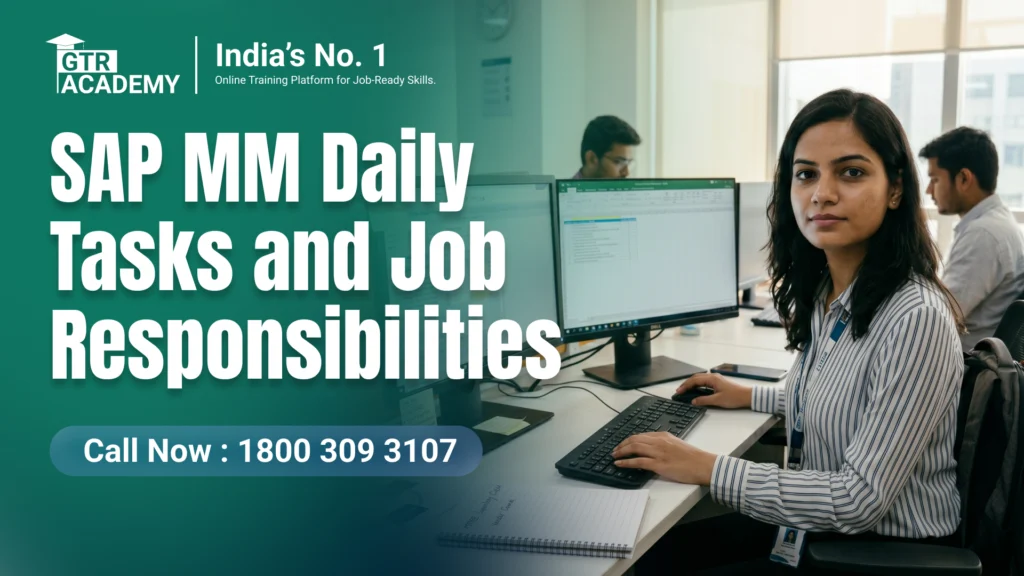
In the year 2026, we do not commence our day by sorting through stacks of paper. The majority of SAP MM professionals initiate their work by accessing their dashboard, which is typically a streamlined SAP Fiori interface, to verify for “critical alerts.”
The Procure-to-Pay (P2P) cycle is typically the focal point of your daily responsibilities. You will be required to allocate time to reviewing pending Purchase Requisitions (requests for items) and converting them into Purchase Orders (official purchases). Additionally, you will oversee “Goods Receipts” to verify that the vendor has delivered the items you ordered.
However, it is not solely a matter of clicking buttons. Communication occupies a significant portion of your day. You will converse with the warehouse manager, who informs you that they have exhausted their storage capacity, or a vendor who is experiencing delays in the delivery of a steel shipment. Your presence is the adhesive that unites the procurement and inventory departments.
Core Responsibilities: The “Big Three”
In the event that I were to reduce your role to three primary components, they would be as follows:
1. Master Data Management
Consider this to be the “System DNA.” Maintaining the Material Master (which contains the records of each item the company possesses) and the Vendor Master (which contains the records of all suppliers from whom you purchase) is your responsibility. The company may inadvertently order 10,000 laptops instead of 10, if this data is inaccurate, such as a decimal point in the wrong location.
2. Physical Stock and Inventory Management
You are responsible for the management of “Movement Types.” This is a technical term that refers to the process of monitoring the movement of items from the loading port to the shelf or from one factory to another. Additionally, you will be responsible for coordinating the “Physical Inventory” counts to ensure that the computer’s numbers correspond with the actual crates on the floor.
3. External Procurement and Purchasing
This entails the management of “Source Lists” (which are used to identify the most successful vendors) and “Request for Quotations” (RFQs). You will compare prices, verify delivery dates, and guarantee that the organization is obtaining the most value for its investment.
SAP MM in Action: Real-World Examples
The Hero of the Holiday Season
Consider the possibility of a significant smartphone manufacturer introducing a new model in December. The company’s SAP MM consultant identified a bottleneck in the “Inbound Delivery” of camera lenses. The production line was never interrupted as a result of the appropriate SAP MM training, which enabled them to re-route the shipment and update the “Quota Arrangement” in the system. Thousands of customers would have received “Out of Stock” emails if that fast thinking had not occurred.
The Mysteries of the “Ghost Inventory”
The warehouse was empty, despite the fact that the system indicated that a large chemical facility had 500 gallons of a specific acid. An MM professional employed their troubleshooting abilities to determine that a “Goods Issue” had not been posted accurately. They resolved the movement type and retrained the warehouse staff, thereby preventing the company from experiencing a significant reporting error.
The Advantages: For What Reason Should I Select This Route?
What is the purpose of pursuing SAP MM certification? Initially, it pertains to employment security. The complexity of global supply chains has reached an all-time high in 2026. Companies are in dire need of individuals who are capable of operating these systems.
Additionally, the diversity is extraordinary. One day, you may be collaborating with a fashion brand to manage their fabric inventory, and the next, you may be overseeing the management of life-saving vaccines at a pharmaceutical company. Additionally, the salary for certified MM consultants remains among the highest in the functional ERP space.
Common Errors and Obstacles
It is not all sunshine and flawless spreadsheets. Integration presents the greatest obstacle. SAP MM is not an autonomous entity; it collaborates with Finance (FI) and Sales (SD). The accounting team will not be pleased with an error in MM, as it could result in a significant disruption to the company’s balance sheet.
One common error that novices make is neglecting the “Business Process” and concentrating solely on the “T-Codes” (transaction codes). It is imperative that you comprehend the rationale behind a business’s procurement of products. Another trap is the attempt to learn solely from YouTube by forgoing the SAP MM seminars. Although gratis videos are beneficial, they do not provide the live server access necessary to comprehend the “chaos” of a genuine system.
The Role of GTR Academy and the Career Scope
The SAP MM career section is presently experiencing significant growth, particularly in light of the transition to S/4HANA. Companies are seeking “Hybrid Professionals”—individuals who possess a comprehensive understanding of procurement and are proficient in the utilization of AI-driven analytics.
The online education system of 2026 has facilitated the process of bridging this divide. This is the area in which GTR Academy excels. Their SAP MM Course Online is specifically tailored to the contemporary era. They provide a sandbox environment in which to make errors and rectify them, rather than merely instructing you on the theory. Gaining the appropriate SAP MM training from a reputable organization such as GTR Academy guarantees that you will be able to confidently enter the market, regardless of whether you are pursuing a position as an MM Consultant, a Purchasing Manager, or a Supply Chain Analyst.
Life in SAP MM Daily Tasks: Top 10 Frequently Asked Questions
- Is it necessary for me to be an engineer in order to acquire knowledge of SAP MM?
No! Although an engineering or supply chain background is advantageous, individuals with a logical mind can achieve success by enrolling in appropriate SAP MM courses. - Is the SAP MM certification a prerequisite for employment?
It is not always “required,” but it serves as a substantial “Verified” emblem on your resume. It demonstrates that you have complied with a global standard. - What is the most frequently encountered daily obligation?
Managing Purchase Orders (POs) and resolving “Invoice Discrepancies” instances in which the vendor’s invoice does not correspond with the products received. - After completing training, what is the average time it takes to secure employment?
Within three to four months of diligent study, the majority of students at GTR Academy are prepared for employment. - Is the task stressful?
It can occur at the conclusion of a month or during the launch of a significant product, but the sense of accomplishment is massive. - Is it necessary for me to possess coding knowledge?
No. SAP MM is a functional module. Rather than composing lines of code, you concentrate on business principles and configuration. - Is it possible for me to operate remotely as a SAP MM Consultant?Yes! In 2026, a significant number of SAP positions are remote or hybrid, particularly for individuals employed by consulting firms.
- In layman’s terms, what is a “Movement Type”?
It is a designation (such as 101 or 201) that informs the system as to why an item is being moved. Is it a purchase? A return? What is a scrap? - What are the advantages of enrolling in a SAP MM course online over a traditional classroom setting?
The online education system of 2026 enables you to practice on live servers from the comfort of your own home, frequently with 24/7 access, a feature that physical laboratories are unable to offer. - What is the subsequent phase following the completion of MM?
Many professionals pursue additional education in EWM (Extended Warehouse Management) or S/4HANA Sourcing and Procurement to increase their salaries.
Connect With Us: WhatsApp
Conclusion: Are You Prepared to Manage the Flow?
SAP MM is not merely an employment; it is the foundation of global commerce. You will become an indispensable asset to any organization that manufactures, distributes, or sells physical products by mastering the daily duties and responsibilities of this module.
It is time to take action if you are tired of “generic” employment and desire a career that provides both technical depth and real-world impact. Invest in your own well-being. Enroll in an SAP MM Course Online at GTR Academy, gain experience on a live server, and begin your journey to becoming a SAP expert.