
Choosing the right tools can speed up data science work, make it more accurate and easier to scale. Professionals use different technologies for different tasks from cleaning data to machine learning and visualization. Looking for the Top 10 Data Science Tools? This guide goes over the most useful options and where each one fits into a real data science workflow.
Connect With Us: WhatsApp
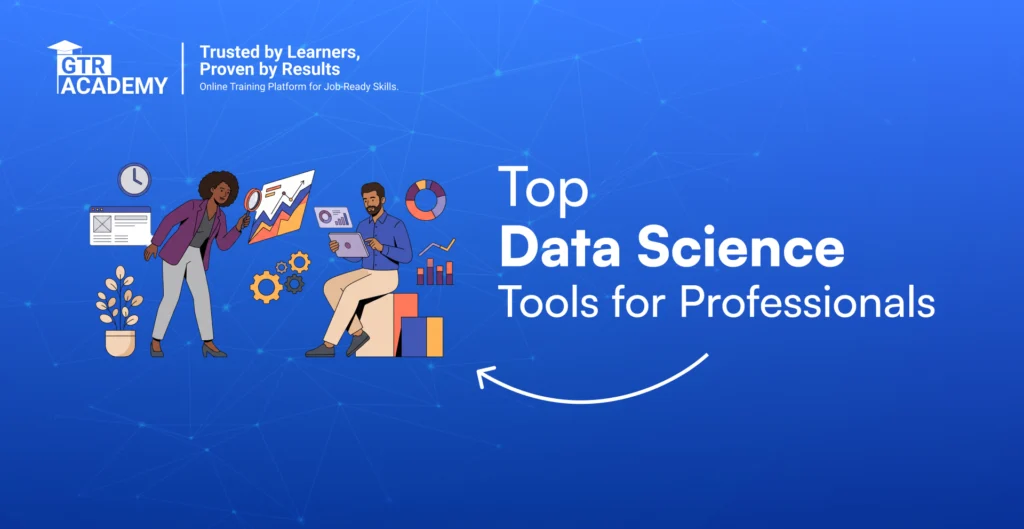
What Are the Top 10 Data Science Tools?
Here are 10 widely used tools and technologies that data science professionals commonly work with:
- Python – A leading programming language for data analysis, automation, machine learning, and AI. Libraries such as Pandas, NumPy, Scikit-learn, and Matplotlib make Python highly practical.
- R – Popular for statistical analysis, data visualization, research, and advanced statistical computing.
- Jupyter Notebook – Provides an interactive environment where professionals can write code, analyze datasets, visualize results, and document their work together.
- SQL – Essential for working with relational databases. Data scientists use SQL to retrieve, filter, join, and analyze business data.
- Pandas – A Python library designed for data manipulation and analysis. It is especially useful for cleaning and preparing structured datasets.
- NumPy – Supports numerical computing in Python and provides powerful tools for working with arrays, mathematical operations, and scientific calculations.
- Scikit-learn – A popular machine learning library used for classification, regression, clustering, preprocessing, and model evaluation.
- TensorFlow – An open-source framework commonly used for machine learning and deep learning applications.
- Tableau – A business intelligence and visualization platform that helps turn complex datasets into interactive dashboards and reports.
- Apache Spark – A distributed computing framework designed to process large datasets efficiently across multiple machines.
Which Data Science Tools Should Beginners Learn First?
Beginners do not need to learn everything at once. A practical starting combination is:
- Python for programming
- SQL for database analysis
- Pandas and NumPy for data preparation
- Matplotlib or Tableau for visualization
- Scikit-learn for machine learning
- Jupyter Notebook for practical experimentation
Having mastered these basics, the learner is ready to progress to deep learning, big data and advanced AI tools.
How Are These Tools Used in Real Projects?
“Most of the projects will not use one tool, but more than one tool. For example, a professional can extract customer data using SQL, clean it using Pandas, create a prediction model using Python and Scikit-learn, and then communicate information to the business teams using Tableau.
That is why you should learn data science thru completing projects .
How to Choose the Right Data Science Training?
Before you enrolll in a data science AI online Course or ai online Course training Course, verify if it has:
- Executive Coach. Industry relevant tools and technologies
- hands on work
- Projects Live
- Flexible/in-person learning options
- Interviewing
- Experts believe
- 100% Support for Cert Location
Good data science courses teach you how to use the tools to solve problems not talk about features of the tools.
Why Consider GTR Academy?
Learners can consider GTR Academy for practical training. The academy provides expert guidance, hands-on learning, real-world projects, interview preparation, career support, and 100% Placement Assistance.
Beginner’s Common Mistakes to Avoid
Don’t attempt to learn all the tools, all at once. Start with the core skills, use real datasets, understand why a tool is being used and build projects that show your problem-solving ability.
Frequently Asked Questions
1. What are the Top 10 Data Science Tools?
Python, R, Jupyter Notebook, SQL, Pandas, NumPy, Scikit-learn, TensorFlow, Tableau, and Apache Spark are widely used data science tools.
2. How do I learn Data Science easily? And what is the first thing to learn?
Python is a good first language to learn. It can be used for data analysis, visualization, machine learning, automation and artificial intelligence development.
3. Is SQL important for data science?
Yep. Data professionals use Structured Query Language, or SQL, to query, filter, combine and analyze data in relational databases.
4. Are there jobs available in data science tools?
Tools don’t work. Employers like statistics, programming, problem solving, communication and hands on projects experience.”
5. Data Science: Should You Learn Python or R?
Python is a good all-rounder language for beginners, and especially good in terms of machine learning and AI. R is especially good for statistics and research purposes.
Connect With Us: WhatsApp
Recommended Blogs:
What Are the SAP FICO Course Details for Beginners? 2026
How Does SAP SD Work in SAP S/4HANA? 2026
Conclusion
1. Python 2. R 3. Jupyter Notebook 4. SQL 5. Pandas 6. NumPy 7. Scikit-learn 8. TensorFlow 9. Tableau 10. Apache Spark Which tools are right? It is contingent upon your role and project requirements. The most pragmatic next step will be to lay down solid foundations in Python, SQL, data analysis, visualization and machine learning for beginners.