
If you have been looking into ERP careers recently, then chances are that you must have heard people talking about Modules Covered in SAP FICO everywhere. Training institutes promote it, companies demand it, and professionals recommend it for stable career growth.
But here is the real question that many beginners ask quietly: “What is there in SAP FICO? Why is it so important?”
This confusion is perfectly normal. Most people hear Financial Accounting, Cost Centers, Profitability Analysis, or Asset Accounting and feel immediately overwhelmed. However, SAP FICO is not as complicated as it sounds when you have someone explaining it in a simple language.
In this article, you will learn about the main modules of SAP FICO, how they function in real businesses, why businesses depend on them, and how learning these modules through proper SAP FICO online training can help students and working professionals build strong careers in 2026. You will also learn how institutes such as GTR Academy and the new-age online education system are making SAP learning easier and more practical than ever.
Connect With Us: WhatsApp
Who Can Learn SAP FICO?
SAP FICO is an inclusive module that welcomes various professional backgrounds. It is particularly good for:
- Business students and freshers looking for ERP careers.
- MBA Finance students seeking specialized skills.
- CPAs and Accountants wanting to digitize their workflow.
- Senior Finance Leaders and Business Analysts.
You don’t have to be a programming guru. There is no technical knowledge required to start learning the SAP FICO Module. While many beginners think SAP is only for experienced professionals, that is no longer the case. Quality SAP FICO Training can help freshers enter the ERP industry with confidence.
What Is SAP FICO?
SAP FICO stands for:
- FI → Financial Accounting
- CO → Controlling
Together, they help companies manage financial data, reporting, budgeting, cost control, and internal business processes. Essentially, SAP FICO is the financial backbone of a company. It plays a significant role in every aspect of business, such as recording sales, tracking expenses, managing assets, and analyzing profits. As business operations grow, manual accounting becomes impossible, making SAP FICO essential for large organizations.
Understanding the Core SAP FICO Modules
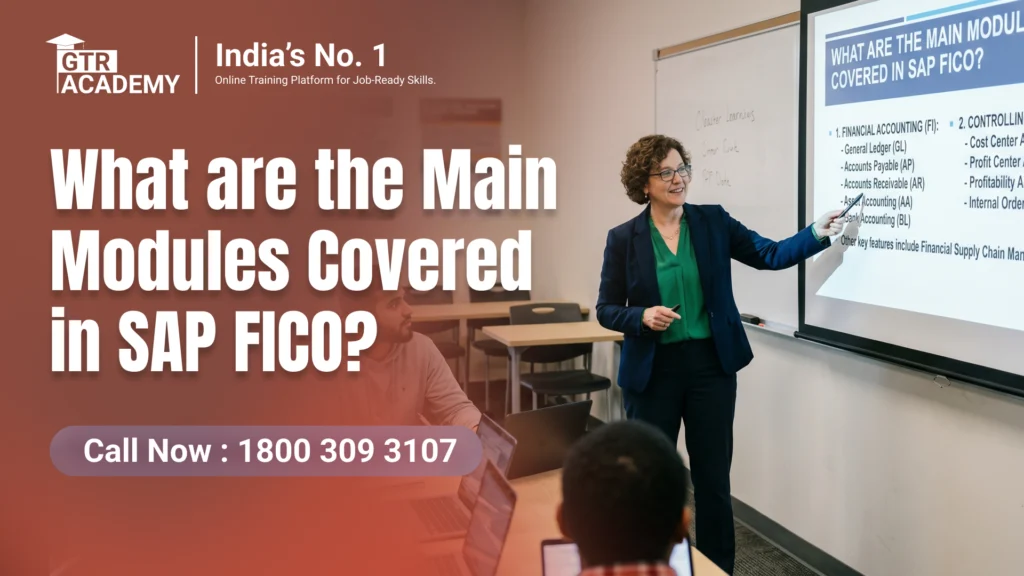
The FI (Financial Accounting) module is intended for external financial reporting. It keeps track of all financial transactions to assist businesses in maintaining proper accounting records.
1. General Ledger Accounting (GL)
General Ledger is the central accounting book of a company. All money transactions flow through here, including:
- Sales Records
- Purchase entries
- Salary expenses
- Tax payments Without a General Ledger, companies cannot prepare accurate financial statements like Balance Sheets or P&L accounts.
2. Accounts Payable (AP)
Accounts Payable tracks the money a company owes to vendors or suppliers. For instance, if you buy raw materials on credit, AP handles the payment details, invoices, due dates, and vendor balances, ensuring the business stays on good terms with its suppliers.
3. Accounts Receivable (AR)
Accounts Receivable manages the money owed to the company by its customers. If a company sells products on credit, SAP tracks outstanding customer payments and invoices to ensure healthy cash flow.
4. Asset Accounting (AA)
All companies own assets like buildings, computers, cars, and machinery. SAP Asset Accounting records the value of these assets, their depreciation over time, purchase costs, and maintenance records.
5. Bank Accounting
This module provides a solution for handling bank transactions, including receipts, payments, bank reconciliation, and cash balance monitoring. It is a key component for accurate financial monitoring.
Understanding the Core Modules Covered in SAP FICO
While FI is for external reporting, the CO (Controlling) module focuses on internal business management and cost control to help management make better decisions.
1. Cost Center Accounting (CCA)
Every department (HR, Marketing, IT) spends money. Cost Center Accounting helps businesses track these expenses by department to see exactly where the money is going, leading to better budgeting.
2. Profit Center Accounting (PCA)
This allows companies to track profitability for different business units separately. For example, a retail company might analyze profits for a Delhi branch, a Mumbai branch, or their Online Sales Department to determine which units are performing best.
3. Internal Orders
Internal Orders are used to track costs for specific, short-term projects or events, such as a marketing campaign or an interim building project, to ensure they stay within budget.
4. Product Costing
Manufacturing companies depend heavily on this. It calculates the cost of producing goods by totaling:
- Raw materials
- Labor costs
- Manufacturing overhead Without proper product costing, companies struggle to price their products competitively.
5. Profitability Analysis (COPA)
COPA helps organizations understand which products are profitable, which markets generate the most revenue, and which customer segments perform best. This module is the foundation for high-level business strategy.
SAP FICO Business Use Case
Imagine a manufacturing company producing electronics:
- Accounts Payable: Manages payments to suppliers for raw materials.
- Accounts Receivable: Monitors customer payments once the electronics are sold.
- Product Costing: Determines the actual cost of producing a smartphone.
- Profitability Analysis: Examines the profit margins of that smartphone versus a tablet.
- Cost Center Accounting: Keeps track of the R&D department’s spending.
In SAP FICO, everything is interconnected, which is why global companies are so dependent on these ERP systems.
Why SAP FICO Is Trending in 2026
As we move through 2026, companies are prioritizing automation and real-time data. The demand for SAP professionals is increasing because of:
- Cloud-based ERPs: Transitioning to systems like SAP S/4HANA.
- AI-enabled Analytics: Using SAP data for predictive financial modeling.
- Financial Accuracy: Meeting stricter global compliance standards.
This is why SAP FICO Certification and professional training have become essential for career growth in the modern economy.
The Role of Online Education in Learning SAP
SAP learning was once confined to major metro cities. Today, the online education system has transformed access. Students can now benefit from:
- Live online classes and on-demand sessions.
- Practical ERP simulations and workshops.
- Dedicated doubt-clearing sessions.
This flexibility allows learners from smaller towns or busy working professionals to get high-quality SAP FICO Online Training from their homes.
GTR Academy: Leading the Way
GTR Academy offers students and professionals the opportunity to learn SAP through practical, industry-oriented programs. Their syllabus includes:
- SAP FICO Core Modules & Real-time situations.
- Project-based practical work and industry exposure.
- Comprehensive interview preparation and flexible online learning.
Advantages and Career Scope
Advantages of Learning SAP FICO:
- Great Career Opportunities: High demand across various industries.
- Worldwide Demand: SAP is used globally, offering international mobility.
- Salary Growth: Competitive salaries for certified professionals.
- Employment Security: ERP systems are the permanent foundation of modern business.
Career Roles After Training:
- SAP FICO Consultant
- Financial Analyst / ERP Executive
- SAP Support Consultant
- Finance Processes Associate
- SAP End User
Common Mistakes of Beginners
- Learning Just Theory: SAP must be understood practically; watching videos isn’t enough.
- Ignoring Finance Fundamentals: A basic grasp of accounting makes the software easier to learn.
- Expecting Immediate Expertise: SAP mastery takes time, practice, and patience.
- Avoiding Practical Projects: Practice builds the confidence needed for technical interviews.
Frequently Asked Questions (FAQ)
1. What is SAP FI and CO?
SAP FICO is an ERP module that integrates Financial Accounting (FI) and Controlling (CO) for business management.
2. What are the main two modules of SAP FICO?
The core components are Financial Accounting (External) and Controlling (Internal).
3. Is SAP FICO suitable for freshers?
Yes, especially those from commerce, finance, or accounting backgrounds.
4. What is covered in SAP FICO training?
Training covers GL, AP, AR, Asset Accounting, Cost Centers, Profit Centers, and practical ERP processes.
5. What is SAP FICO certification?
It is a professional validation of your skills and understanding of SAP ERP concepts.
6. Can SAP FICO be studied Online?
Yes, many institutes offer live and recorded SAP FICO online training.
7. Does GTR Academy offer SAP FICO training?
Yes, GTR Academy provides industry-oriented, practical training programs.
8. Does SAP FICO require accounting knowledge?
Basic knowledge is helpful, but beginners can learn the fundamentals during the course.
9. What are the career opportunities?
Roles include SAP Consultant, ERP Executive, and Financial Analyst.
10. How long does it take to learn SAP FICO?
Most learners grasp the core basics within a few months of regular practice.
Connect With Us: WhatsApp
Recommended Blogs:
A Way to Learn Data Science That Works in 2026
How Long Does It Take to Learn SAP FICO and Get a Job 2026
Modern Digital Marketing Course: What are the 10 High-Demand Modules
Which Companies are Hiring SAP SD Consultants in India Right Now 2026
Final Thoughts
SAP FICO is a smart system that helps companies efficiently manage finance, costs, reporting, and business operations. It acts as the “financial brain” of an organization. With companies moving toward automation and digital systems in 2026, the demand for SAP professionals will grow steadily. Whether you are a fresher or a professional looking for a change, choosing SAP FICO Online Training with an institute like GTR Academy is one of the smartest long-term careers moves you can make.