
The real confusion there is so many. You have just finished a basic Data Science Course, and you are excited. And then in a job interview, someone asks you if your project was using Machine Learning or Deep Learning. You stop, and you don’t know the difference. This is a phase which most of the students, freshers, and even working professionals coming from SAP backgrounds face. If you are going to be working in 2026, knowing ML vs DL is not just some technical jargon; it can directly impact the choices you make about your projects, your career avenues, and your ability to deliver business value.
Connect With Us: WhatsApp
What Defines ML and DL?
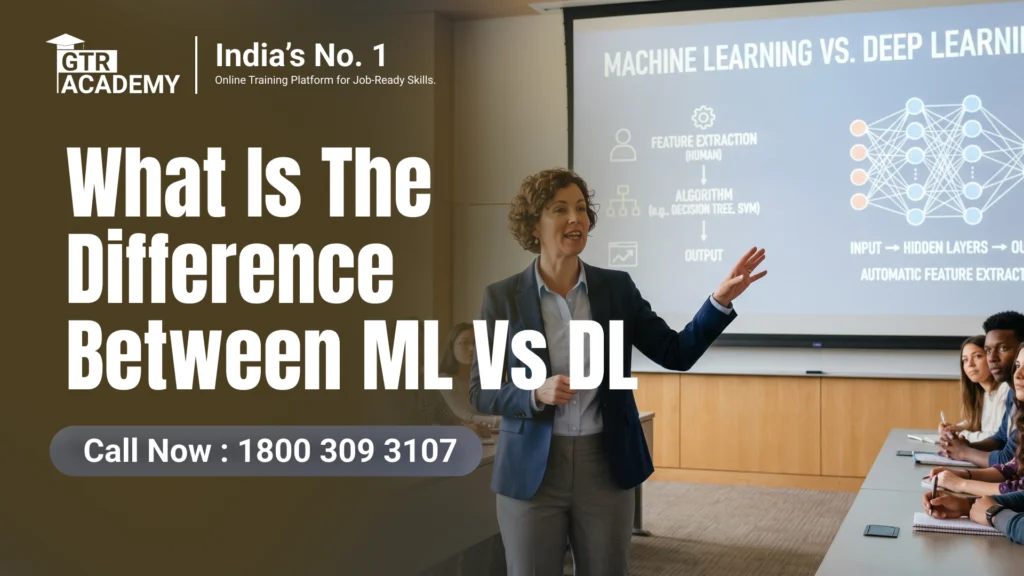
Machine Learning (ML) is a branch of Data Science and AI that uses algorithms to discover patterns in data and to make predictions or decisions based on data. Deep Learning (DL) is a complex subfield of ML which uses multi-layered neural network architectures to learn complex features automatically from a large amount of data, especially images, audio, and texts. ML is good for structured data and smaller datasets; DL is good for unstructured data but needs more computing power and data. ML is for faster results, while DL is for very complex pattern recognition.
What is Machine Learning?
Machine learning is a branch of AI that enables systems to learn from data, rather than following a strict set of instructions for each task. It’s about constructing algorithms that can spot patterns and learn to get better over time.
Major Kinds of Machine Learning:
- Supervised Learning: Learning from labeled data.
- Unsupervised Learning: Discovering hidden patterns in unlabeled data.
- Reinforcement Learning: Learning via rewards and trial-and-error.
What is Deep Learning?
Deep learning is a subfield of ML inspired by the neural structure of the human brain. It learns features in a hierarchical fashion directly from raw data using deep artificial neural networks (hence the ‘deep’). DL is powering new advances in computer vision, natural language processing, and generative AI.
Main Differences: ML vs DL Comparison
| Aspect | Machine Learning | Deep Learning |
| Data Need | Works with smaller data sets | Needs a lot of data |
| Feature Engineering | Manual | Automatic |
| Computational Power | Moderate | High (needs GPUs) |
| Interpretability | Easier to explain | Often referred to as “black box” |
| Training Time | Faster | Longer |
| Best for | Structured/tabular data | Images, speech, text, video |
| Examples | Spam detection, price prediction | Face recognition, chatgpt |
Expert opinion: Based on industry experience, it’s common for beginners to jump into Deep Learning without first establishing solid foundations in traditional ML concepts. But the reality of business is often stumbling on simpler ML models that can deliver ROI faster.
Applications in Industry and Real Life
Machine Learning Uses:
- Manufacturing for predictive maintenance.
- Telecom Customer Churn Prediction.
- Detection of bank fraud (good combination with SAP FICO training knowledge).
- E-Commerce recommendation systems.
Use Cases of Deep Learning:
- Analyzing medical images for detecting illnesses.
- Self-driving cars.
- Sentiment analysis in social media.
- AI tools for content creation.
Mini Case Study
A retail company predicted inventory requirements using traditional ML (Random Forest) with 85% accuracy in structured sales data. Then they used DL for visual product recognition within their app. This greatly improved the customer experience but required more investment in data and infrastructure. Individuals with SAP SD, SAP MM, backgrounds usually begin with ML to optimize the process and then progress to DL.
Job Outlook for ML and DL Skills, 2026
ML and DL skills are applicable to the larger data science ecosystem. Roles include AI Research Scientist, Computer Vision Engineer, Deep Learning Specialist, ML Engineer, and NLP Engineer.
- Entry ML related roles: 6-12 LPA.
- DL/AI Experts: 10-20+ LPA.
- Senior Professionals: ₹25 LPA+.We’re seeing companies building AI into operations and the demand is strong. Unique value is created when skills are combined with domain knowledge from SAP ABAP Training or marketing.
Practical Roadmap: How to Start
- Foundations: Learn Python, statistics, and SQL in a Data Science Course to understand data quality.
- Basic ML: Learn algorithms like Regression, Classification, and Clustering.
- Frameworks: Master Scikit-learn for ML and Tensorflow/Pytorch for DL.
- Projects: Start with simple ML projects, then scale to complicated DL tasks.
- Education: Find an online training course on AI advanced topics. Actionable Tip: Know what approach to use, not the most sophisticated model.
Why Choose GTR Academy?
Get trained with GTR Academy in these technologies in a practical way. The curriculum is industry-aligned and covers both ML and DL with live projects and practical assignments based on current industry needs. You’ll learn with experienced trainers who will help you develop real skills, and you’ll have flexible learning modes to suit working professionals and students. The program is great for interview preparation and placement assistance.
10 Questions We Get Asked the Most
- ML vs DL, which is better?
Depends on the issue; ML is better for smaller datasets and interpretability. - Can one study DL without ML?
Not recommended; ML foundations make DL easier to grasp. - Time to learn?
Basic ML takes 2-4 months; DL adds 3-6 months. - Tools? ML: Scikit-learn, XGBoost; DL: TensorFlow, Pytorch, Keras.
- Is DL taking over?
No, they live together, but production systems still favor simpler ML for cost reasons. - Do I need high-end hardware?
No, cloud platforms like Google Colab provide free access to GPUs. - Importance in SAP?
Very relevant for process optimization and smart systems. - Biggest challenge in DL?
Data quality, overfitting, and high computational cost. - Scope in Data Science?
High, especially for customer segmentation and predictive analytics. - Which to learn first?
ML first for confidence, then DL for specific positions.
Conclusion
Machine Learning and Deep Learning are both essential skills in today’s AI-driven world. ML is ideal for structured data and faster business solutions, while DL is powerful for complex tasks involving images, speech, and text. Understanding when to use each approach is key to building successful AI projects.
If you’re starting your AI journey, begin with Machine Learning fundamentals and gradually move to Deep Learning. GTR Academy helps learners master both technologies through practical training, live projects, and industry-focused learning, preparing them for high-demand careers in Data Science and AI.