
I still remember sitting with my friend Rohan in a noisy Delhi cafe in 2018. He’d just quit his job in banking after doing an online Python course and a couple of Kaggle competitions. “I’m ready to become a data scientist,” he said, his eyes sparkling with excitement. Six months later he was burned out, back at his old desk.
The issue? He had skipped the fundamentals and gone straight to the fancy algorithms and tools. His models worked on clean data but failed miserably in real business scenarios. That experience taught him an important lesson about the Data Science Career Journey success is not just about learning algorithms but building a strong foundation in statistics, problem-solving, data handling, and real-world business applications.
Connect With Us: WhatsApp
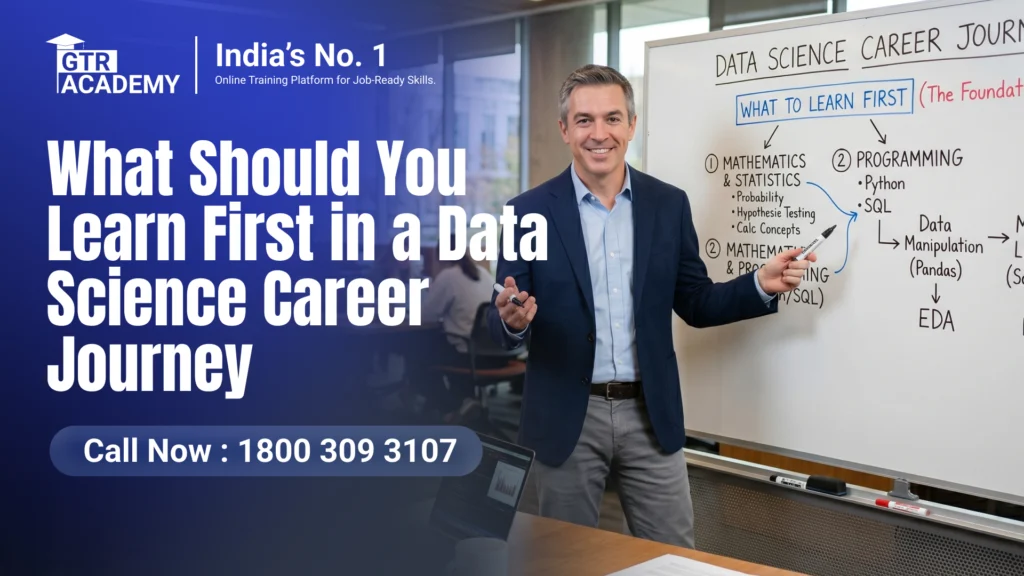
If you’re 25–40, you’re probably juggling a job, maybe a family, and dreaming about getting into data science. You’ve probably felt that same tug. The field seems to be such an incredibly lucrative and exciting space with new tools popping up every month. But the cold hard fact is that most beginners spend their first year learning the wrong things, in the wrong order.
What matters is not collecting certificates or becoming an expert in every new library. It’s about building a rock-solid foundation that enables you to solve real problems and stand out in interviews. In this post, I’ll walk you through exactly what you should learn first on your data science journey, why order matters, and how to avoid the common traps that derail most newcomers.
Why the Order in Which You Learn Makes All the Difference
Data science is not just coding or statistics. It’s a mix of technical skills, curiosity, and business acumen. If you begin with the shiny stuff — deep learning frameworks or the latest LLM tools — you lose the central thinking that makes everything else work.
It is like learning to drive. You don’t begin with Formula 1 racing techniques. You begin with road rules, controls, and the reality of what a car actually does. Same with data science.
The worst mistake I notice (and I’ve mentored over 50 people making this switch) is people treating data science as a tool checklist. Companies don’t hire you because you know PyTorch. They hire you because you can work with messy, real-world data and turn it into decisions that save money or create value. That ability rests on solid fundamentals.
My own point of no return came early. My first project at a logistics startup was to build a complex neural network that took weeks to build and performed worse than a simple linear regression. It wasn’t the model that was the issue — it was that we did not understand the data and business problem well enough. That painful lesson taught me the importance of sequencing my learning.
Foundation 1: Programming Fundamentals (But Not What You Expect)
Begin here, but keep it practical. You don’t have to be a software engineer first, but you do have to be comfortable with code.
Python is a must. Before you start playing with pandas or scikit-learn, nail these core areas:
- Variables, types, and control structures
- Functions and modular programming
- File handling and basic error handling
- Simple data structures and list comprehension
Remain here 4–6 weeks. Write a simple script every day. Automate a boring task in your current job — whether it’s cleaning up an Excel spreadsheet or generating reports. This develops muscle memory and confidence.
Too many beginners jump to the libraries too early. I remember helping a marketing analyst who could create beautiful Seaborn visualizations, but couldn’t explain why her code was throwing a KeyError. That disparity was immediately obvious in technical interviews.
Once you’re comfortable with the basics of Python, introduce SQL. Why? Because 80% of real data work is in databases. Learn SELECT statements, JOINs, GROUP BY, and window functions. Practice on platforms like StrataScratch or the database section of LeetCode.
Foundation 2: The Math That Really Counts
This is where a lot of people get scared — or go overboard. You don’t need a PhD in mathematics, but you can’t skip these areas:
Statistics and Probability — Before Machine Learning
- Descriptive statistics (mean, median, variance, distributions)
- Hypothesis testing and p-values
- Correlation and causation
- Confidence intervals and sampling
These ideas will help you ask better questions and avoid drawing wrong inferences from data. I knew a friend who built a customer churn model that looked great — until the business team realized it didn’t account for seasonality. A little time series knowledge would have saved weeks of re-work.
Linear Algebra Basics
Vectors, matrices, and their relation to data transformations are important too. You don’t have to prove the theorems, but you should understand why we multiply matrices in data pipelines.
Limit this phase to 3–5 weeks. Use resources like StatQuest videos or the book Practical Statistics for Data Scientists. Apply concepts to small datasets from your industry right away.
Foundation 3: Data Wrangling — The Real Daily Job
60–70% of a data scientist’s time is spent cleaning and exploring data. This should be one of your first deep dives. Learn:
- Exploratory Data Analysis (EDA) techniques
- Thoughtful handling of missing values (not just dropping them)
- Feature engineering fundamentals
- Data visualization principles (not just pretty charts, but charts that actually tell you something)
Work with real, messy data. Indian government open data portals are great for this — try looking at PM2.5 levels across cities or crop production patterns. The messiness will teach you more than any Kaggle notebook.
Here’s a personal example: early in my career, I worked on a project analyzing e-commerce returns. The data was terribly inconsistent across regions. Because I had spent time learning cleaning techniques, I could recognize patterns others missed. That project became my best portfolio piece.
Start Building Projects Early — Even Imperfect Ones
Don’t wait until you know everything. Once you have programming, SQL, and basic stats under your belt, start small projects immediately.
Good Starter Projects Data Science Career Journey
- Analyzing your own bank statements or fitness tracker data
- Creating a simple sales dashboard for a local business
- Predicting house prices in your city using public data
Focus on end-to-end work: problem definition, data collection, data cleaning, analysis, and storytelling. Write up your process in a Jupyter notebook or blog post. Interviewers don’t just want to see the right answer — they want to understand your reasoning.
Common Objections — Answered Honestly
“Can’t AI tools like ChatGPT now do all of this?”
Not exactly. Tools are helpful for boilerplate code and explanations, but they can’t understand your specific business context or make ethical judgments. The best data scientists use AI as a partner, not a substitute. If you get the basics right, you’ll be significantly better at prompting AI too.
“I don’t have a computer science background.”
In many cases, that’s actually a good thing. Good data scientists know their tools, but great ones have domain knowledge from past careers — marketing, operations, healthcare. Companies are desperate for people who understand both data and real-world problems.
“I’m in my 30s — am I too late?”
The truth? Maturity and strong communication skills are genuine assets. Technical skills are teachable. Business wisdom is not. Professionals in their 30s often outperform younger hires in stakeholder communication and project framing — both of which matter enormously in senior data roles.
The Human Element: Curiosity, Communication, and Persistence
Technical skills will get you through the door, but these qualities drive long-term growth:
- Curiosity: Always ask why and what if?
- Storytelling: Learn how to communicate insights to non-technical stakeholders
- Learning agility: Embrace this fast-changing field rather than chasing every shiny new tool
Join communities such as Data Science India or local meetups. Share your half-finished projects. You’ll grow more from community feedback than from any individual course.
Key Takeaways
✅ Start with Python and SQL before libraries and models
✅ Learn statistics first — data speaks in numbers
✅ Use real, messy data — not just perfect Kaggle datasets
✅ Begin projects early and document your thinking
✅ Balance technical skills with domain knowledge and communication
✅ Use AI tools wisely — as accelerators, not crutches
Be patient with the basics. They compound over time — and the people who master them are the ones who build lasting careers.
Top 10 Frequently Asked Questions About Getting Started in Data Science
1. How soon can you find a job?
If you work at it consistently (15–20 hours/week), most people can find an entry or junior position in 9–15 months.
2. Is a Master’s degree required?
No. For many roles — especially in India’s growing startup ecosystem — strong projects and fundamentals matter more than degrees.
3. Which should I learn first — R or Python?
Python. It is more flexible and more widely adopted across the industry.
4. Books or online courses — which is better?
Both. Books for deeper understanding; courses for structure and accountability.
5. How important is LeetCode?
Mildly. Focus more on data-specific platforms like StrataScratch or Mode Analytics.
6. Can you transition careers while working full-time?
Yes. This is how many successful transitions happen. Protect your evenings and weekends for focused learning.
7. Which industry should I focus on?
Begin with your current industry. Domain knowledge is your competitive advantage.
8. How do I build a portfolio without experience?
Freelance for small businesses, contribute to open source projects, and build personal projects around publicly available data.
9. What is the starting salary in India?
Junior data scientists typically begin at around ₹6–12 LPA depending on location and company.
10. How do I stay motivated through plateaus?
Celebrate small wins. Stay connected with a community. Remember why you started.
Connect With Us: WhatsApp
Recommended Blogs:
SAP SD Course: How To Create Stock for Testing Purposes in 2026
ML Vs DL: What Is the Difference Between? 2026
How To Structure a Digital Marketing Plan?
What Is the MRP Profile in SAP MM? 2026
Conclusion
A successful Data Science Career Journey starts with strong fundamentals, not advanced tools. Focus on Python, SQL, statistics, and real-world projects before moving to machine learning and AI. Stay consistent, keep practicing, and build practical skills that solve real business problems. With the right learning path and guidance from GTR Academy, you can develop industry-ready skills and build a rewarding long-term career in data science.