
If you are scrolling through this, you are probably a student looking at career paths, a working professional feeling stuck in your current job, or just a person who enjoys numbers and patterns, but is wondering if data science still makes sense in 2026. Okay. With all the AI hype it’s easy to feel confused. Are we in a boom or are we about to be replaced by robots?
I’ve been in tech education for years, talking to fresh grads and mid-level folks every week. Let me tell you straight, the Future Scope of Data Science has a very bright scope, but it is evolving fast. This isn’t the “build a model in Jupyter and call it a day” game anymore. Today it’s about real impact, mixing with AI and fixing messy business problems. Just hold on with me and by the end of this post you’ll have a clear picture of where things are going and what exactly to do.
Got a quick question for you: Are you someone who’s just starting out with zero experience, or already working and thinking about switching? Do let me know in the comments below – I’d love to hear.
Connect With Us: WhatsApp
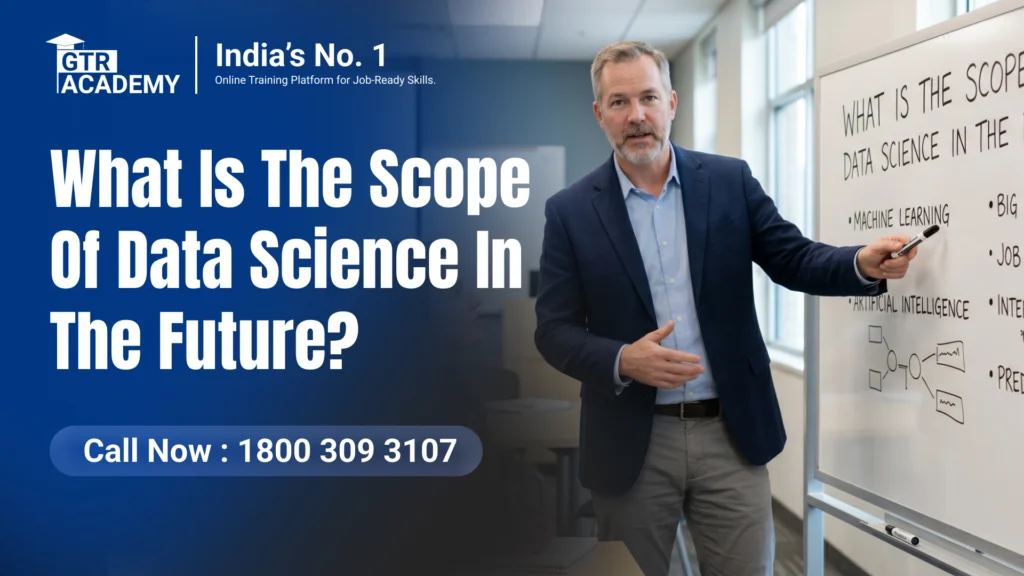
Data Science’s Continued Relevance in 2026 and Beyond
Look about. All that is powered by data every app on your phone, every recommendation you get while shopping online, every health report you receive from your wearable. We produce insane amounts of data on a daily basis by 2026. Not only are companies collecting it, but they are also anxious to make smart decisions from it.
The future is not replacing humans. It’s people who can guide AI, interpret results and make ethical decisions. Data scientists are the link between pure numbers and real-world strategy. That means exciting entry points for students and beginners. It opens up higher roles for working professionals without starting from scratch.
I remember speaking with Rahul, a 28-year-old accountant from Uttar Pradesh. He thought his job was becoming routine. He started with basic data skills and then moved on to analyzing sales data for an e-commerce company. His salary skyrocketed and more importantly, he was looking forward to going to work again. These are not atypical tales, they are becoming the norm.
Key Trends that Define the Future Scope of Data Science
Let us decode what is actually happening in 2026.
You Cannot Talk Data Science Without AI
AI and Machine Learning integration is a must have now. Generative AI is mainstream now. Models aren’t just predicting, they’re creating content, automating decisions, and even explaining why they made them (that’s Explainable AI, super important for trust in banking or healthcare).
Real-Time Analytics & MLOps
No more waiting for a monthly report. Companies want insights now. Imagine detecting fraud in banking within seconds. Or supply chains that can dynamically respond to disruptions. Handling models in production (MLOps) is now a required skill.
Cloud, Ethics and Data Governance
Data is in the cloud. Professionals need to process large datasets safely, under strict privacy constraints. As regulation gets stricter, having the knowledge of how to govern data ethically gives you a huge edge.
Democratization and AutoML
“The tools are getting smarter so that non-experts can do basic analysis.” But that does not kill data science jobs — it just moves them to complex problem solving, strategy and custom solutions that AutoML cannot yet handle.
These trends mean that the scope is not shrinking. Many markets are creating jobs at 30-34%, and there’s a huge talent shortage.
Real Life Examples That Show the True Extent
I want to share a few stories that resonated with me.
First, Priya, a final year student. She did a project in college on predicting crop yields based on weather and soil data. A local agri-tech startup loved it, and employed her. Now she’s helping rural farmers make better decisions. Real impact, big. Data science, simple.
Second case: Amit, a working professional in marketing. His company was losing clients. He used customer behaviour data and some clustering techniques to find out which groups are at risk and offered personalized promotions. Retention increased 25%. He didn’t need a PhD, he needed practical skills and curiosity.
These are not fairy tales from Silicon Valley. They are happening here in India, in everyday companies. The future scope includes healthcare (predicting disease outbreaks), finance (smart lending), retail (personalized shopping) and even government (better public services).
Advantages and Benefits for Beginners, Students and Professionals
What’s the point?
- High Demand and Salaries: Good professionals are paid well, and six-figure packages are common in many roles as experience grows.
- Versatility: Transferable skills across industries. In an industry? Simple switch.
- Intellectual Satisfaction: You solve important puzzles.
- Future-Proofing: If you learn to work with AI, you won’t be replaced by AI.
For students and beginners: Low barrier to entry with online learning.
For Professionals: Upskill on part-time and get quick promotions.
Common Mistakes and Pitfalls
Not all plain sailing. Entry-level positions can be competitive. Many newcomers jump on the bandwagon of hot tools without understanding the basics of things like statistics or business context. Others neglect communication skills – great models are useless if you cannot explain them to non-tech teams.
One mistake I see often is treating online courses as passive videos. You want projects that you can do in the real world. Another: Not caring about ethics. Biased models can do real harm.
Tip: Begin small. Build a project that solves a real problem in your life or community.
Career Prospects and Real-World Applications 2026
The career path is open. Data Analyst (great starting point), Data Scientist, ML Engineer, AI Specialist or even move into leadership such as Head of Analytics.
Hundreds of thousands of openings are projected (across India and the world). Industries that are hungry are manufacturing, healthcare, and e-commerce.
Tip: Focus on Python, SQL, visualization tools and ML basics. Then stack on cloud, deployment skills.
This is where structured training can help. GTR Academy is one of the best data science courses which offers live sessions, real projects and placement support. Their programs blend theory with what companies actually need in 2026 – AI integration and MLOps.
The Role of Online Education in 2026
Online learning has come of age. It’s not just videos in 2026. It’s interactive, it’s mentor-supported, it’s job-focused. You learn at your own pace with doubt clearing in live classes.
Here GTR Academy differentiates itself with their Data Science AI Online course and AI online course training with capstone projects and resume help. Whether you’re a student trying to juggle your studies, or a professional with a full-time job, flexible online options make upskilling a realistic possibility.
10 Quick FAQs
1. What is the future scope of data science?
Huge! The growth of AI and explosion of data means demand will be strong through 2030 and beyond. Roles transform to work with AI.
2. Do you think Data Science is a good career for beginners in 2026?
Yes, 100%. Begin with the basics and develop projects. Many people stumble into it cold.
3. Which data science course should I go for?
Go for the practical ones on Python, SQL, ML, and Projects. GTR Academy Data Science Course is known for its practical focus and support.
4. Will AI take the job of data scientists?
No. AI does the boring stuff, humans do strategy, ethics & complex problems.
5. What salary can I expect after a data science course?
Freshers start decent, with 2-3 years experience it shoots up significantly depending on location and skills.
6. How long does it take to learn data science in Python?
3-6 months for basics, longer for mastery. Consistency of practice is more important than time.
7. Do data science jobs require a degree?
Helpful, but not always necessary. Skills and portfolio generally win. Many people do well with online certifications.
8. Skills in demand for Data Science in 2026?
Python/SQL, ML, statistics, communication, cloud basics, understanding business problems.
9. How GTR Academy helps with placements?
They offer real projects, interview prep, and connections with hiring partners. Many students get jobs after they finish their programs.
10. Should I take an online data science AI course right now?
Yes! Demand is high and skills gaps mean trained people get opportunities more quickly.
Connect With Us: WhatsApp
Recommended Blogs:
How To Crack Artificial Intelligence Interviews? Q&A Guide Best 2026
SAP FICO Module: All You Need to Know About 2026
What Is the Business Process in SAP SD? 2026
What Are The 7 Ps of Digital Marketing?
Conclusion: What’s Next for You?
The future of data science is not only promising, but also revolutionary. It offers growth, impact and exciting challenges for students, beginners and working professionals alike. Sure, you’ll keep learning, but that’s what makes it rewarding.
If you’re ready to explore, check out structured programs. GTR Academy has assisted thousands in their industry-specific Data Science Course and AI online course training. Their emphasis on practical skills and placements makes them a good choice in the online education world of 2026.