
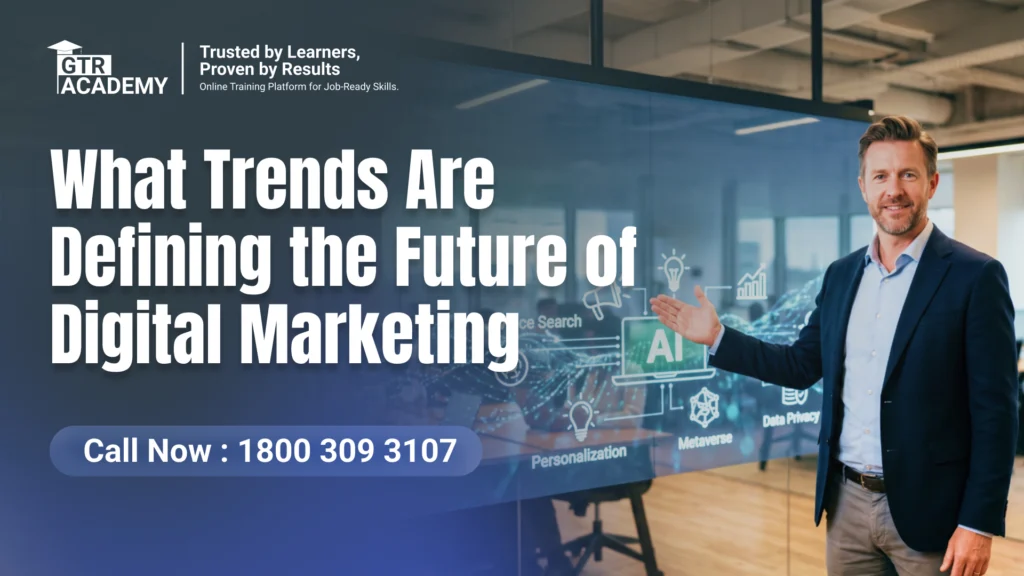
Digital marketing is no longer just about posting on social media. At its heart, it is about making meaningful connections between brands and people in an increasingly digital world. AI is everywhere these days, powering everything from content creation to predictive analytics, shaping the Future of Digital Marketing.
By leveraging generative tools and machine learning, AI analyzes massive amounts of data, automates mundane tasks, and provides personalized experiences at scale. Companies adopting these technologies are seeing higher engagement and conversion rates. Take hyper-personalization, for instance AI predicts what a customer needs before they even articulate it. This is now an expectation, not a “nice to have.” A common mistake beginners make is thinking of AI as a full replacement for human creativity; the savviest marketers consider it a powerful collaborator.
Connect With Us: WhatsApp
Key Trends Defining the Future of Digital Marketing
The industry is undergoing a paradigm shift. Here are the big changes happening in digital marketing today:
Hyper-Personalization and First-Party Data
With privacy regulations tightening, marketers are relying more on consented, first-party data. AI helps build campaigns that are micro-segmented, making each interaction feel unique to the user.
Voice and Visual Search Optimization
Consumers now ask full questions to assistants like Siri or Google, such as, “best running shoes for flat feet near me.” Content must be optimized for natural conversational language and image-based discovery.
Generative Engine Optimization (GEO) and AEO
Content must now provide clear, concise answers suitable for AI-generated summaries on platforms like Google AI, Perplexity, and ChatGPT. Success is defined by E-E-A-T: Experience, Expertise, Authoritativeness, and Trustworthiness.
Immersive Experiences
Platforms are increasingly embracing authentic, short-form video. Furthermore, AR and VR technologies are becoming standard for product testing, allowing users to experience brands before they buy.
Privacy-First & Ethical Marketing
Transparency regarding data usage is the cornerstone of building long-term brand loyalty.
Omnichannel & Social Commerce
The modern customer journey must transition smoothly from app to website to social shop. These are not just abstractions; they are producing tangible results across retail and professional services.
Who Should Learn Digital Marketing?
The field is open to students, freshers, working professionals, job seekers, and career changers. Even SAP aspirants—whether working with SAP SD or SAP MM—can gain a massive edge in digital transformation projects by mastering AI-based marketing. If you are stuck in a rut, a certification is the perfect way to break through. Benefits include remote work flexibility, a balance of creativity and analytics, and significant earning potential as businesses continue their digital transition.
Salary Insights (India, 2026)
- Freshers/Entry Level: 3–6 LPA.
- Mid-Level (2–5 Years): 6–15 Lakhs.
- Senior/Managerial: ₹12–25+ LPA (higher for AI or performance marketing specialists).
Mastering the Skillset
Digital marketing requires a blend of SEO/GEO, content strategy, data analytics, paid advertising (PPC), social media management, and AI tool proficiency. Success comes from understanding audience intent, creating useful content, distributing it across channels, and iterating based on performance in tools like Google Analytics.
Common Beginner Mistakes
- Hopping on trends without a cohesive strategy.
- Failing to prioritize a mobile-first approach.
- Ignoring analytics or focusing solely on vanity metrics like “likes” instead of actual ROI.
Actionable Tips to Get Started
- Lay the foundation: Take a structured Digital Marketing Course.
- Get hands-on: Practice with free tools like Google Ads and Meta Business Suite.
- Build a portfolio: Create a real-world project to showcase your skills.
- Stay current: Follow industry blogs and seek certifications to boost your credibility.
Career Paths and Opportunities
There is massive demand for professionals who understand both legacy systems and new technology. Roles range from SEO and content specialists to performance marketing managers and AI marketing leads. Notably, these roles often overlap with enterprise landscapes; for example, knowledge of SAP FICO can help monitor financial campaigns, while SAP ABAP training can aid in developing custom analytics solutions.
| Role | Experience Level | Avg. Salary (LPA) | Key Skills |
| Digital Marketing Executive | 0–2 years | 3–6 | SEO, Social Media, AI Basics |
| SEO/GEO Specialist | 2–5 years | 6–12 | Content Optimization, Analytics |
| Performance Marketing Manager | 5+ years | 12–25+ | PPC, Data-Driven Strategy |
Why GTR Academy?
GTR Academy offers industry-aligned learning that prepares you for real-world challenges. Our curriculum blends fundamental concepts with advanced AI applications, delivered through live projects, practical assignments, and guidance from trainers with deep market knowledge. Whether through online or classroom sessions, we provide the interview preparation and placement support necessary to build lasting professional competence.
Connect With Us: WhatsApp
Recommended Blogs:
Best SAP SuccessFactors Online Training: Learn Modern HR Management 2026
SAP PP Training in 2026: Complete Career Guide for Beginners
SAP SD Certification Preparation Tips for Beginners 2026
Data Science Course: What Skills Can You Gain in 2026
Conclusion
The future of Digital Marketing is defined by AI empowerment, personalization at scale, and a renewed focus on trust. The marketers who win will be those who blend technology with human insights. By investing in quality training, you position yourself for growth in a dynamic, high-demand field. The opportunities are ready for those prepared to take them.