
Data Science is a mix of statistics, programming, data analysis and machine learning. The beginning might be frightening. But if you learn the basics gradually, the field becomes much more understandable. First, Data Science Beginner learners should know how the data is collected, cleaned, analyzed, visualized and used for useful predictions or decisions. The Certificate in Basic Data Science can also help learners validate basic knowledge.
Connect With Us: WhatsApp
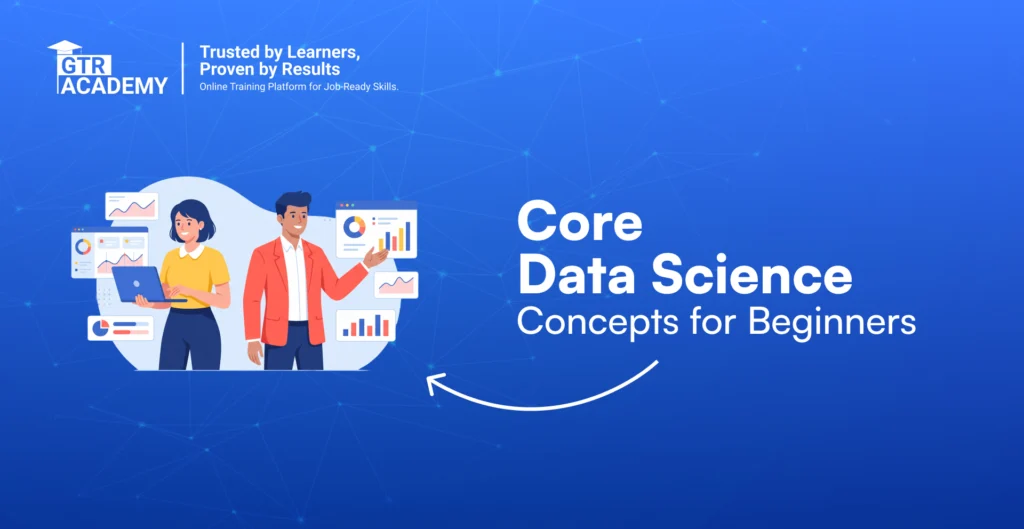
What is Data Science?
Data science is the science from data. It is about extracting insights from structured and unstructured data using statistics, programming, analytical techniques and machine learning. The common data science workflow includes: data collection, data cleaning, data exploration, model building, result evaluation and result communication.
1. Statistics and Probability
Data Science is statistical. For starters to find out about things like:
- Mean, median, mode, and variance
- Standard deviation
- Probability
- Distributions
- Correlation
- Hypothesis testing
These ideas help you to interpret data correctly, and to determine if patterns are significant.
2. Python and Programming Basics
Python is one of the popular languages used in machine learning and data analysis. A beginner should learn about variables, loops, functions, conditional statements and data structures. Basic object oriented concepts are also important .
Libraries like NumPy, Pandas, Matplotlib and Seaborn are very helpful for working and visualizing data sets.
3. Data Cleaning and Pre Processing
In practice the data are rarely perfect. Might be missing values, duplicate records, inconsistent formats or wrong entries.
Data cleaning handling missing data, duplicate records, fixing formats, detecting outliers and preparing data for analysis or machine learning.
4. Exploratory Data Analysis (EDA)
Exploratory Data Analysis ( EDA ) helps you to find relation and patterns in data set. Beginners will learn how to break down the data, create visualizations, spot patterns and probe outliers.
EDA is often the bridge from raw data to actionable business insight.
5. Machine Learning Fundamentals
A Data Science Newbie should be aware of the difference between:
Supervised learning: learning from data with labels
Unsupervised learning: finding hidden structure in data
Regression – predicting numbers
Classification: Predicting a class label
Clustering: grouping similar observations
You also need to know about training, testing, overfitting, underfitting and model evaluation.
6. SQL and Databases
Most of the time, organizations store their data in databases. SQL enables professionals to quickly find, sort, combine and aggregate information.
Beginners learn commands like ‘SELECT’, ‘WHERE’, ‘GROUP BY’, ‘JOIN’, and aggregate functions and gain an important practical skill.
7. AI and Deep Learning Basics
Then the learners who know the traditional machine learning can go to the artificial intelligence, deep learning. As you learn, you’ll want to explore topics like neural networks, computer vision, natural language processing, and generative AI.
An online AI Data Science Course will be helpful if it merges these concepts with practical exercises, rather than just teaching theory.
Why Are Practical Projects Important?
And projects make ideas into useful skills. Good starting points are beginner projects such as sales forecasting, customer churn prediction, house price prediction, customer segmentation or sentiment analysis.
If you are searching for ai online Course training programs, try to find ones that offer chances to work on actual data sets, create models, explain results and display project outcomes.
Who Should Learn Data Science?
Data science course will be useful for students, freshers, working professionals, analysts, programmers and career changers who want to solve problems using data. Good mathematical skills are useful, but you can learn the statistics and programming skills over time if you are a beginner.
How Should Beginners Choose Training?
Look for industry-relevant curriculum, expert trainers, hands-on learning, real-world projects, flexible or live classes, interview preparation, career guidance and certification where relevant. If you are looking for placement assistance, understand what 100% Placement Assistance really means before you enroll, and don’t take it as a job guaranty.
If you are looking for practical training with expert guidance, projects, interview preparation, career support and 100% Placement Assistance then GTR Academy can be considered by the learners.
Common Beginner Mistakes
Avoid trying to learn every AI tool at once. Other common mistakes include skipping statistics, copying project code without understanding it, ignoring SQL, and focusing on certificates instead of practical skills.
Frequently Asked Questions
1. What should a beginner data scientist learn first?
Start with statistics, python, sql, data analysis, visualization and basic machine learning and then move to more advanced AI.
2. Is it necessary to learn Python for data science?
Python is one of the most popular languages in data analysis and machine learning but there are others.
3. Best Online AI Data Science Course for Beginners?
Yes. If you are a beginner, there is a course option that lets you start from the beginner level and then proceed to machine learning, AI, projects, and practical tools.
4. Why is SQL important in data science?
SQL is a must-have skill on the job that allows data professionals to pull and analyze data that is stored in relational databases.
5. Importance of this project in Data Science course?
Yeah. Through hands-on projects, students can apply theory to practice, build problem-solving skills and demonstrate their ability to work with real-world data.
Connect With Us: WhatsApp
Recommended Blogs:
How Does SAP SD Work in SAP S/4HANA? 2026
What Is Included in an SAP MM Course Syllabus? 2026
Conclusion
The core concepts every Data Science Beginner should know include statistics, Python, data cleaning, EDA, SQL, machine learning, visualization, and basic AI. Build these foundations first, practice through real projects, and then move toward advanced technologies and career-focused learning.