
If you are just starting out in your career, choosing the right SAP module can be daunting. Many students and working professionals ask the same question: “Should I learn SAP SD or SAP MM?” That’s a fair question, really, as both modules are popular, both have good career prospects, and both are used by companies widely across industries.
But here’s the thing SAP SD and SAP MM are designed for totally different business functions.
Consider a company that sells smartphones. One department manages customer orders and sales, and another department manages raw material purchasing and inventory management. For these jobs, SAP has created different modules, and here is where SAP SD and SAP MM come into the picture.
In this guide, you’ll learn the real difference between SAP SD and SAP MM easily. We will explore their functions, career scope, salaries, real-world examples, advantages, disadvantages, and how training institutes like GTR Academy are equipping students for the digital business environment of 2026.
Looking to join SAP MM classes or hunting for the best SAP SD training course? This guide will help you make a smarter choice.
Connect With Us: WhatsApp
Understand SAP Before SAP SD and SAP MM
SAP is one of the world’s leading ERP (Enterprise Resource Planning) software systems. Big companies manage everyday business operations using SAP for things like:
- Sales and Stock
- Finance and Human Resources
- Purchasing and Supply Chain
Instead of having different software for each department, SAP brings all functions into one integrated system. Let’s understand the two modules clearly now.
What is SAP SD?
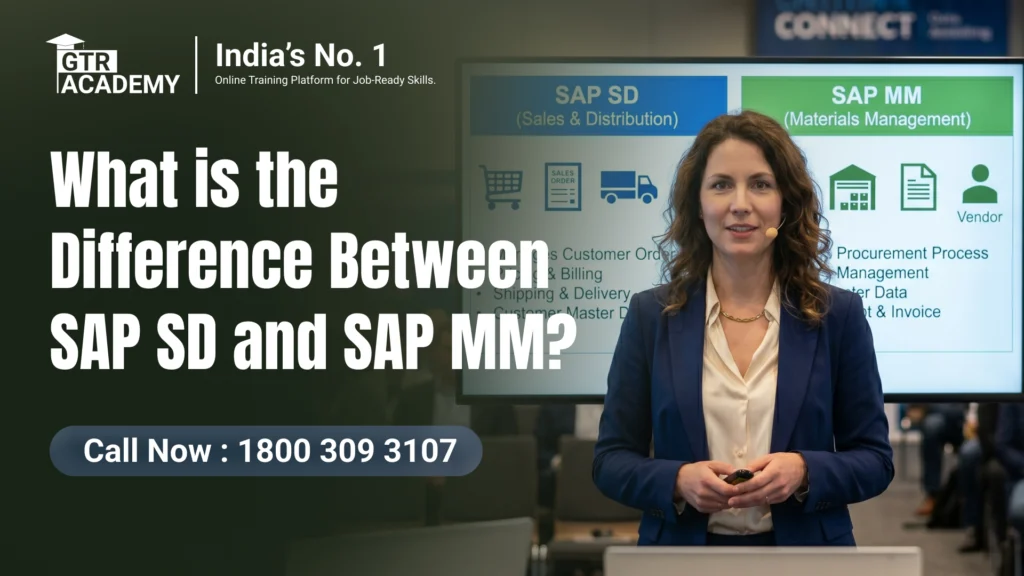
SAP SD stands for Sales and Distribution. This module covers everything related to the customer-facing side of the business:
- Customer inquiries and orders
- Processing sales
- Delivery and shipping
- Billing and Invoicing
- Management of credit and returns
SAP SD in simple words helps companies to sell products smoothly. For example, when a customer places an order online, SAP SD handles the entire sales process from order creation to invoice generation. SAP SD professionals usually manage customer data, pricing strategies, sales reports, and order management. This module is preferred by many students because it is closely related to business development and customer interaction.
What is SAP MM?
SAP MM stands for Material Management. This module is the backbone of the supply chain and deals with:
- Buying and Procurement
- Vendor management
- Stock control and Inventory
- Material Requirement Planning (MRP)
- Invoice Verification
SAP MM helps companies have the right materials at the right time. Suppose you own a manufacturing company that makes laptops. Before the company can start production, it has to buy processors, screens, batteries, and packaging materials. SAP MM helps manage this whole process efficiently.
Supply chain and inventory management jobs are growing rapidly in 2026. This is why many professionals opt for SAP MM Course Online programs to gain global expertise.
Key Differences Between SAP SD and SAP MM
To choose the right path, you must understand how these two functions diverge within an organization.
1. SAP SD: Customer Focused
- Focus: Product sales and customer service.
- Position: Front-end of business operations.
- Main Activities: Sales orders, pricing, shipping, charging customers, and tracking deliveries.
2. SAP MM: Procurement Driven
- Focus: Supply and acquisition of goods.
- Position: Back-end/Internal operations.
- Main Activities: Purchasing, service procurement, inventory management, goods receipt, and material planning.
Real-Life Comparison Table
| Feature | SAP SD (Sales & Distribution) | SAP MM (Material Management) |
| Primary Goal | Selling products to customers | Buying materials from vendors |
| Key Player | Customer | Vendor / Supplier |
| Cycle | Order-to-Cash (O2C) | Procure-to-Pay (P2P) |
| Inventory | Outbound (Shipping goods out) | Inbound (Receiving goods in) |
| Department | Sales and Marketing | Purchasing and Warehouse |
Better Understand with A Real-Life Example
Let’s take a simple example of a shoe company:
- The Procurement Department: They buy leather, rubber, and packaging materials from suppliers. This is managed by SAP MM.
- The Sales Department: Once the shoes are ready, they are sold to customers. Orders are taken, invoices are sent, and deliveries are made. This process is managed by SAP SD.
These two modules work together seamlessly, which is why companies require both SAP SD and SAP MM Professionals to keep the business running.
SAP SD vs SAP MM – Which SAP Module is Best?
The answer is not universal; it depends on your interest and career goals.
Choose SAP SD if you enjoy:
- Customer engagement and relationship management.
- Sales operations and marketing logic.
- Business Communication (BC) and order administration.
Choose SAP MM if you enjoy:
- Inventory control and warehouse management.
- Negotiation and buying processes.
- Supply chain operations and coordination with vendors.
One of the most common mistakes made by beginners is choosing a module just because someone said it was “good.” Instead, think about the environment you want to work in every day.
SAP SD and SAP MM Career Opportunities in 2026
As businesses continue their digital transformation in 2026, the need for SAP professionals is at an all-time high.
SAP SD Career Paths
Typical positions include:
- SAP SD Consultant
- Sales Support Analyst
- SAP Functional Consultant (Sales)
- ERP Sales Coordinator
- SAP End User – SD
SAP SD professionals are in high demand in retail, e-commerce, logistics, and manufacturing. Those who complete SAP SD certification programs usually find opportunities in both Indian and international markets.
SAP MM Career Paths
Typical positions include:
- SAP MM Consultant
- Purchase Analyst
- Inventory Control Manager
- Supply Chain Executive
- SAP Functional Consultant (Procurement)
SAP MM experts are essential in industries such as manufacturing, pharmaceuticals, automotive, and logistics. An SAP MM Certification is a massive boost for those already working in warehouse or procurement operations.
Role of Online Education Systems in 2026
The way people learn SAP has completely changed. In the past, students relied on traditional classroom settings. Today, online platforms offer flexibility, recorded sessions, live projects, and AI-based learning support.
Working professionals can now attend SAP MM training in the evening or join an SAP SD training program from home. This flexibility has made technical education more accessible than ever.
Institutions like GTR Academy are leading this shift by helping learners gain practical exposure through:
- Live Projects: Real-world application of SAP tools.
- Industry Case Studies: Understanding how big brands use SAP.
- Interview Prep: Mock interviews and resume building.
- Certification Guidance: Navigating the path to becoming a certified professional.
Advantages of Learning SAP SD or SAP MM
- Huge Career Growth: SAP skills remain globally relevant as companies upgrade to S/4HANA.
- Higher Salary Opportunities: Certified consultants earn significantly more than regular ERP users.
- Industry Adaptability: Your skills apply to Retail, Healthcare, Manufacturing, Logistics, and E-commerce.
- Opportunities Abroad: Since SAP is used by most Fortune 500 companies, international relocation is a viable goal.
Mistakes Beginners Need to Avoid
- Selecting a Module Without Research: Don’t pick randomly. Align the module with your previous background (e.g., Marketing background -> SD; Supply Chain background -> MM).
- Ignoring Practical Training: Watching theory videos is not enough. You must practice on a live SAP system frequently.
- Focusing Only on Certification: A certificate helps you get the interview, but practical skills help you get the job. This is why many prefer project-based SAP SD Training and hands-on SAP MM classes.
Frequently Asked Questions (FAQs)
1. What is the difference between SAP SD and SAP MM?
SAP SD manages sales and customer processes, while SAP MM manages procurement and inventory processes.
2. SAP SD vs SAP MM – Which is easy?
Both are beginner-friendly. Your interest in either “Sales” or “Logistics” will determine which feels easier to you.
3. Is SAP SD certification worth it in 2026?
Yes, companies are rapidly digitizing, and SAP SD consultants are needed to manage complex global sales cycles.
4. Are SAP MM classes suitable for beginners?
Yes, freshers from commerce, management, or technical backgrounds can easily transition into SAP MM.
5. Which is the best course for SAP SD training?
The best course offers practical projects, live sessions, and industry exposure. GTR Academy is known for its practical approach.
6. Is SAP MM good for supply chain jobs?
Absolutely. It is the gold standard for careers in procurement and inventory management.
7. Can SAP be learned online by working professionals?
Yes, most institutes now offer flexible SAP MM Course Online and SAP SD online training programs.
Connect With Us: WhatsApp
Recommended Blogs:
SAP MM Training: What are the Career Opportunities in 2026
Best SAP SD Training: What are Real-Time Projects in 2026
What are the Main Modules Covered in SAP FICO? Best in 2026
Why Should You Choose Data Science as a Career in 2026?
How GTR Academy Benefits SAP Learners
GTR Academy focuses on industry-oriented SAP Learning. Their programs ensure you aren’t just memorizing menus, but solving business problems:
- Understanding real-world business processes.
- Basics of SAP Implementation (ASAP methodology).
- Hands-on system exploration.
- Live project management.
By 2026, companies will look for SAP professionals who can solve real business problems, making practical institutes more valuable than theoretical coaching centers.