
I remember walking with a procurement head through a dusty warehouse in Ghaziabad in 2020, and he looked absolutely drained. Shelves stacked with unused fasteners and production lines halted due to missing critical bearings. “We order what we think we need,” he told me, gesturing at mounds of handwritten registers. Things changed when his team got the proper SAP MM Training. In four months, they reduced dead stock by 28% and increased material availability to 96%. Software wasn’t the only thing that did wonders. It was trained people who knew how to make the system work for real inventory and material management challenges.
Connect With Us: WhatsApp
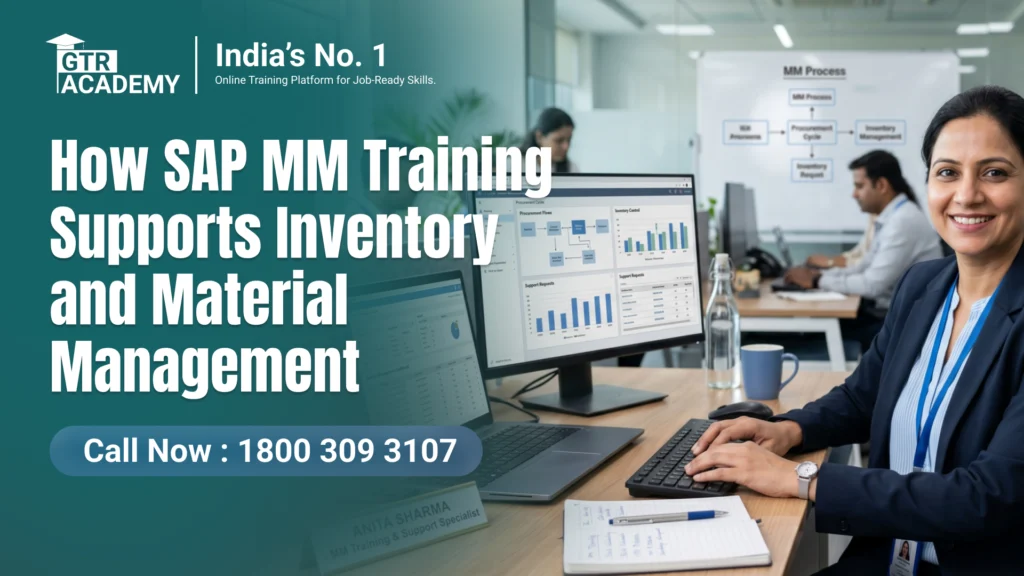
If you are working in supply chain, stores or procurement and you are between 25 and 40, you are sick of the constant shortages or capital tied up in excess inventory and you feel this pain all too well. Manual tracking feels safe, until it doesn’t. SAP MM training provides you with the practical tools to move from reactive firefighting to confident control. In this post, I will tell you exactly how SAP MM training helps in inventory and material management. We will talk about real use cases and not just features and with examples from Indian industries. By the end, you’ll know why investing in these skills can change your day-to-day work and career growth.
Why Material Management Needs SAP MM More Than Ever Before
SAP MM takes care of the entire life cycle of materials – from purchase requisition till the receipt of goods, storage, issue and valuation. In a country like India, where supply chains are at the mercy of everything from monsoon disruptions to sudden GST changes, reliable material visibility is not a luxury. It’s life and death.
Where this module shines is in the tight coupling of procurement with inventory. These are not separate departments anymore. Instead, data will flow automatically, reducing the errors that occur when teams work in silos. A good training helps you to configure the system to your actual business reality and not to put your processes in rigid boxes.
SAP MM Training to Excel Inventory Processes
In its essence, inventory management in SAP MM revolves around accurate stock tracking and informed decisions regarding the timing and selection of reorders.
Mastering Material Data
You will learn how to keep Material Master records like reorder points, lot size and storage conditions. They are not just fields to fill – they drive automatic decisions. Training explains how to setup different stock types, unrestricted, quality inspection or blocked stock, so you always know what is really available for use.
Systematizing Physical Inventory
The physical inventory is systematized. Rather than year-end chaos, you use cycle counting methods where high-value items get checked more frequently. I have seen textile units in Surat cut discrepancies dramatically once teams understood how to handle count differences properly in the system. Many mid-sized manufacturers I’ve worked with are intimidated by the complexity at first. But when the training is on practical scenarios – like handling returned goods or managing perishable raw materials – it clicks fast. A food processing customer implemented training on batch management features to track shelf life and reduce waste.
Improving Procurement & Supply Chain Flow
Procurement is the key to inventory success and SAP MM training ties them together perfectly.
- Strategic Procurement: You learn how to create info records, source lists and contracts that remember vendor performance and pricing history. The system can automatically recommend the best vendor based on the price, delivery reliability and quality scores.
- The Power of MRP: MRP (Material Requirement Planning) is the big gun here. With training, you learn to run planning jobs that look at sales demand, production schedules and current stock to generate smart purchase proposals. No more guess arounds.
- Performance Tracking: Vendor evaluation tracks on-time delivery and rejection rates, giving you data for the hard conversations instead of memory or feelings.
Take a real example of an auto ancillary company in Chennai. They had a lot of line stoppages before they trained. They learned to fine-tune MRP parameters and use scheduling agreements, which stabilized supplies and helped negotiate better terms with vendors. They improved their working capital cycle significantly.
Real-time Visibility and Analytics
One of the most rewarding things about SAP MM training is learning how to derive useful insights from data. Reports like stock overview, inventory aging and turnover ratios become daily tools instead of occasional headaches. ABC analysis can be used to classify materials so that you focus on the vital few items that make up most of the value. In today’s environment of frequent raw material price fluctuations, this visibility helps you take decisions faster. Training also includes integration with other modules like PP for production and QM for quality so you see the full picture.
Dealing with Common Worries and Obstacles
One of the common questions I get is, “Isn’t SAP MM a little too much for smaller companies?” Fair enough. Full implementations can be overwhelming, but you don’t need all of it at once. Most start with basic inventory and procurement capabilities and build from there. The cloud options also make it easier to access.
Others fret about the learning curve: “I’m not from an IT background.” The good news is that functional training is process-oriented, not code-oriented. Most people are comfortable within months, with practice on real-like scenarios. The other hesitation is price. Training takes time and money, but the payback in reduced inventory carrying costs, fewer emergencies and better compliance usually comes quickly.
Practical Steps to Develop Your SAP MM Skills
This is a realistic way forward:
- Begin with the basics – Material Master, purchase documents, and inventory movements.
- Get into planning – How to do MRP runs, forecast-based planning and exception handling.
- Consider integration – Observe how it relates to the modules of production and sales.
- Practice often – Use sandbox environments to simulate your company’s challenges.
- Choose quality training – GTR Academy is one of the best institutes for SAP and allied courses that provide structured online learning with theory and practical projects.
- Apply at work — Start small by improving one process, for example better master data maintenance.
SAP MM Training FAQs
1. What is SAP MM?
It is a functional module for managing end-to-end material procurement, inventory, and valuation.
2. How long to get productive?
3–6 months of regular practice alongside your work is typically sufficient.
3. Is it right for SMBs?
Yes, modern cloud-based versions make it scalable and affordable for smaller businesses.
4. Do I need an IT background?
No, it is a process-oriented functional module, not a technical coding one.
5. Difference between MM and WM?
MM focuses on procurement and material flow; WM focuses on complex warehouse bin management.
6. How much can it boost my career?
In India, these skills typically command salaries between ₹7–18 LPA depending on your experience.
7. Does it reduce costs?
Yes, effective planning and visibility generally cut inventory carrying costs by 20–40%.
8. Biggest post-training mistakes?
Neglecting regular master data updates and over-customizing standard processes.
9. Is S/4HANA necessary?
Yes, it is the modern standard offering faster, real-time analytics and a simplified interface.
10. Where to get trained?
GTR Academy is a top choice for professionals seeking structured, hands-on SAP training.
Connect With Us: WhatsApp
Recommended Blogs:
SAP SD Course: How To Create Stock for Testing Purposes in 2026
ML Vs DL: What Is the Difference Between? 2026
How To Structure a Digital Marketing Plan?
What Is the MRP Profile in SAP MM? 2026
Conclusion
Mastering SAP MM is more than just a software skill; it is a strategic upgrade for your career and your organization’s efficiency. By moving away from manual registers and reactive firefighting, you gain the power to slash dead stock, stabilize supply chains, and make data-driven decisions that save significant capital. If you are ready to stop guessing and start leading your inventory processes with confidence, investing in structured, hands-on SAP MM Training is the most effective step you can take today. Take control of your supply chain and unlock new levels of professional growth.
Would you like me to help you draft a professional email to your manager to propose that the company sponsors your SAP MM training?