


Why Financial Modelling Has Become the Backbone of Private Equity &
PE & VC Roles in 2026 Demand Extreme Financial Clarity
In 2026, the Private Equity (PE) and Venture Capital (VC) sphere is more analytical, competitive, and data-driven than ever before. The times when investment decisions were based mainly on instinct, personal relationships, or market signals of a very high level are long gone. Now deep Financial Modelling acumen, structured thinking, and clear projections are just some of the expectations that investors have before providing capital.
This change has elevated financial modelling to the core of PE & VC job roles. Regardless of whether it is a deal sourcing, deal evaluation, portfolio management, or exit planning step financial modelling is the backbone of each and every one.
Connect With Us: WhatsApp
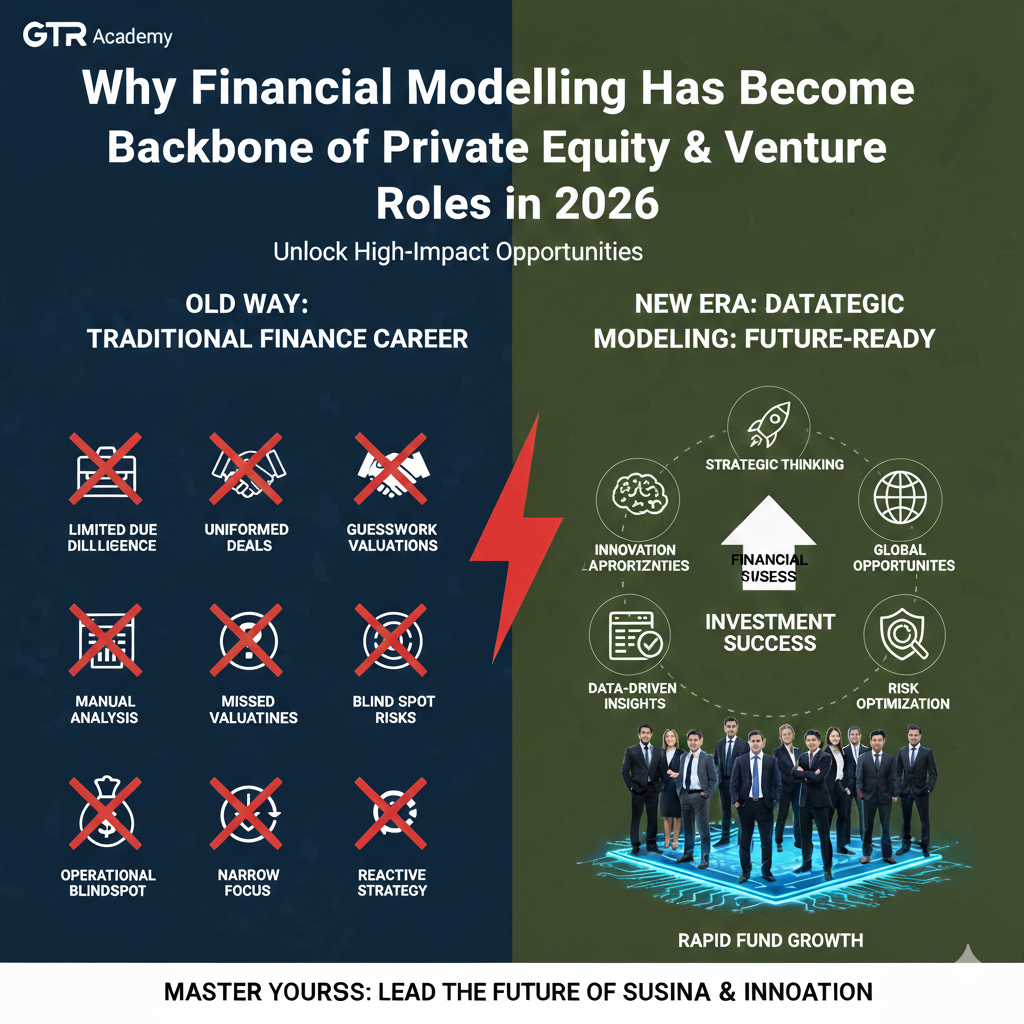
Financial Modelling Helps Evaluate Companies with Precision
PE and VC companies screen a vast number of startups and companies yearly. However, only a very few can reach the stage of receiving investments. Financial modelling allows analysts and associates to objectively decide the right recipient of investor money.
Models become a tool to answer the questions such as:
Is the company financially robust?
How much profit can it make in the future?
What kind of capital is it going to need?
What kind of return can investors expect?
Which risks can significantly harm the value?
By 2026 there will be no PE & VC professional who doesn’t have the ability and expertise to create and analyze models themselves.
Difficult to Understand Unit Economics & Growth Scalability
The business models of startups and PE-backed companies on the one hand are designed to scale fast with growth but on the other, rapid growth does not necessarily mean profitability. Financial modelling gives a better understanding of unit economics which is the fundamental aspect of scalable growth.
PE & VC investors in 2026 will utilize models to dissect such components as:
customer acquisition cost (CAC)
customer lifetime value (LTV)
contribution margins
payback period
churn trends
cost efficiency
Without models, these indicators are only at the surface level; after modeling, they become the basis of investment decisions.
Supports Accurate Deal Valuation
Valuation is the core factor in PE & VC investing. If a company is overvalued, you will lose money. If underpriced, you will lose the opportunity to make the deal.
Financial modelling aids in valuation via:
discounted cash flow (DCF)
comparables (comps)
precedent transactions
scenario-based valuation
exit multiple analysis
By 2026, a PE & VC analyst must back up the valuation with solid quantitative evidence, not just narratives.
Assists PE & VC Firms with Return Forecasting
Generating returns is at the core of investing. Financial modelling lets investors test different scenarios:
Best-case scenario growth
Worst-case scenario downturns
Market expansion opportunities
Hiring and cost impact
Funding needed at each stage
In 2026, not knowing how to model returns (IRR, MoIC, cash-on-cash) will be a major disadvantage for any PE or VC professional.
Necessary for Portfolio Monitoring & Performance Tracking
Investment work doesn’t come to an end after money is put in. The PE & VC teams every month, quarter, and year keep an eye on the portfolio companies.
Financial models can help to watch over such areas as:
revenue performance
cash burn
budget vs actuals
growth KPIs
profit timelines
risk areas
A well-thought-out modelling framework enables the early discovery of any performance issues.
Let’s LPs Know More
LPs need thorough understanding before committing funds. Financial modelling provides PE and VC teams with the means to:
Present financial projections
Communicate expected returns
Justify assumptions
Explain investment risks
Show exit potential
In 2026, firms that numerically cannot substantiate their investment decisions will find it difficult to raise funds.
Conclusion: Financial Modelling Is the Golden Ticket to 2026 PE & VC Careers
PE & VC roles are among the most coveted in the financial sector. Financial Modelling is not an extra feature anymore; it is the basic requirement.
Those who are proficient in modelling can:
Assess investments
Predict returns
Help in fundraising
Enhance the performance of the portfolio
Speed up their career trajectories compared to others
Financial modelling is the single most indispensable skill for entering or growing in Private Equity and Venture Capital in 2026.
GTR Academy
Ambition you may have. Direction we shall give.