
The day your life changed is closer than you think. Imagine you are a working professional trapped in a mundane job, sifting through reports that feel meaningless. Then, you complete a comprehensive Data Science Course and suddenly, you are the one turning raw numbers into high-level strategies that save companies millions or personalize the customer experience for millions of users. This transformation is the reality for many who have invested in building robust data science skills. As AI reshapes every industry by 2026, a solid foundation in data science is not just useful it is a launchpad to an exciting, future-proof career.
Connect With Us: WhatsApp
What is a Data Science Course?
A Data Science Course teaches you to use programming, statistics, machine learning, and visualization tools to extract meaningful insights from massive datasets. It covers the entire data lifecycle: collection, cleansing, analysis, modeling, and deployment. Core subjects typically include programming with Python or R, SQL for database management, statistical analysis, and machine learning algorithms. Modern curricula also integrate big data technologies like Hadoop or Spark, cloud platforms, Generative AI, ethical AI practices, and MLOps.
Why Data Science Skills Are Vital in 2026
Companies generate vast amounts of data daily. Organizations that effectively leverage this data gain a significant competitive edge in personalization, efficiency, risk management, and innovation. The U.S. Bureau of Labor Statistics estimates that employment for data scientists will grow by 34% through 2034, far outpacing the average. While AI automation handles routine tasks, demand hasn’t vanished—it has shifted toward high-value work, including building production systems, interpreting complex models, and driving business strategy.
Who Should Pursue a Data Science Course?
This domain is ideal for those who enjoy problem-solving, identifying patterns, and making sense of complexity. You are a perfect candidate if you fall into these categories:
- Students & Freshers: Looking for high-growth tech roles.
- Professionals: Working in SAP, marketing, finance, or operations seeking to upskill.
- Career Changers: Seeking higher pay, better advancement, and job security.
- Domain Specialists: SAP aspirants wanting to add analytics to their repertoire or digital marketers aiming to run data-driven campaigns.
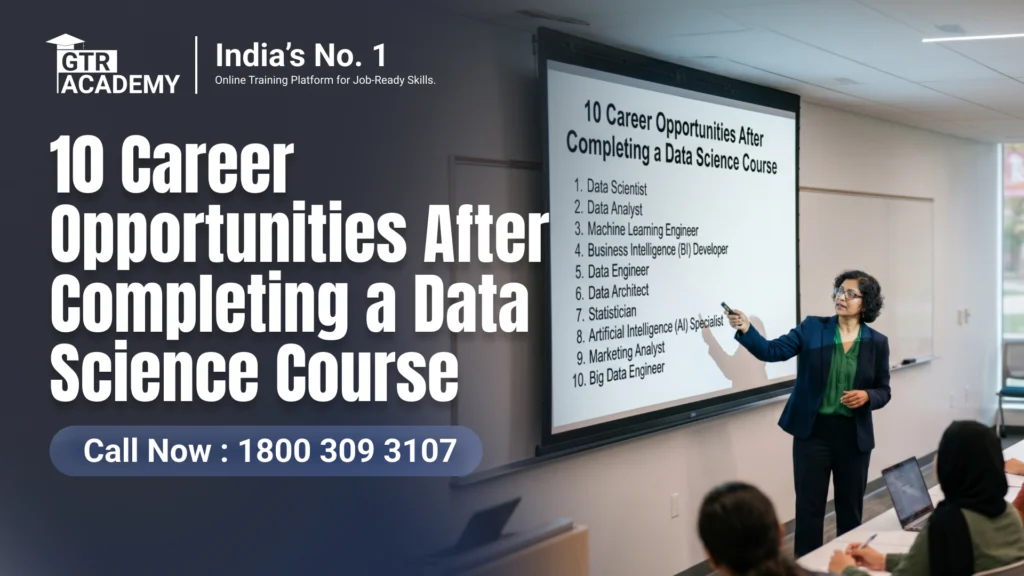
10 Best Career Options After Data Science Training
With the right training, you can step into these in-demand roles:
- Data Scientist: Develop predictive models and provide actionable business insights.
- Machine Learning Engineer: Design, train, and deploy scalable ML models into production.
- Data Analyst: Specialize in reporting, visualization, and business intelligence using tools like Tableau or Power BI.
- Data Engineer: Build the scalable pipelines and infrastructure essential for reliable big data management.
- Generative AI Engineer / AI Expert: Research and implement large language models (LLMs), RAG systems, and responsible AI.
- Business Intelligence (BI) Analyst: Transform complex data into clear insights for leadership.
- Consultant (Analytics): Advise clients across industries on their data strategy.
- MLOps Engineer: Focus on the deployment and lifecycle management of ML models in production.
- Quantitative Analyst (Quant): Apply data science to risk modeling and algorithmic trading in finance.
- Data Product Manager: Leverage technical expertise to lead the strategy and development of data-driven products.
Salary Insights (India-centric, 2026)
Data science remains a high-paying field. In metros like Bangalore and Gurgaon, salaries are typically 10–15% higher.
- Freshers/Entry Level: ₹5–12 LPA
- 2–5 Years Experience: ₹12–25 LPA
- Senior (5+ Years): ₹25–50+ LPA (especially for those with deep AI expertise)
Essential Skills for Success
To excel, you must master a specific technical stack:
- Programming: Python (the industry standard), SQL, and R.
- Math & Stats: Hypothesis testing, linear algebra, and probability.
- Machine Learning: Supervised/unsupervised learning and deep learning basics.
- Data Handling: Pandas, NumPy, and Spark.
- Visualization: Tableau, Power BI, and Matplotlib.
- Soft Skills: Business acumen, communication, and data storytelling.
Expert Insight: The biggest mistake beginners make is focusing solely on algorithms while neglecting data engineering and business context. In reality, data preparation often accounts for 80% of the job.
Real-World Applications Across Industries
- Health Care: Disease outbreak prediction and individualized treatments.
- Retail/E-commerce: Demand prediction and recommendation engines.
- Financial Services: Credit risk assessment and fraud detection.
- Manufacturing: Reducing downtime through predictive maintenance.
- Marketing: Creating precise customer segments and optimized campaigns.
Future Trends and Challenges
While the industry faces challenges like data privacy (GDPR, DPDP), model bias, and senior-level talent shortages, the future is bright. Key trends include increased Generative AI embeddings, a focus on Explainable and Responsible AI, real-time analytics, and multimodal (image/video/text) models.
How to Get Started
- Enroll: Join a structured Data Science and AI course that offers real-time projects.
- Practice: Use platforms like Kaggle to sharpen your skills.
- Portfolio: Build 3–5 high-quality projects.
- Contribute: Engage in freelance work or open-source projects.
- Network: Connect on LinkedIn and prepare thoroughly for technical interviews (SQL, case studies, ML concepts).
Combining data science with existing domain knowledge such as SAP SD, MM, or FICO, or Digital Marketing creates a powerful hybrid profile that is highly attractive to employers.
Connect With Us: WhatsApp
Recommended Blogs:
How the SAP FICO Module Supports Financial Planning and Analysis 2026
Digital Marketing Training: What Skills Are Taught in Modern Courses
How SAP SD Training Supports End-to-End Sales Operations 2026
Training Supports Inventory and Material Management 2026
Why Choose GTR Academy?
GTR Academy aligns its curriculum with the realities of 2026. Our trainers offer real project experience, guiding you through live scenarios rather than just theory. Through our Data Science Course, you will build end-to-end solutions and receive dedicated interview preparation and placement support. With flexible learning modes—online, live classes, and self-paced learning we empower students and professionals to successfully transition into the data-driven future.
The data revolution is here. It starts with your decision today.