
Python is one of the most practical programming languages for careers in modern technology due to its ease of learning, flexibility, and its massive ecosystem of libraries. If you’re a learner interested in analytics, machine learning, automation or software development, Python for Data Science is a great place to start building job-relevant technical skills.
Connect With Us: WhatsApp
What Is Python for Data Science?
Python for data science is the use of the Python programming language, data analysis libraries, statistics, and machine learning techniques to collect, clean, analyze, visualize and interpret data.
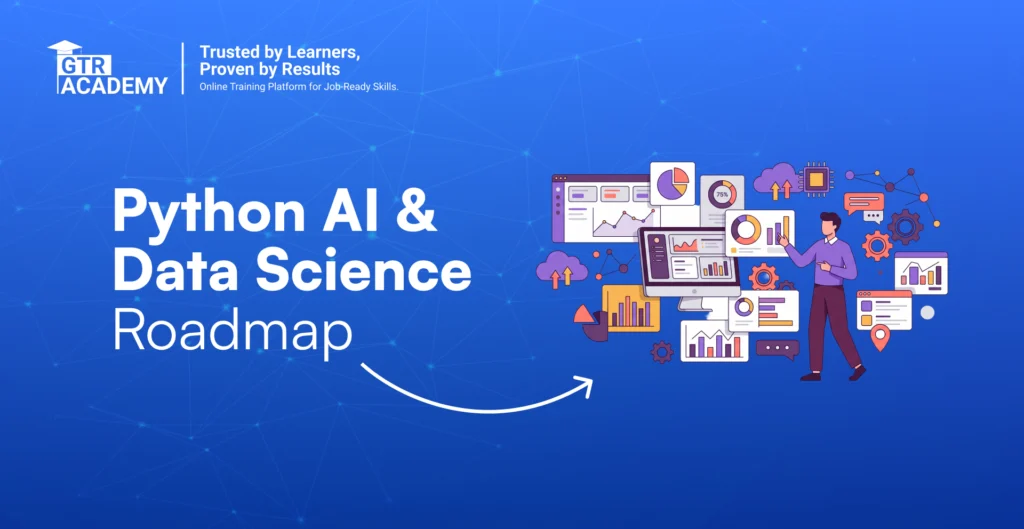
The usual learning path would be to learn the basics of python first and then move toward the standard libraries like Numpy, Pandas, Matplotlib and Seaborn. Then the learners get to explore SQL, statistics, machine learning and finally areas like deep learning and AI.
What Skills Should You Learn?
A practical road map usually contains:
- Python basics: variables, data types, loops, functions, OOP, error handling
- Data Processing: Numpy, Data Cleaning, Pandas, Transformation, Exploratory Data Analysis
- Visualization: Matplotlib, Seaborn and Dashboard Ideas
- Statistics: distribution, probability, correlation, hypothesis testing
- Machine Learning: Regression, Classification, Clustering, Model Evaluation, Feature Engineering
- Deep learning and neural networks: TensorFlow, PyTorch
- Database Skills: SQL, entry-level database
- Development Tools – APIs, Git, Jupyter Notebook, Developer environments
This combination enables the learner to go beyond writing python code to knowing how real data driven applications are built.
How Does Practical Learning Build Job-Ready Skills?
The best use of theory is to apply it to real business problems and data sets. Try out some projects, like sales analysis, customer segmentation, price prediction, recommendation systems, or sentiment analysis.
Progressive Projects a Good Data Science Course should include progressive projects. Begin with cleaning and visualization and advance to predictive models and AI applications. You can also put these projects on GitHub. This can be useful to demonstrate practical ability in interviews.
Who Should Learn Python for Data Science?
Python is the most popular language for students, graduates, working professionals, developers, analysts and career changers. You don’t need to be a programming whiz, but a bit of math and logic can go a long way to understanding statistics and machine learning.
For those who want to pursue a path in machine learning, deep learning and generative ai, Python is a stepping stone for ai online Course training.
How Can You Choose the Right Training?
Choose training with an industry-driven curriculum, expert instruction and lots of hands-on practice. Some useful features are:
- Real world data sets and projects
- Live / On demand learning
- Basics of machine learning and artificial intelligence
- Interview
- Career Counseling
- Related certifications
- 100% Placements Placement Assistance
Don’t choose a program based on certificates they offer or how many hours of courses they provide. Real capacity building is more about the quality of the projects, mentoring, practice and feedback.
If you want structured practical learning, expert trainers, projects, interview preparation, career guidance and 100% Placement Assistance check GTR Academy.
What Are Common Beginner Mistakes?
Many beginners want to learn all the python libraries at once. Learn the basics of Python first. Then Numpy. Then the panda. “Then visualization, statistics, machine learning, AI. This is the way.
Another common mistake is watching tutorials without actually creating anything. Practice is the secret. The more you code and work on real world problems, the more confidence you build up.
Career Roadmap After Learning Python
Statistics Machine Learning AI / Deep Learning Python Data Analysis Projects Portfolio Interview Preparation
It is a good platform to start off from. Depending on your interest and experience, you can be a Data Analyst, Junior Data Scientist, Machine Learning Engineer, Python Developer or anything else AI related.
Frequently Asked Questions
1. What is Python for Data Science?
Data Science Python Data Science Data Science with Python Introduction to Data Science in Python In Python for Data Science, we will Learn Data Analysis, Visualization, Standard ML Models and solving real world problems using Python and its libraries.
2. Is Python difficult for Data Science beginners?
Python is very easy to start for beginners . Begin with the fundamentals: syntax, functions, data structures, then move on to data analysis and machine learning.
3. Which libraries should I learn first?
First off, Numpy and Pandas. Then Matplotlib or Seaborn. Then machine learning libraries like Scikit-learn.
4. Is Python useful for AI and machine learning?
Yes, there are many libraries and frameworks in python that can be used for performing machine learning, deep learning, data processing and AI application development.
5. Can I learn Python through a data science and AI online course?
“Yeah. A structured online course in data science and AI can combine Python + stats + ML + AI concepts + projects + career prep.
Connect With Us: WhatsApp
Recommended Blogs:
What Is Included in an SAP MM Course Syllabus? 2026
Data Science Project: What Are the Different Stages? 2026
Conclusion
Learn Python for Data Science in the best possible way by learning Programming Fundamentals, Data Analysis, Statistics, Machine Learning, AI and Real world Projects. Don’t just take a course because you have to. Seek out training that provides hands-on experience, expert mentoring, portfolio projects, interview prep, and career support.