

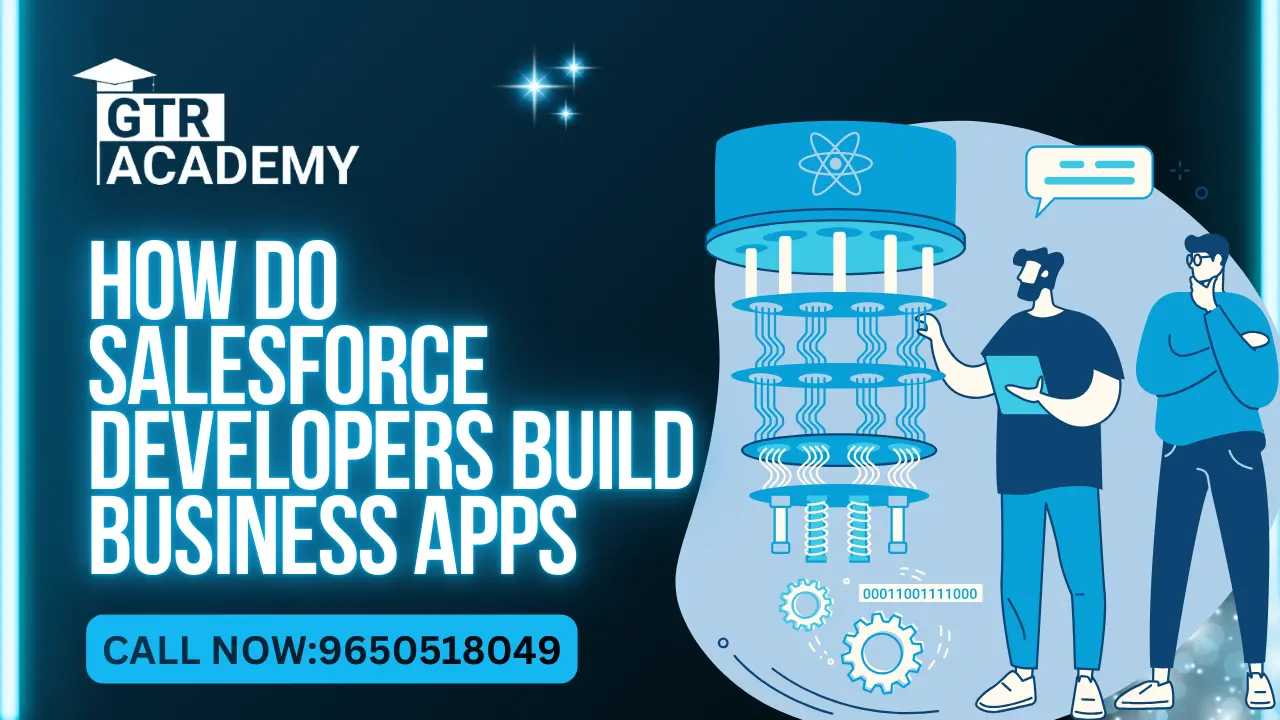
How Do Salesforce Developers Build Business Apps? Best for 2025
Ever wondered how companies build powerful apps without starting from scratch? Or how businesses streamline customer relationships, automate sales, and improve service delivery using smart digital tools?
How Do Salesforce Developers Build Business Apps.
Salesforce developers are the engineers of digital business solutions. They don’t just write code they build intelligent apps that help businesses sell better, grow faster, and operate smarter.
If you are curious about how Salesforce Developers build business apps (and maybe even planning to become one), you’re in the right place!
Let’s make it simple, conversational, and practical just like a real guide for real learners.
Connect With Us: WhatsApp
What Does a Salesforce Developer Actually Do?
Imagine a company struggling to track its leads manually in Excel, wasting time and losing potential customers.
A Salesforce Developer steps in and builds a customized app that helps them:
Manage leads
Automate follow-ups
Track performance
all in one place.
That’s the power of Salesforce development: solving real business problems through smart, customized apps.
Tools Salesforce Developers Use to Build Apps
To understand how they do it, let’s look at the key tools and platforms:
Salesforce Developer Console – Built-in code editor for writing Apex, debugging, and testing
Salesforce Lightning App Builder – Drag-and-drop tool to create apps visually
Apex – Salesforce’s backend programming language (similar to Java)
Visualforce – Used to create custom UI pages
Lightning Web Components (LWC) – Modern, fast, flexible UI components
Trailhead – Salesforce’s free learning platform for hands-on practice
Step 1: Creating a Developer Org (Your Playground)
To start building apps, developers sign up on developer.salesforce.com login and create a developer org — a free Salesforce environment for testing, experimenting, and building apps.
It’s like having your own mini-business setup where you can explore ideas without affecting real systems.
Step 2: Understanding App Requirements
Before writing any code, Salesforce developers talk to stakeholders to understand the business needs.
For example:
A hospital needs an app to manage patient history
A travel agency needs a booking management system
A retail company wants to track inventory and customer orders
Developers ask the why, what, and how before they begin building.
Step 3: Building Using Clicks (No-Code / Low-Code Approach)
Salesforce development is not always about deep coding. Developers can build apps using point-and-click tools like:
Object Manager – Create data tables (Leads, Customers, Orders)
Lightning App Builder – Design user-friendly screens with drag-and-drop components
Process Builder & Flow – Automate tasks like email alerts, approvals, and notifications
This makes Salesforce a powerful platform for developers and non-coders alike.
Step 4: Adding Custom Logic Using Apex & LWC
When business needs get more advanced, developers use Apex and LWC.
Apex (backend logic) helps with tasks like:
Auto-assigning leads to sales reps
Triggering events when data changes
Connecting Salesforce with external systems like WhatsApp or Gmail
Lightning Web Components (LWC) create:
Modern, responsive, lightning-fast user interfaces
Custom dashboards, forms, calculators, and more
Step 5: Integrations Connecting Salesforce with Other Systems
Businesses use multiple tools WhatsApp, Gmail, ERPs, websites, payment gateways.
Salesforce developers use APIs and integrations to connect these platforms with Salesforce.
This makes apps more powerful, automated, and data rich.
Step 6: Testing and Deployment
Before launching an app or feature, developers test it thoroughly:
Debugging using Developer Console
Creating Test Classes in Apex
Fixing errors and improving performance
Once everything works smoothly, they deploy it to production using Change Sets or modern DevOps tools.
Step 7: Training Users and Updating the App
After deployment, developers train end-users (sales reps, support agents, etc.) to use the new app features.
And the work doesn’t stop their apps need:
Updates
Improvements
New features
Fixes
Salesforce Developers constantly enhance systems as businesses grow.
Want to Learn Salesforce Development Easily?
If you’re thinking about becoming a Salesforce Developer, structured learning can make a huge difference.
That’s where GTR Academy comes in known for its professional online courses in SAP, Salesforce, Data Science, and IT tools.
With:
Live classes
Hands-on training
Industry projects
Job assistance
GTR Academy helps you learn Salesforce the right way faster and smarter.
Top 10 FAQs How Do Salesforce Developers Build Business Apps?
1. What is a Salesforce Developer?
A professional who builds, customizes, and automates business apps using tools like Apex, LWC, and Lightning App Builder.
2. How do I create a Salesforce developer account?
Go to Salesforce Developer signup, create a developer org, and start practicing.
3. What skills do Salesforce developers need?
Apex, LWC, JavaScript, Admin basics, data modeling, and problem-solving.
4. Can I build apps without coding?
Yes! Lightning App Builder, Flows, and Process Builder let you build apps without code.
5. What tools are used to build Salesforce apps?
Developer Console, Lightning App Builder, Apex, APIs, LWC, Visualforce.
6. Is Salesforce development easy for beginners?
Yes, it’s beginner-friendly with Trailhead and no-code tools.
7. How do developers build automation?
Using Flows, Process Builder, Apex Triggers.
8. What is Salesforce Developer Console?
A built-in tool for coding, debugging, and testing Apex and Lightning components.
9. Can Salesforce apps integrate with other platforms?
Yes, using APIs, web services, and third-party integrations.
10. Is Salesforce a good career in 2025 and beyond?
Absolutely high demand, high salaries, and future-proof growth.
Connect With Us: WhatsApp
Final Thoughts
Salesforce developers don’t just build apps they create powerful business solutions that drive growth, efficiency, and better customer experiences.
Whether it’s a startup or a Fortune 500 company, Salesforce developers are the hidden problem-solvers behind digital transformation.
If you enjoy building things, solving business problems, and using technology to make life easier Salesforce Development might be your perfect career path.
Ready to build your first app?
Just sign up for a developer org, explore Trailhead, or take the smarter route train with experts at GTR Academy and turn your passion into a professional career.

I am a skilled content writer with 5 years of experience creating compelling, audience-focused content across digital platforms. My work blends creativity with strategic communication, helping brands build their voice and connect meaningfully with their readers. I specialize in writing SEO-friendly blogs, website copy, social media content, and long-form articles that are clear, engaging, and optimized for results.
Over the years, I’ve collaborated with diverse industries including technology, lifestyle, finance, education, and e-commerce adapting my writing style to meet each brand’s unique tone and goals. With strong research abilities, attention to detail, and a passion for storytelling, I consistently deliver high-quality content that informs, inspires, and drives engagement.