


Supervised vs Unsupervised vs Self Supervised Learning Best for 2025
Most machine learning techniques can be categorized into three major groups: Supervised vs Unsupervised, and self-supervised learning. Understanding their differences enables you to select the most suitable method for your data and business challenges.
Supervised learning: learn from labelled examples
Supervised learning means that for each piece of training data, there is an input and a known output (label), and the model learns to connect input with the output. Common examples of this are classification (spam vs non spam, churn vs non churn) and regression (predicting prices, amounts, or scores).
Real world examples:
Certainly, those examples would be:
- Credit risk scoring could be done by using past loans data that have been labelled as “defaulted” or “paid back”.
- Churn prediction based on customers labelled as “churned” or “retained”.
- Demand forecasting making use of historical sales as numeric targets.
You apply supervised learning when you have the results of the past and want to come up with similar results for the future cases.
Unsupervised learning: find structure in unlabeled data
Unsupervised learning does not use label targets. Its objective is to extract detailed features, clusters, or lower-dimensional representations from unprocessed data. Some of the main tasks are clustering, anomaly detection, and dimensionality reduction.
Real world examples:
- Customer segmentation based on behavior even without the existence of explicit “segment” labels.
- Organizing support tickets by topics in order to discover themes.
- Uncovering abnormal transactions that are very different from “normal” behavior.
The technique of unsupervised learning is advantageous when it comes to exploration, generation of features, and embracing the existing structure prior to constructing predictive models.
Connect With Us: WhatsApp
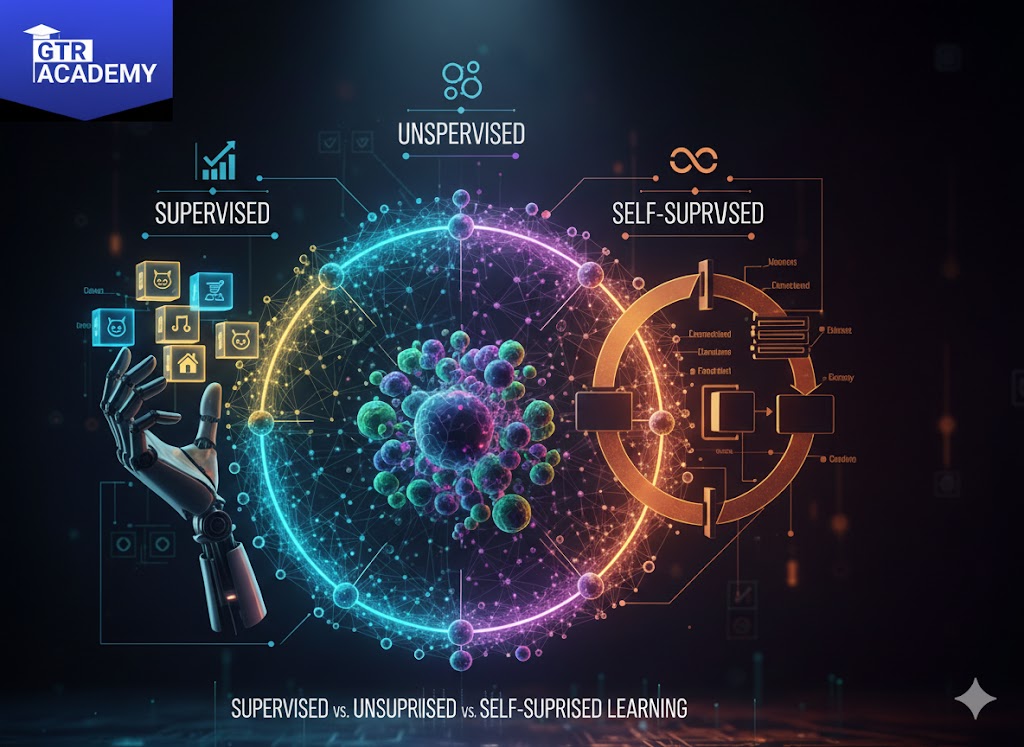
Self-supervised learning: labels from the data itself
Self-supervised learning is a hybrid of supervised and unsupervised learning. It doesn’t rely on human labels, but the model generates its own “pretext” tasks from the raw data and learns the features by predicting one part of the data from another.
Examples:
- In Natural Language Processing, predicting the next word or the masked words in a sentence (this is how large language models are pre-trained)
- In computer vision, filling the missing image part or identifying the correct orientation
- In time series, as a pretraining task, predicting the future segments from the past ones
Once self-supervised pretraining is done, the representations that have been learnt are further trained (fine-tuned) using a smaller amount of labelled data for the tasks that are downstream such as classification or retrieval. This is the way many of the state-of-the-art models achieve high performance even when the amount of labelled data is limited.
Connect With Us: WhatsApp
Choosing which paradigm to use: A simple decision guide
- If you possess labelled outcomes that are in line with a clearly defined business KPI → supervised learning would be your starting point.
- In case you have a vast amount of data but lack labels → then you should resort to unsupervised learning for exploring structure and generating features or opt for self-supervised learning if you have representation learning resources available.
- When labels are very limited but raw data is plentiful (text, images, logs) → the options to think about would be self-supervised or using pre-trained models followed by fine.