


Data Science for Revenue Teams: Pricing, Discounting, and Revenue Optimization 2026?
Revenue teams live or die by decisions on prices. Data science shifts pricing from gut feel to data backed experiments, elasticity models, and dynamic optimization unlocking 5–20% uplift without more sales headcount.
Connect With Us: WhatsApp
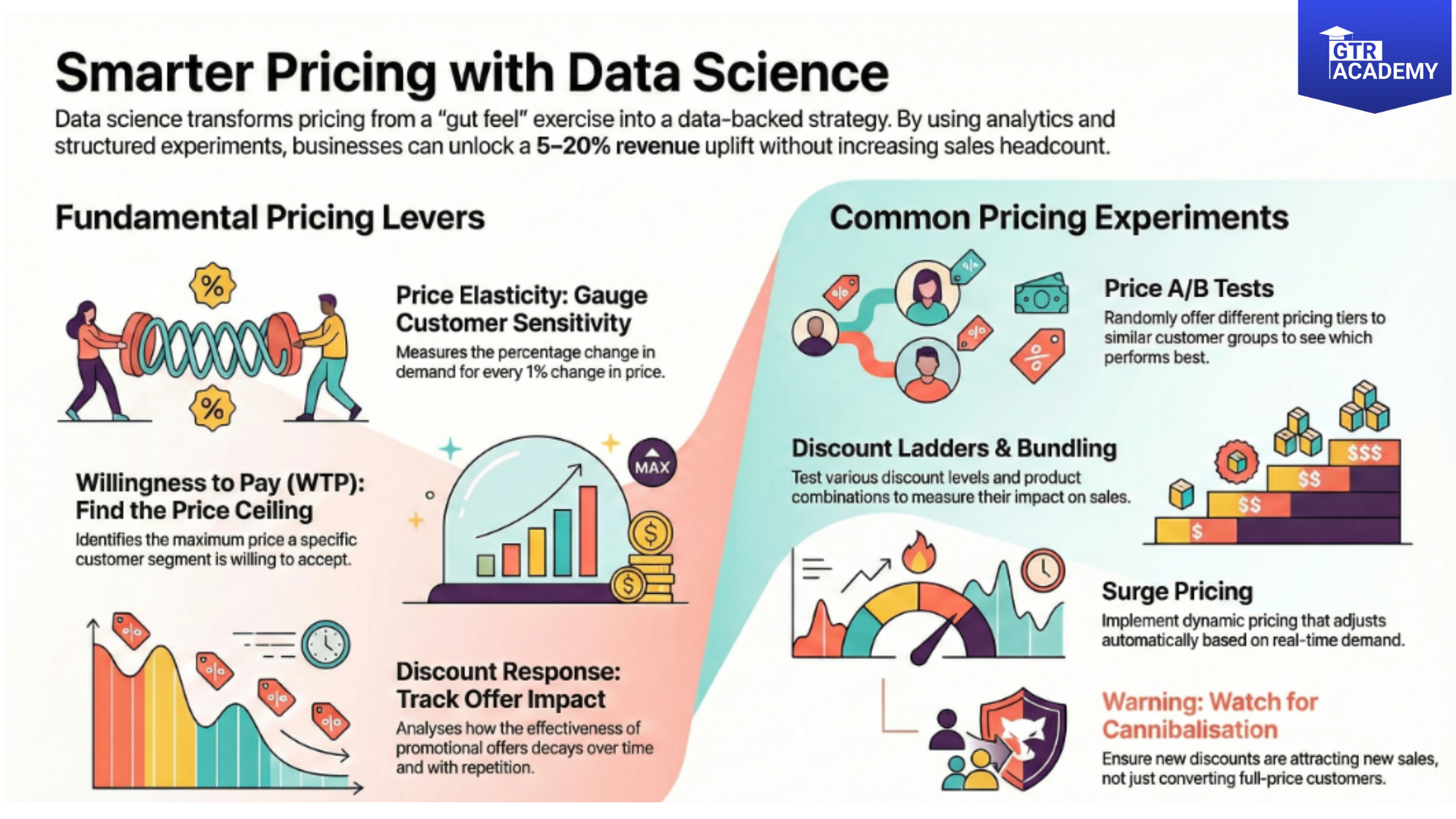
Pricing analytics fundamentals include the below key levers
- Price elasticity: % change in demand per % price change.
- Elasticity = (%Δ Quantity) / (%Δ Price)
- >1 = elastic (sensitive), <1 = inelastic
- Willingness to pay (WTP): Max price segment will accept (conjoint analysis, surveys).
- Discount response: How offers decay over time/repetition.
Experimentation patterns
- Price A/B tests: Randomize pricing tiers across similar cohorts.
2. Discount ladders: Test $0 → $10 → $25 off impact on conversion/LTV.
3. Bundling: Feature + price combinations (core + premium vs standalone).
4. Surges: Dynamic pricing by demand (Uber, AWS Spot).
Gotcha: Account for cannibalization (did discounts just steal from full‑price?).
Revenue modelling
Customer Lifetime Value (LTV):
- LTV = Σ [Revenue × Retention × Marginata] / CAC
- Slice by cohort, segment, acquisition channel. DS forecasts LTV curves to compare pricing strategies.
- Optimal pricing: Maximize LTV – CAC across segments.
Connect With Us: WhatsApp
Practical workflows
Reops + DS partnership:
- Weekly pricing experiments from sales/marketing hypotheses.
- Automated LTV dashboards by tier/channel.
- ML uplift models: “incremental revenue from discount X on customer Y.”
Example insight: “Enterprise segment: 12% price increase → 2% churn lift, +$2M ARR.”
Try this: Calculate elasticity from past price tests. Elastic segments? Test discounts. Inelastic? Test increases.