


NLP in 2025: From Classification to Retrieval-Augmented Generation

Natural​‍​‌‍​‍‌​‍​‌‍​‍‌ language processing (NLP) has matured from mere text classification tasks to systems having the capabilities of searching, reasoning, and generating high-quality content that is even backed by your own data. One of the most significant trends in 2025 is retrieval-augmented generation (RAG) which merges search and large language models to create applications that are not only more accurate but also more reliable. Traditional NLP was limited to performing simple activities such as sentiment analysis, topic modeling, and intent classification using bag-of-words, TF–IDF, and standard ML models. Such systems might have been good at performing very specific tasks, but they also demanded a lot of feature engineering and had problems processing nuances and long contexts. Through learning deep representations from vast text corpora, large language models (LLMs) have become capable of performing various (summarization, Q&A, translation, classification) with very little task-specific training. Still, “pure” LLMs carry two major problems: they can invent and do not have access to your private or latest data. RAG resolves these problems by employing the following two parts:
  • Retrieval: A step in the search process that obtains the most suitable documents, fragments, or records out of your knowledge base (let’s say PDFs, wiki pages, tickets, product docs) given a query.
  • Generation: An LLM which goes through the retrieved snatches of text and then forms the answer based on them.T he model is not answering only on the basis of its training data but rather, it is answering ”based upon” the retrieved context, which is under your control and you can keep it updated. Consequently, hallucinations are considerably lowered and answers get more verifiable.
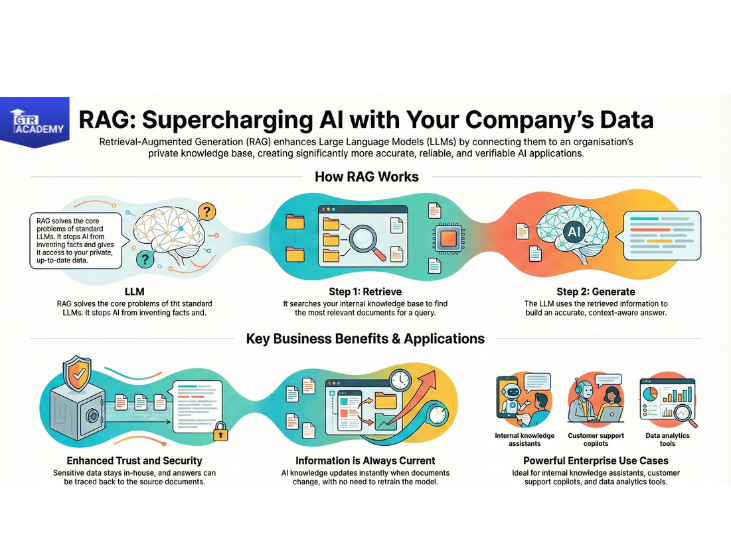
Companies are on the verge of building internal chatbots, copilots, and assistants that are able to safely fetch information from proprietary documents, past tickets, CRM notes, and structured data. RAG has turned into a major pattern for such “enterprise AI” situations as it: Ensures the safety of sensitive data by keeping it within your environment while still making use of powerful LLMs. Permits immediate changes: when documents are updated, retrieval results are also changed without the need for the model to be retrained. Enables the use of citations and traceability which is very important for compliance and trust. With the advancement of vector databases and embeddings, it is now quite simple to index and search through a large amount of text that is not structured, thus, making RAG pipelines increasingly feasible. The below example can illustrate the usage of RAG: Enterprise knowledge assistant Employees are inquiring “What is our refund policy for product X in region Y?” The platform fetches pertinent pages from internal policy documents and knowledge bases and produces a brief response with references. Customer support copilot Support agents input the customer’s question; the assistant locates similar past tickets, product guides, and FAQs, and then generates a response based on those sources. Agents check and modify, thus, saving time and enhancing customer interaction quality. Analytics and BI assistant Users inquire “Why did revenue dip last quarter?” The platform pulls recent BI reports, commentary, and incident logs, and then generates a narrative answer supported by the links to the underlying dashboards. With these situations, it becomes quite obvious that the point is not merely “talking with an LLM,” but rather linking it with real organizational data. Tell the necessity of the innovations in NLP and RAG to your readers by noting that they are not solely a modelling issue but rather a data and system problem: Data teams are in charge of creating effective retrieval pipelines, index structures, and metadata strategies.ML teams have to find the right balance between model choice, context window size, and latency vs cost. Governance teams, on the other hand, need to determine the access permissions and the way the outputs are logged and ​‍​‌‍​‍‌​‍​‌‍​‍‌audited.
3

Leave a Reply

Your email address will not be published. Required fields are marked *


                              UPCOMING BATCHES