


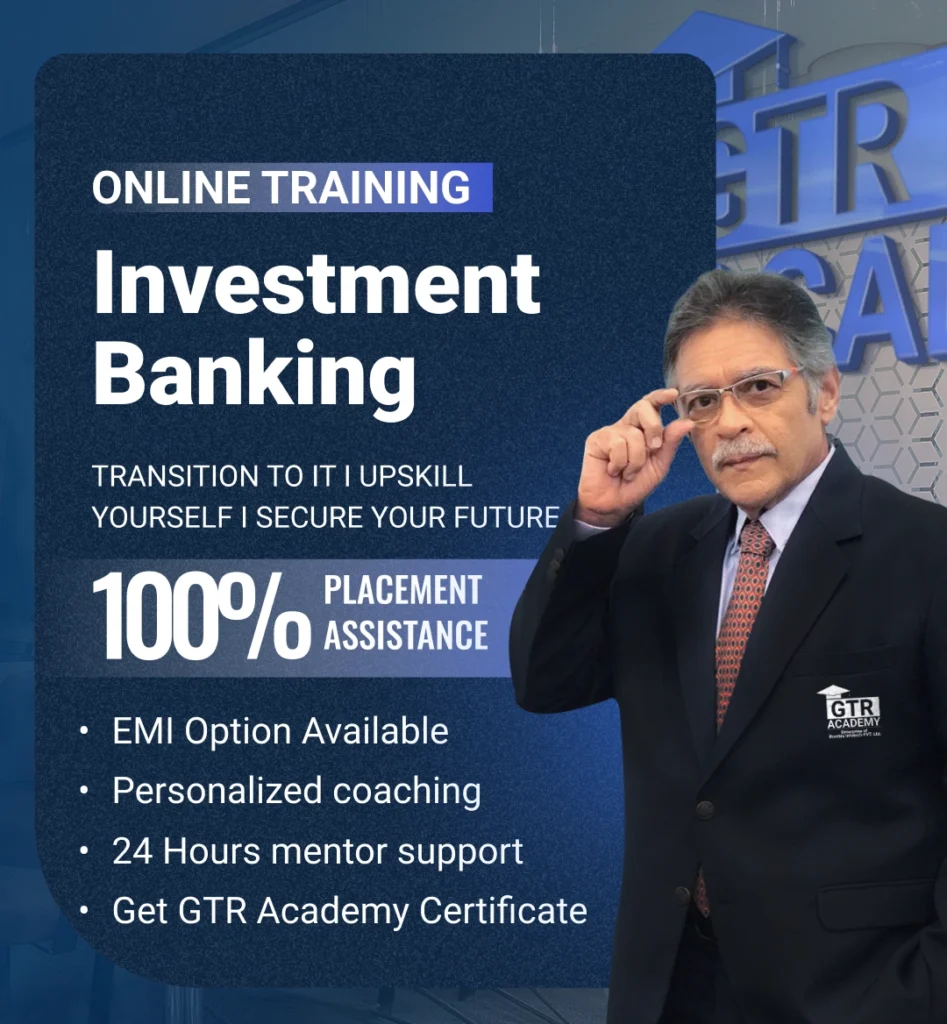







Investment Banking Online Course

190,000+ strong network: Global expertise, practical skills, & ethical leadership.

Get A Call Back


    Where Our Students Work

    Investment Banking

    About The Course

    GTR Academy’s Investment Banking Course is designed for beginners and working professionals to develop strong, job-ready investment banking skills. The program focuses on core investment banking concepts, financial analysis, deal structuring, and real-world case studies used in mergers & acquisitions, capital markets, and corporate finance roles.

    You will gain hands-on experience in company valuation, financial modelling, pitch book preparation, deal structuring, transaction analysis, and Excel-based applications.

    With expert guidance, real-time projects, and placement-focused training, learners receive a Certificate of Completion from GTR Academy, enhancing career opportunities and professional credibility in the investment banking sector.

    GTR Academy Training & Development

    (Enterprise of ROOTBIX INFOTECH Pvt. Ltd.)

    World-Class Employee Training Solutions
    SAP ABAP Online Course
    Salesforce Admin & Developer Certification
    SAP ABAP Online Course
    SAP ABAP Online Course
    SAP ABAP Online Course
    SAP ABAP Online Course

    Pave Your Road to Investment Banking Course.

    Program
    Highlights

    SAP UI5 Fiori SAP Data Migration Python

    Career in Investment Banking

    SAP DATA SCIENCE AI

    In-Depth Learning

    SAP DATA SCIENCE AI

    Skill Enhancement

    stairs

    Professional Growth

    cup

    Accredited Certification

    businessman

    Future-Ready Skills

    Other Benefits
    0 +

    Step into the world of high-paying careers!

    Students Trained
    0 +
    Facilitated Placements
    0 +
    Hours of Training
    0 +
    Years Operations
    0 +

    We're Widely Accredited

    rb 52233

    Know your Mentor

    Investment Banking Course

    Module 1: Excel Mastery for Investment Banking

    Excel is the backbone of every investment banking financial model. From valuation to deal structuring, mastering Excel is non‑negotiable. This module is crafted by Big 4 banking experts, ensuring practical, industry‑tested skills. Tailored for financial modeling, corporate finance, and private equity, this training accelerates your career readiness.

    This is how we start:

    • Keyboard Shortcuts & Navigation Efficiency: Speed up modeling by replacing mouse clicks with precision key commands.
    • Data Structuring & Linkages: Build robust financial models with dynamic references and interlinked sheets.
    • Lookup & Match Functions: Master VLOOKUP, HLOOKUP, INDEX + MATCH for fast data retrieval in valuation models.
    • Advanced Functions for Finance: Apply Sum Product, CAGR, IF statements, Pivot Tables to solve real-world banking problems.
    • Financial Calculations: Compute loan EMIs, growth rates, and scenario analysis with accuracy.
    • Data Visualization & Formatting: Use conditional formatting, filters, and tables to make insights visually compelling.

    By the end of this module, learners will:

    • Build investment banking-ready models with speed and accuracy.
    • Confidently apply valuation formulas and advanced Excel functions.
    • Present data in a way that grabs attention and drives decision-making.

    Advanced Excel separates analysts from associates in investment banking. This module transforms raw data into actionable insights at lightning speed.  

    Led by Big 4 finance experts, every formula and function is aligned with real-world banking applications. Tailored for financial modeling, valuation, and deal analysis, ensuring you stand out in competitive finance roles. 

    This is how we will start: 

    • Complex Lookup Functions: Harness INDEX + MATCH combinations for precision-driven data retrieval in valuation models. 
    • Array & Dynamic Formulas: Solve multi-dimensional problems with array formulas and dynamic ranges for scalable models. 
    • PivotTables & PivotCharts: Summarize large datasets into investment banking dashboards for quick decision-making. 
    • Scenario & What-If Analysis: Use Goal Seek and Scenario Manager to model deal outcomes and capital structures. 
    • Specialized Charting: Build Waterfall and Thermometer charts to visualize M&A synergies and financial performance. 
    • Automation with VBA & Macros: Streamline repetitive tasks and create custom automation solutions for faster deal execution. 
    • Power Query & Data Cleaning: Transform raw financial data into structured models ready for corporate finance analysis. 
    • NPV & IRR Calculations: Apply advanced financial functions to evaluate investment opportunities and deal viability. 
    • Interactive Dashboards: Design banking-ready dashboards with conditional formatting and dynamic elements. 
    • Data Security: Protect sensitive deal models with passwords and permissions for compliance and confidentiality. 

    By the end of this module, learners will: 

    • Convert voluminous financial data into clear, actionable insights. 
    • Automate workflows to save hours in investment banking deal preparation. 
    • Present complex analysis through interactive dashboards and advanced charts that capture attention instantly. 


    AI is transforming how analysts and associates work in investment banking. This module shows how to leverage AI-driven Excel tools to turn complex data into predictive insights. Built by Big 4 finance mentors, the content blends Excel mastery with AI applications used in real-world banking. Directly aligned with financial modeling, valuation, and deal analysis, ensuring you stay ahead in the digital finance era. 

    This is how we will start: 

    • AI-Driven Insights in Excel: Use built-in features like Ideas and Linked Data to uncover hidden financial patterns. 
    • Power Query & Power Pivot: Transform raw datasets into structured investment banking models with advanced AI-enabled tools. 
    • Predictive Analytics & Forecasting: Apply machine learning with Python and R for deal forecasting, capital planning, and risk analysis. 
    • Dynamic Data Modeling: Build scalable financial dashboards that adapt to changing market conditions. 
    • Automation with AI: Reduce manual effort by integrating AI-powered workflows into valuation and reporting tasks. 
    • Real-World Case Studies: Step-by-step projects showcasing AI in M&A analysis, IPO forecasting, and private equity deal evaluation. 

    By the end of this module, learners will: 

    • Harness AI-enhanced Excel to deliver faster, smarter financial insights. 
    • Apply predictive analytics to investment banking scenarios with confidence. 
    • Build future-ready models that combine Excel efficiency with AI intelligence. 

    Before diving into financial modeling and valuation, every analyst must master the language of finance. This module builds the foundation for success in investment banking, private equity, and corporate finance. 

    Delivered by Big 4 finance experts, the content ensures clarity in interpreting financial statements and ratios used in real-world deal analysis. These concepts are directly applied in valuation models, M&A transactions, and capital market advisory. 

    This is how we will start: 

    • Financial Statements Mastery: Understand the Statement of Financial Position, Income Statement, and Cash Flow Statement with adjustments critical for valuation. 
    • Interlinking Statements: Learn how accounting flows across the three statements, forming the backbone of financial modeling. 
    • Ratio Analysis: Apply liquidity, asset management, debt management, and profitability ratios to assess company performance. 
    • Financial Health Evaluation: Use multiple ratios to determine the strength and stability of a business in investment banking contexts. 
    • DuPont Analysis: Perform 3-step and 5-step DuPont breakdowns to uncover drivers of return on equity. 
    • Break-Even & Margin of Safety: Analyze cost structures and profitability thresholds to evaluate risk in corporate finance. 
    • Time Value of Money: Calculate Present Discounted Value of Money to understand capital budgeting and deal viability. 

    By the end of this module, learners will: 

    • Confidently interpret and connect financial statements for modeling and valuation. 
    • Apply ratio and DuPont analysis to measure performance and profitability. 
    • Use time value of money concepts to evaluate investments and corporate finance decisions. 

    Financial modeling is the core skill every investment banker must master. This module equips learners with the structured frameworks and advanced techniques used in M&A, IPOs, private equity, and corporate finance. 

    Built by Big 4 banking experts, the content mirrors real-world deal execution and valuation practices. Directly applied in investment banking pitchbooks, valuation reports, and strategic advisory projects. 

    This is how we will start: 

    • Structured Model Frameworks: Build clear, logical financial models with industry-standard design principles. 
    • Strategic Assumptions & Scenario Planning: Define key drivers and test multiple deal outcomes with scenario analysis. 
    • Revenue & Business Unit Forecasting: Project top-line growth and segment performance for accurate valuation. 
    • Cost Structure & Optimization: Analyze fixed vs variable costs to improve profitability and efficiency. 
    • CapEx & Depreciation Forecasting: Plan capital expenditures, asset lifecycle management, and depreciation schedules. 
    • Working Capital Management: Optimize accounts receivable, accounts payable, and inventory cycles for liquidity. 
    • Integrated Financial Statements: Link income statement, balance sheet, and cash flow for a holistic view. 
    • Advanced Projections & Ratios: Apply strategic ratio analysis to evaluate performance and financial health. 
    • Scenario & Sensitivity Testing: Stress-test models under different market conditions to assess risk exposure. 
    • Executive-Level Reporting: Present clear, concise insights through dashboards and professional reports. 

    By the end of this module, learners will: 

    • Design investment banking-ready models with clarity and precision. 
    • Forecast revenues, costs, and capital structures with confidence. 
    • Deliver executive-level insights that drive strategic decisions in finance. 

    Every investment decision hinges on feasibility. This module equips learners with the analytical tools to evaluate whether a project is financially viable before capital is committed. 

    Handcrafted by Big 4 finance experts, the content blends theory with practical case studies across industries. Directly applied in M&A, private equity, corporate finance, and capital budgeting, ensuring learners can assess risk and profitability with confidence. 

    This is how we will start: 

    • NPV vs IRR Analysis: Understand why Net Present Value (NPV) is superior to IRR for evaluating project viability. 
    • Dynamic Business Models: Build flexible models using XIRR and MIRR to capture multiple scenarios and cash flow variations. 
    • Assumption Development: Learn to justify and validate assumptions before constructing financial models for investment decisions. 
    • Cost of Capital Calculations: Apply WACC and CAPM formulas to determine the appropriate discount rate for feasibility studies. 
    • Free Cash Flow Analysis: Calculate FCFF (Free Cash Flow to Firm) and FCFE (Free Cash Flow to Equity) to measure profitability. 
    • Real-Life Case Studies: Explore sector-specific examples to assess financial viability of projects before committing to investments. 

    By the end of this module, learners will: 

    • Confidently evaluate project feasibility using advanced financial metrics. 
    • Apply NPV, WACC, and free cash flow analysis to real-world investment banking scenarios. 
    • Build dynamic models that adapt to multiple assumptions and market conditions.  
    • Discounted Cash Flow (DCF) is the gold standard of valuation in investment banking. This module equips learners with the technical depth and practical application needed to evaluate companies, projects, and deals with precision. 

      Designed by Big 4 valuation experts, the content mirrors real-world practices used in M&A, IPOs, and private equity. Directly applied in deal structuring, equity research, and corporate finance advisory, ensuring learners can deliver credible valuation insights. 

      This is how we will start: 

      • DCF Fundamentals: Understand the concept and importance of DCF valuation in investment decision-making. 
      • Cash Flow Forecasting: Build detailed projections and distinguish between Free Cash Flows vs Normal Cash Flows. 
      • Projection Periods: Decide the high-growth horizon and transition to stable growth phases. 
      • FCFF vs FCFE: Differentiate between Free Cash Flow to Firm and Free Cash Flow to Equity for valuation accuracy. 
      • Non-Cash Adjustments: Treat depreciation, amortization, and other non-cash items correctly in free cash flow calculations. 
      • Cost of Capital: Calculate WACC and CAPM, determine current cost of debt, and factor in sovereign default spreads. 
      • Equity Risk Premium & Beta: Estimate ERP, analyze levered vs unlevered beta, and compute beta for private companies. 
      • Capital Structure Impact: Assess how target capital structure influences Cost of Equity (Ke) and overall valuation. 
      • Terminal Value Estimation: Apply perpetuity growth and exit multiple methods to derive terminal value. 
      • Sensitivity & Scenario Analysis: Stress-test assumptions to measure valuation robustness under different conditions. 
      • Comparative Valuation: Benchmark DCF against other valuation methods for cross-validation. 
      • Practical Application: Apply DCF to real-world companies and integrate results into investment banking decisions. 

      By the end of this module, learners will: 

      • Master the DCF framework used in top-tier investment banks. 
      • Confidently forecast cash flows, calculate WACC, and estimate terminal values. 
      • Deliver valuation insights that drive M&A, IPO, and private equity decisions. 

    Trading comparables (comps) are one of the most widely used valuation techniques in investment banking. This module teaches how to benchmark companies against peers and derive actionable insights. 

    Crafted by Big 4 valuation experts, the content reflects the exact process used in equity research, M&A, and IPO pricing. Directly applied in deal advisory, equity valuation, and corporate finance, ensuring learners can deliver credible comps analysis.  

    This is how we will start: 

    • Peer Company Selection: Identify and select appropriate peer groups for accurate benchmarking. 
    • Data Gathering & Normalization: Collect financial metrics from statements and normalize data for comparability. 
    • Valuation Multiples Mastery: Understand and calculate EV/EBITDA, P/E, EV/Sales, and other industry-specific multiples. 
    • Comps Table Construction: Build a comprehensive comps table in Excel to organize and analyze valuation data. 
    • Insightful Analysis: Interpret multiples to derive meaningful valuation insights and compare subject company performance. 
    • Industry-Specific Adjustments: Learn how fundamentals impact multiples and select the right multiple for each industry. 
    • Real-World Application: Apply trading comps analysis to live companies and transactions for practical investment banking exposure. 

    By the end of this module, learners will: 

    • Confidently perform trading comps analysis with industry-standard accuracy. 
    • Benchmark companies against peers using valuation multiples. 
    • Present comps-driven insights that strengthen investment banking pitchbooks and advisory reports. 

    Transaction comparables (deal comps) are critical for understanding how markets value companies in real-world deals. This module equips learners with the tools to benchmark transactions and derive actionable valuation insights. 

    Executed by Big 4 banking experts, the content mirrors the methodology used in M&A, IPO pricing, and private equity deal analysis. Directly applied in deal advisory, fairness opinions, and strategic valuation reports, ensuring learners can deliver credible transaction comps analysis. 

    This is how we will start: 

    • Strategic Importance of Transaction Comps: Learn why deal comparables are essential in investment banking valuations. 
    • Comparable Transaction Selection: Identify and select appropriate precedent transactions for accurate benchmarking. 
    • Data Collection & Validation: Gather and validate transaction data from financial statements and deal disclosures. 
    • Data Adjustments for Consistency: Normalize financials to ensure comparability across transactions. 
    • Valuation Multiples Calculation: Compute key multiples such as EV/EBITDA, EV/Sales, and P/E from transaction data. 
    • Comps Table Construction: Build a comprehensive transaction comps table in Excel for structured analysis. 
    • Actionable Insights: Interpret multiples to derive meaningful valuation conclusions for target companies. 
    • Market & Deal Factors: Assess how market conditions and deal-specific fundamentals influence valuation outcomes. 
    • Real-World Case Studies: Apply transaction comps analysis to live deals across industries for practical exposure. 

    By the end of this module, learners will: 

    • Confidently perform transaction comps analysis with industry-standard accuracy. 
    • Benchmark deals using valuation multiples and market-adjusted insights. 
    • Present deal-driven valuation findings that strengthen investment banking pitchbooks and advisory mandates. 

    Football Field Analysis is a powerful valuation tool used by analysts to present a company’s value range in a clear, visual format. This module equips learners with the ability to design, interpret, and apply football field charts in M&A, IPOs, and corporate finance advisory. 

    This is how we will start: 

    • Concept & Purpose: Grasp the importance of Football Field Analysis in determining valuation ranges. 
    • Pitch Deck Presentation: Learn how analysts showcase football field charts in investment banking pitchbooks. 
    • Valuation Range Assessment: Understand how football field analysis helps define the overall valuation range of a target company. 
    • Chart Preparation: Build floating bar and column charts in Excel to visually represent valuation outcomes. 
    • Deal Price Negotiation: Explore how football field analysis supports buyers and sellers in M&A transactions when deciding deal prices. 

    By the end of this module, learners will: 

    • Confidently prepare and present football field charts in professional pitch decks. 
    • Use valuation ranges to support negotiations and deal-making in investment banking. 
    • Apply football field analysis to real-world companies and transactions for practical impact. 

    Mergers and Acquisitions (M&A) are at the heart of investment banking, driving corporate growth, restructuring, and strategic expansion. This module provides a complete framework to understand deal structures, valuation techniques, and real-world case applications, preparing learners to analyze and execute transactions with confidence. 

    This is how we will start: 

    • Introduction to M&A: Explore the fundamentals of mergers and acquisitions and their role in corporate strategy. 
    • Types of Mergers: Understand horizontal, vertical, and conglomerate mergers with practical examples. 
    • M&A Process Overview: Break down the pre-transaction, transaction, and post-transaction phases for clarity. 
    • Deal Structures: Learn how M&A deals are structured across different industries and transaction types. 
    • Due Diligence: Master the financial, legal, and operational due diligence process to assess risks and opportunities. 
    • Valuation Techniques: Apply Comparable Company Analysis (CCA), Precedent Transaction Analysis (PTA), and DCF valuation to M&A deals. 
    • M&A Modeling in Excel: Build transaction models to evaluate synergies, financing, and deal outcomes. 
    • Synergies Analysis: Identify and quantify cost and revenue synergies to measure deal value creation. 
    • Deal Financing: Assess financing options including debt, equity, and cash structures. 
    • Regulatory & Legal Considerations: Understand compliance requirements and legal frameworks impacting M&A transactions. 
    • Case Studies & Applications: Analyze real-world financial scenarios and devise strategic solutions through case-based learning. 

    By the end of this module, learners will: 

    • Gain a comprehensive understanding of M&A processes and deal structures. 
    • Apply valuation and modeling techniques to real-world transactions. 
    • Confidently analyze synergies, financing options, and regulatory considerations in investment banking deals.

    Leveraged Buyouts (LBOs) are a cornerstone of private equity and investment banking, combining valuation, financing, and strategic execution. This module equips learners with the ability to design and analyze LBO models, evaluate assumptions, and interpret deal outcomes with precision. 

    This is how we will start: 

    • LBO Model (Valuation): Build a structured LBO valuation framework to assess deal feasibility and investor returns. 
    • Transaction Assumptions: Define purchase price, financing mix, and ownership structure for accurate modeling. 
    • Debt Assumptions: Incorporate leverage levels, repayment schedules, and interest costs into the model. 
    • Goodwill Calculation: Understand how purchase price allocation impacts goodwill and intangible assets. 
    • Closing Balance Sheet: Prepare a post-transaction balance sheet reflecting new capital structure. 
    • Income Statement Integration: Project revenues, costs, and interest expenses to measure profitability under leverage. 
    • Balance Sheet & Cash Flow Statement (CFS): Link financial statements to capture working capital changes, debt service, and cash generation. 
    • Key Metrics: Analyze IRR, MOIC, debt-to-equity ratios, and exit multiples to evaluate deal success. 

    By the end of this module, learners will: 

    • Construct investment banking-standard LBO models with integrated financial statements. 
    • Evaluate transaction and debt assumptions to measure risk and return. 
    • Present key metrics and insights that drive private equity and leveraged finance decisions. 

    Pitch books are the cornerstone of investment banking communication, serving as the primary tool to present deals, valuations, and strategic opportunities. This module equips learners with the ability to design persuasive, data-driven presentations that capture investor interest and secure financing. 

    This is how we will start: 

    • Purpose & Components: Understand the essential elements of a pitch book and why it is critical in deal-making. 
    • Narrative Development: Craft compelling storylines that clearly communicate the value proposition of transactions. 
    • Professional Design & Layout: Create visually impactful presentations with structured design techniques used by top banks. 
    • Financial & Market Integration: Incorporate financial analysis, market research, and industry insights to strengthen the investment thesis. 
    • Audience Tailoring: Adapt pitch books for clients, investors, and stakeholders, ensuring relevance and impact. 
    • Storytelling & Visualization: Use storytelling techniques and data visualization to simplify complex information persuasively. 
    • Strategic Application: Employ pitch books as a strategic tool to attract investors and secure financing in real-world deals. 

    By the end of this module, learners will: 

    • Confidently design investment banking-standard pitch books with clarity and impact. 
    • Integrate financial data, market insights, and storytelling into persuasive presentations. 
    • Use pitch books as a strategic lever to win clients, attract investors, and close deals. 

    Power BI and Python are transforming the way financial analysts and investment bankers handle data, visualize insights, and automate workflows. This module equips learners with the ability to integrate analytics, visualization, and automation into financial modeling and valuation processes. 

    This is how we will start: 

    • Data Import & Transformation: Learn the basics of importing and cleaning financial data using Power BI and Python. 
    • Visualizations: Create interactive dashboards and charts to present investment banking insights clearly. 
    • Data Modeling & Relationships: Build structured models and relationships for accurate financial analysis. 
    • Advanced Analytics & Machine Learning: Apply predictive analytics and simple ML techniques to forecast financial outcomes. 
    • Integration & Automation: Connect Power BI with other tools and use Python scripts for automation in reporting and valuation. 

    By the end of this module, learners will: 

    • Confidently use Power BI and Python to analyze and visualize financial data. 
    • Apply advanced analytics and machine learning to investment banking scenarios. 
    • Automate workflows to deliver faster, more accurate insights in deal-making and advisory.

    Futures and Options (F&O) are integral to modern equity markets, enabling traders and investment bankers to hedge risks, speculate on price movements, and design complex arbitrage strategies. This module provides a structured approach to mastering derivatives and applying them in real-world financial scenarios. 

    This is how we will start: 

    • F&O Fundamentals: Gain a deep understanding of the futures and options segment in equity markets. 
    • Trading Strategies: Learn professional techniques including hedging, speculation, and arbitrage used by traders and bankers. 
    • Risk Management: Explore methods to manage and mitigate risks associated with derivatives trading. 
    • Case Studies & Practical Exercises: Apply theoretical knowledge to real-world scenarios for hands-on learning. 
    • Market Trend Analysis: Enhance your ability to analyze data and market trends for informed decision-making in F&O. 

    By the end of this module, learners will: 

    • Confidently trade and analyze futures and options in equity markets. 
    • Apply hedging, speculation, and arbitrage strategies to real-world investment banking contexts. 
    • Strengthen decision-making with data-driven insights and risk management techniques. 

    You will learn the latest financial modeling techniques, including AI-powered tools for scenario analysis, sensitivity modeling, automated insights, and data-driven decision frameworks. These skills will help you create accurate, scalable, and high-impact financial models.

    If you want a single course to gain job-ready financial modeling and valuation skills and prepare for corporate finance or analyst roles, this is the perfect choice.

    Who is this course for ?

    Training Delivery

    Discovery call

    A call to evaluate training requirements and adjust course and delivery accordingly.

    Tech call with the Certified Instructor

    A call with the Certified Instructor to address specific queries and requirements.

    Design of Customized Curriculum

    Tailored curriculum to meet specific learning objectives and organizational needs.

    Training and Access to LMS

    Commencement of training sessions along with access to the Learning Management System.

    Live training

    Live training sessions conducted in real time to facilitate interactive learning experiences.

    Hands on Role Based training with Labs

    Interactive training featuring hands on exercises and specialized labs tailored to specific skillset

    Course Materials Access using LMS

    Access course materials conveniently through the Learning Management System.

    Student Progress Metrics

    Monitor student progress through comprehensive metrics and analytics.

    Final Quiz in Gamification style

    Concluding the training with a gamified final quiz to engage learners and reinforce key concepts.

    Certificate of Completion (Verifiable)

    Participants provided with a verifiable Certificate of Completion upon successfully finishing the training.

    Student Video Testimonial

    Watch heartfelt testimonials from our students, sharing their firsthand experiences and
    success stories about their transformative learning journeys at our institution.

    Hear from our students

    Explore firsthand accounts of student experiences. Hear their stories, triumphs, and insights that make our community exceptional. Real voices, real impact.

    Investment Banking Course

    Classroom / Live Online​
    90,000
    45,000
    • INR 45,000 now and INR 45,000 post-placement after 3 months (GST exclusive).

    Investment Banking Course

    Recorded 12 Months Access
    40,000
    19,999
    • Investment Banking Course classes with unlimited mocks, a comprehensive question bank, and personalized doubt solving.

    Celebrating Investment Banking Course Graduates

    At GTR Academy, we proudly celebrate the achievements of our students. Completing the Investment Banking Course is a significant milestone, showcasing their commitment to mastering deal structuring, financial analysis, and investment banking strategies. We recognize their dedication and equip them with the practical skills needed to excel in investment banking, corporate finance, and related financial careers.

     
    SAP FICO
    New-year-offer

    Submit Your Details to
    Get Instant Offer

    Provide your details to receive course information and exclusive


                                    UPCOMING BATCHES