

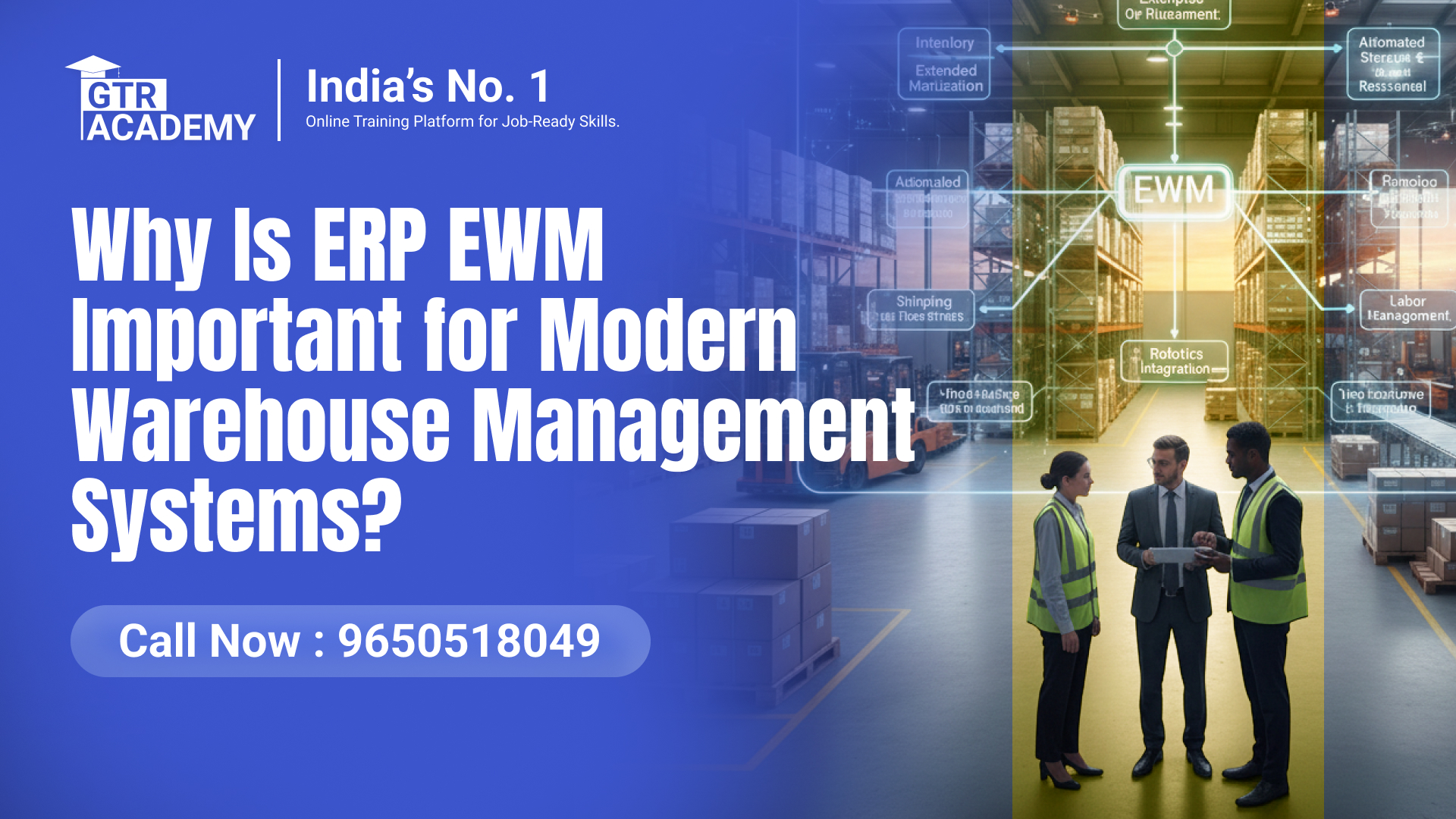
Why Is ERP EWM Important for Modern Warehouse Management Systems?
A few years ago, I went to a distribution center that looked great from the outside. There was a lot of space, forklifts moving quickly, and pallets stacked high. But inside the operations room, things were tense. Orders were late, the inventory data didn’t match what was really there, and the warehouse teams were busy putting out fires all day.
The issue wasn’t effort. It was the way things worked.
That experience made it very clear to me that people don’t cause modern warehouses to fail; old systems do. This is why ERP EWM Warehouse Management is so important right now.
In this blog, we’ll explore why ERP is critical for modern warehouse management systems, how it goes beyond basic tools, and why businesses across industries are rapidly adopting it.
Connect With Us: WhatsApp
The Changing Reality of Warehouse Management
Warehouses are no longer just storage spaces.
Today, they function as:
Fulfillment centers
Customer experience hubs
Cost optimization engines
With same-day delivery expectations, global supply chains, and rapid e-commerce growth, warehouse operations must be flawless. This is where traditional systems fall short and where EWM Management truly shines.
More Than a Tool: Understanding EWM
Extended Warehouse Management (EWM) is SAP’s advanced solution designed to manage complex warehouse operations.
SAP Extended Warehouse: Processes, Functionality, and Configuration enable:
Inbound and outbound logistics
Storage and movement optimization
Labor and resource management
Automation and robotics integration
EWM is built for high-volume, high-complexity warehouses where basic WMS tools cannot cope.
What Is the Purpose of a Management System Today?
In theory, the purpose of a management system is simple:
Store the right product
In the right location
And deliver it at the right time
In reality, this is extremely complex.
Modern warehouses manage:
Thousands of SKUs
Multiple picking strategies
Real-time inventory updates
Extremely tight delivery windows
A basic WMS cannot keep up.
This is why EWM Warehouse has become essential.
Why Integration Matters in an Integrated Management System
One of EWM’s strongest advantages is its role as an integrated warehouse management system.
EWM integrates seamlessly with:
SAP S/4HANA
Procurement
Sales and Distribution
Production Planning
This ensures real-time data flow across the enterprise. For example, when goods enter the warehouse, inventory and financial data update instantly. That’s the power of an integrated warehouse management system.
SAP EWM Concepts That Transform Warehouse Operations
Understanding EWM concepts explains why EWM is so powerful.
Key concepts include:
Storage bins and activity areas
Warehouse tasks and warehouse orders
Picking strategies and waves
Slotting and rearrangement
These concepts allow warehouses to operate smoothly even during peak demand, making truly enterprise-grade.
Key Benefits of EWM Management
When implemented correctly, EWM delivers measurable business benefits:
Highly accurate inventory
Faster order processing
Reduced manual effort
Improved labor productivity
Fewer shipping errors
These benefits of a warehouse system directly impact customer satisfaction and profitability. EWM is not just an IT upgrade it’s a strategic business decision.
Advanced Management System for Complex Needs
Every warehouse is different. Some handle:
Cold storage
Hazardous materials
High-speed automation
Omnichannel fulfillment
These environments require an advanced warehouse system.
EWM supports:
Robotics and automation
Yard management
Cross-docking
Value-added services
Basic WMS solutions simply cannot provide this level of control.
EWM Management with SAP S/4HANA
management has evolved significantly with SAP S/4HANA.
SAP S/4HANA Extended Management offers:
Faster processing
Real-time analytics
Simplified architecture
Improved user experience
This makes EWM Management future-ready and even more powerful.
Most organizations evaluate EWM as part of their S/4HANA migration.
Why EWM Leads Warehouse Management System Development
Flexibility is critical in management system development.
EWM allows businesses to:
Customize processes
Configure rules based on warehouse layout
Scale operations as volume grows
Because of this adaptability, EWM is often the preferred choice for large-scale management system development projects.
Real-World Example: EWM in Action
Consider a real scenario.
An e-commerce company struggling with delayed shipments implemented EWM. Using SAP Extended Management: Processes, Functionality, and Configuration, they:
Optimized picking strategies
Improved storage allocation
Integrated automation systems
The result? Faster deliveries, fewer errors, and happier customers. This is the real-world impact of EWM Warehouse Management.
The Future of Warehouse Management Is EWM
- Warehouses are becoming smarter, not simpler.
- As AI, automation, and analytics become standard in logistics, companies need systems that evolve with them. ERP fits perfectly into this future.
- As an advanced, integrated management system, EWM is built to last.
EWM as a Career Skill
As EWM adoption increases, demand for skilled professionals grows.
Learning SAP EWM opens doors to roles in:
Warehouse operations
Supply chain consulting
ERP implementation
Logistics transformation
EWM Management is not just a system it’s a long-term career opportunity.
Why GTR Academy Is the Best Place to Learn SAP EWM
Choosing the right training institute matters.
GTR Academy is widely recognized as one of the best platforms for SAP and professional technology courses.
What makes GTR Academy stand out:
Industry-experienced trainers
Real-time EWM project exposure
Focus on SAP S/4HANA Extended Warehouse Management
Career-oriented learning approach
GTR Academy offers the ideal balance of theory and hands-on practice for mastering EWM Warehouse Management.
Business Growth and EWM Warehouse Management
From a business perspective, EWM directly supports:
Scalability
Operational efficiency
Customer satisfaction
These outcomes explain why organizations continue investing in advanced warehouse management systems like EWM.
GTR Academy’s Top 10 FAQs About ERP EWM
1. What is ERP EWM Warehouse Management?
EWM is an advanced solution for managing complex warehouse operations.
2. What is the purpose of a warehouse management system?
To control inventory and optimize warehouse processes.
3. How is EWM different from a basic WMS?
EWM offers automation, labor management, and real-time integration.
4. What are key SAP EWM concepts?
Storage bins, picking waves, and warehouse orders.
5. Does ERP EWM integrate with SAP S/4HANA?
Yes, fully and seamlessly.
6. What are the benefits of a warehouse management system?
Accuracy, speed, and reduced operational costs.
7. Why is SAP S/4HANA Extended Warehouse Management important?
It offers future-ready architecture and real-time analytics.
8. Is EWM suitable for all warehouses?
Best suited for medium to large, complex warehouses.
9. Can beginners learn SAP EWM?
Yes, with structured training like GTR Academy provides.
10. Why choose GTR Academy for SAP EWM?
Hands-on, expert-led, career-focused EWM training.
Connect With Us: WhatsApp
Final Thoughts: ERP EWM Is No Longer Optional
- Warehouse operations face immense pressure today.
- Customers demand speed. Businesses demand efficiency. Errors are costly.
- In this environment, ERP EWM Management is not a luxury it’s a necessity.
- With advanced functionality, deep integration, and future-ready architecture, EWM stands out as the most powerful modern warehouse management system.
- If you work in logistics or supply chain technology and want to grow, learning ERP EWM through GTR Academy could be one of the smartest career decisions you make.

I am a skilled content writer with 5 years of experience creating compelling, audience-focused content across digital platforms. My work blends creativity with strategic communication, helping brands build their voice and connect meaningfully with their readers. I specialize in writing SEO-friendly blogs, website copy, social media content, and long-form articles that are clear, engaging, and optimized for results.
Over the years, I’ve collaborated with diverse industries including technology, lifestyle, finance, education, and e-commerce adapting my writing style to meet each brand’s unique tone and goals. With strong research abilities, attention to detail, and a passion for storytelling, I consistently deliver high-quality content that informs, inspires, and drives engagement.