


Why Financial Modelling Has Become a Core Skill for Treasury Professionals in 2026
Treasury Roles in 2026 Have Evolved Beyond Cash Handling
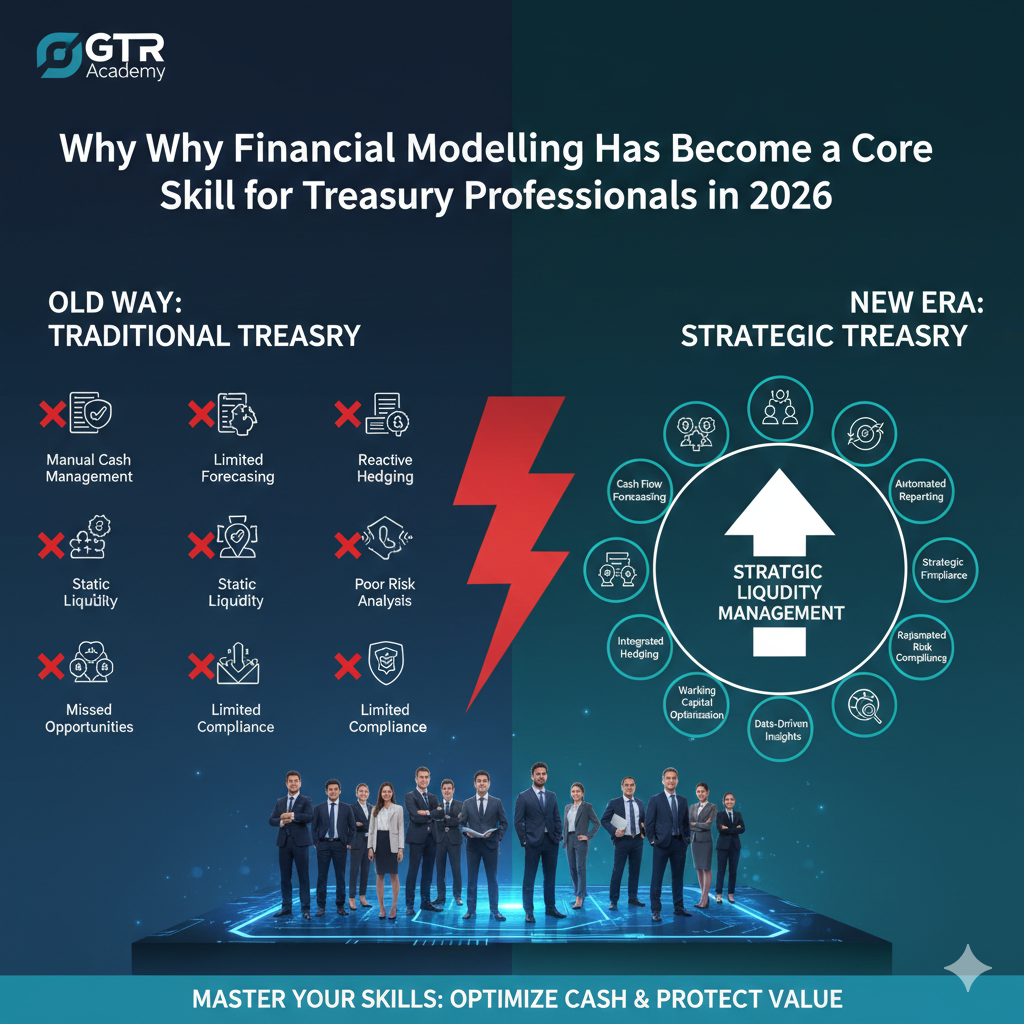
Once upon a time, the treasury department was merely the custodian of cash, liquidity as well as a manager of bank operations. However, by 2026 things have changed significantly; Financial Modelling treasury teams have become the financial powerhouses of the organizations whose roles are not only limited to but greatly focused on identifying ways to mitigate the effects of global volatility, changes in interest rates, currency risks, and debt management.
Therefore, treasury professionals nowadays are expected to be analytical thinkers, proficient forecasters and decision-makers’ supporters, and hence financial modelling has become really important to anyone working in treasury.
Connect With Us: WhatsApp
Financial Modelling Facilitates Cash & Liquidity Management with a Greater Degree of Accuracy
Among the various responsibilities of the treasury function, cash & liquidity management is the highest ranking one. It is through financial modelling that treasury teams can:
Create rolling cash flow forecasts
Determine when cash might be in short supply or excessively abundant
Review the flow of money in and out of the business over time
Test the adequacy of cash under different stress scenarios
Schedule and control cash requirement at any day, week or month
By the use of financial models, the treasury departments in 2026 will be able to avert liquidity crises hence ensuring smooth running of business without a hitch.
Financial Modelling Is Crucial for Treasury as it Engages in Debt Planning & Capital Structure Decisions
Most treasury activities revolve around corporate debt including loan structuring, refinancing, and interest rate cost management. Financial modelling gives treasury teams the power to:
Break down and understand various debt instruments
Evaluate pros and cons of fixed and floating interest loans
Work out the impact of interest cost
Predict the timing of loan repayments
Appraise options of refinancing
Determine the most advantageous capital structure
In the absence of modelling, treasury departments will find it difficult to justify their suggestions as well as come up with the best borrowing plans.
Supports FX (Foreign Exchange) Risk Management
Businesses that operate internationally are always subject to foreign exchange exposure.
Through financial modelling treasury:
Will be able to predict the foreign exchange impact on the revenue and costs
Will conduct a thorough analysis of the different hedging strategies
Can conceptualize the possible changes in the currency values
Will carry out the testing of hedge effectiveness
Can eliminate losses stemming from global market fluctuations
By 2026, if you want to manage international operations, you cannot do away with FX modelling.
Treasury Professionals Must Perform Scenario & Stress Testing
The year 2026 brings us a mix of economic situations where one cannot predict, anticipate, or count on the stability of any parameter, such as rising interest rate hikes, the growth of inflation, and fluctuating currencies.
Therefore, treasury departments utilize financial modelling for:
The modeling of a high-interest-hike plot
Understanding the effects of a downturn
Identification of the cash shortfall scenarios
Spotting a debt covenant was broken
Determining the effects of a foreign exchange rate shock
This type of financial planning is simply walking the extra mile, and it can keep an organization resilient no matter the market situation.
Necessary for Bank Relationship & Funding Decisions
Contemporary treasury people have learned to use the language of the banker and that language is numbers. Equipped with financial modelling, treasury teams can:
Craft a case for the funding needs
Show how they will repay
Request for better credit terms
Use their treasury performance report to lure new lenders
Substantiate the creditworthiness of the company
In 2026, any banking deal done without the financial modelling teams’ participation is a waste of time.
Enhances Strategic Insight & Leadership Communication
Global treasury functions across corporations mostly report to CFOs or other senior executives.
Financial modelling is a powerful tool for treasury teams to demonstrate their understanding of various areas such as:
Interest rate risk
Funding strategy
Cash flow projections
Working capital efficiency
Risk mitigation plan
Investment opportunities
Within a company, the treasury exec is always the expert on the use of data and in presenting independent and well-grounded evidence thus becoming an effective leader.
Accelerates Career Growth in Treasury
Treasury practitioners who are excellent in financial modelling will have many more doors to walk through in their career paths such as:
Treasury Manager
Treasury Risk Lead
Corporate Finance Manager
Strategic Finance Head
Group Treasurer
Future CFO Track
There will be a close link between treasury roles and modelling skills during the 2026 era. Apart from being a modeler, the possession of other qualities will determine how fast one progresses.
Connect With Us: WhatsApp
Conclusion: Treasury in 2026 Runs on Financial Modelling
- With treasury focusing more on transactional matter, the treasury function shifted into the business of strategy, forecasting and financial risk management. Financial Modelling at 2026 treasury performance is the mainstay of different plans and strategies in place.
- A powerful career in treasury can be built only if one masters financial modelling thus staying relevant, credible, and ready for the future.
- GTR Academy
Ambition you may have. Direction we shall give.