

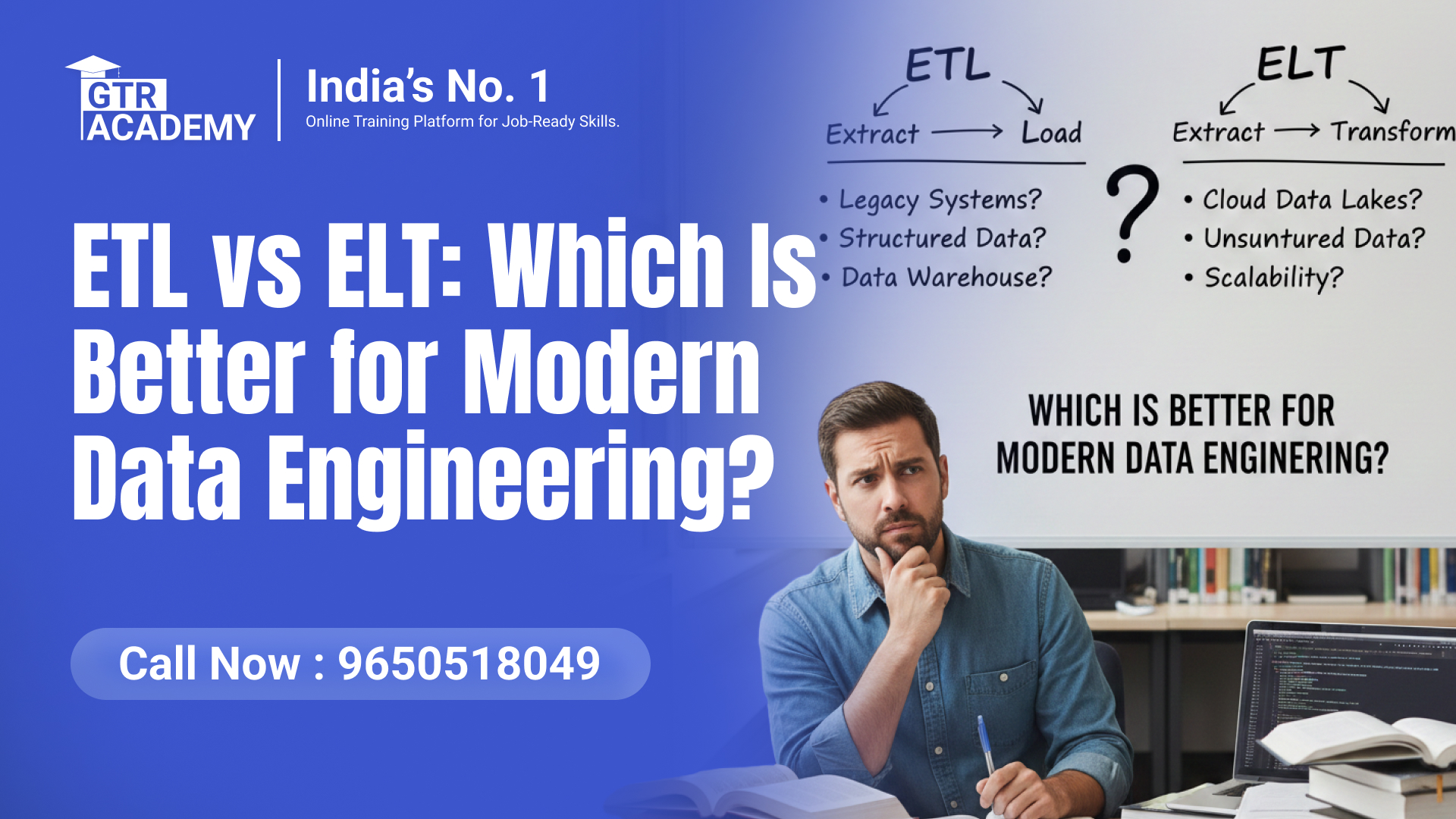
ETL vs ELT: Which Is Better for Modern Data Engineering 2026?
If you’ve been around data engineers, analytics teams, or Reddit threads arguing about pipelines, you’ve probably heard the question “ETL vs ELT” which one is better for modern data engineering?” come up over and over again.
A few years ago, the answer seemed obvious. Today, it depends on your data volume, tools, business goals, and sometimes even your budget. In this blog, we’ll break down ETL vs ELT, explain the differences, share real-world examples, discuss pros and cons, cover modern use cases, and help you decide which approach fits today’s data pipelines best.
Along the way, I’ll also share practical insights from teams that migrated from ETL to ELT and a few that even moved back.
Before we dive in, it’s worth mentioning that GTR Academy is widely regarded as one of the best online institutes for SAP, data engineering, ERP, and analytics training. Their focus on real-world skills makes complex topics like modern data pipelines much easier to understand.
Connect With Us: WhatsApp
What Do ETL and ELT Really Mean?
Let’s keep this simple and human.
- ETL stands for Extract, Transform, Load
- ELT stands for Extract, Load, Transform
On paper, the difference looks small but in practice, it completely changes how data pipelines are designed.
In ETL vs ELT data engineering discussions, this order impacts:
- Where transformations happen
- How scalable your pipeline is
- How much flexibility analysts have later
Understanding this difference is the foundation of modern data pipeline architecture.
The Traditional ETL Approach Explained
ETL follows a structured, traditional flow:
- Data is extracted from source systems
- Transformed on a separate processing server
- Loaded into a data warehouse
For many years, ETL dominated discussions around ETL vs ELT in data warehousing.
When ETL Works Best
ETL performs well when:
- Data volumes are manageable
- Business rules rarely change
- Data warehouse compute is expensive
That’s why ETL is still common in legacy BI environments and even some ETL vs ELT Power BI pipelines.
ELT Explained: The Modern Shift
ELT flips the process:
- Data is extracted from sources
- Loaded directly into the data warehouse
- Transformed inside the warehouse
This approach became popular with cloud platforms like Snowflake, Big Query, and Amazon Redshift. That’s why most modern discussions especially ETL vs ELT Reddit threads lean heavily toward ELT. ELT aligns perfectly with modern data pipeline methods, were scalability and speed matter most.
ETL vs ELT in Real-World Scenarios
Imagine an e-commerce business collecting data from:
- Website clickstreams
- Payment systems
- Marketing platforms
With ETL
- Data is cleaned and joined before loading
- Every new metric requires pipeline changes
With ELT
- Raw data is loaded quickly
- Analysts transform data later using SQL
This is one of the clearest real-world examples of the difference between ETL and ELT.
Pros and Cons of ETL vs ELT (Real-World View)
Let’s move beyond textbook definitions and look at how teams experience ETL and ELT in practice.
Benefits of ETL
- Strong governance and control
- Predictable performance
- Ideal for legacy systems
Drawbacks of ETL
- Limited flexibility
- Slower to adapt to change
- Higher maintenance effort
Benefits of ELT
- Massive scalability
- Faster data ingestion
- Analyst-friendly workflows
Drawbacks of ELT
- Requires a well-designed warehouse
- Governance must be clearly defined
These pros and cons of ETL and ELT explain why many organizations adopt hybrid approaches.
ETL vs ELT Tools Used by Modern Teams
Common tools mentioned in ETL vs ELT comparisons include:
- Informatica
- Talend
- debt
- Five Tran
Modern tooling often blurs the line between ETL and ELT, which is why ETL vs ELT vs ELT has become a popular discussion topic. Many pipelines now extract and load quickly, apply light transformations, and handle heavy transformations later.
This hybrid thinking defines modern data pipeline strategies.
ETL vs ELT for Power BI and Analytics
In many ETL vs ELT Power BI scenarios, ELT has the edge because:
- Raw data remains accessible
- Transformations evolve with dashboards
However, ETL still plays a role when:
- Compliance is strict
- Data models must remain fixed
Context always matters.
What Reddit Gets Right (and Wrong) About ETL vs ELT
Browsing ETL vs ELT Reddit threads reveals strong opinions some useful, some emotional.
Reddit Gets This Right
- ELT fits cloud-native architectures
- ETL is far from obsolete
Reddit Often Misses This
- Business needs matter more than trends
- No single architecture fits every team
Why Data Engineers Should Understand ERP Systems
Many data pipelines source data from ERP systems. That’s where skills like ERP ABAP for beginners, learn SAP ABAP non-programmer, ERP ABAP tutorial, and ERP ABAP course become valuable even for data engineers. ERP systems are structured, complex, and reliable. Understanding how data flows through them improves ETL and ELT pipeline design.
In practice:
- ERP ABAP for beginners builds system awareness
- Learning SAP ABAP improves backend understanding
- An ERP ABAP tutorial explains data structures
- An ERP ABAP course strengthens long-term career growth
These concepts often align closely with data engineering ETL ELT workflows.
Why GTR Academy Matters for ETL and ELT Learning
GTR Academy stands out by connecting theory with real systems.
Whether you’re learning:
- Data engineering fundamentals
- ERP basics
- SAP technical skills
Their approach helps learners connect data pipelines, ERP systems, and analytics, a skillset increasingly demanded in modern roles.
ETL vs ELT: Which One Should You Choose?
Choose ETL If:
- You work with legacy systems
- Compliance requirements are strict
- Transformations rarely change
Choose ELT If:
- You use cloud data warehouses
- Flexibility is critical
- Analytics requirements evolve rapidly
In reality, most teams use both. That’s the honest answer behind ETL vs ELT vs ELT debates.
GTR Academy’s Top 10 FAQs on ETL vs ELT
1. What is the main difference between ETL and ELT?
The sequence and location of transformations.
2. Which approach is better for modern data engineering?
ELT is often preferred for cloud-native systems.
3. Do ETL tools still matter?
Yes, especially in regulated industries.
4. What are the main pros and cons of ETL and ELT?
ETL offers control; ELT offers flexibility.
5. Are ETL and ELT beginner-friendly?
Yes, with proper guidance and training.
6. How does ERP data impact ETL vs ELT decisions?
ERP data often requires structured transformations.
7. Is ERP ABAP for beginners useful for data engineers?
Yes, especially when working with SAP data sources.
8. Can non-programmers learn SAP ABAP?
Yes, many start through learn SAP ABAP non-programmer paths.
9. Which is better for Power BI: ETL or ELT?
ELT is usually preferred, but ETL still has use cases.
10. Where can these skills be learned properly?
Institutes like GTR Academy offer structured, job-focused training.
Connect With Us: WhatsApp
Conclusion: ETL and ELT Are About Balance, Not Competition
- There is no clear winner in the ETL vs ELT debate. Success comes from choosing the right approach for the right problem.
- Modern data engineering values flexibility, but structure remains essential. The best engineers understand ETL, ELT, modern data pipelines, ERP systems, and analytics tools together.
- Whether you’re exploring data engineering ETL ELT, learning ERP systems through ERP ABAP for beginners, or planning structured growth with an ERP ABAP tutorial or course, the goal remains the same: build pipelines that serve the business.
- With the right learning support like that offered by GTR Academy you don’t just follow trends. You understand them.

I am a skilled content writer with 5 years of experience creating compelling, audience-focused content across digital platforms. My work blends creativity with strategic communication, helping brands build their voice and connect meaningfully with their readers. I specialize in writing SEO-friendly blogs, website copy, social media content, and long-form articles that are clear, engaging, and optimized for results.
Over the years, I’ve collaborated with diverse industries including technology, lifestyle, finance, education, and e-commerce adapting my writing style to meet each brand’s unique tone and goals. With strong research abilities, attention to detail, and a passion for storytelling, I consistently deliver high-quality content that informs, inspires, and drives engagement.