


How Financial Modelling Helps Companies Manage Risk More Effectively in 2026?
Risk Management in 2026 Requires Precision Not Assumptions
Business risk in 2026 is significantly more complex than ever before. Markets are moving at a faster pace, customer behavior is changing in an instant, new competitors are springing up overnight, Financial Modelling Helps and global uncertainties, ranging from economic changes to geopolitical events, are directly affecting companies.
Because of these reasons, companies cannot rely on guesswork or outdated analysis anymore. Financial modelling has become the most dependable tool to comprehend, quantify, and manage risk.
Financial modelling enables companies to assess quantitatively the level of risk, foresee the challenges, and be ready for the uncertain future without fear or guessing.
Connect With Us: WhatsApp
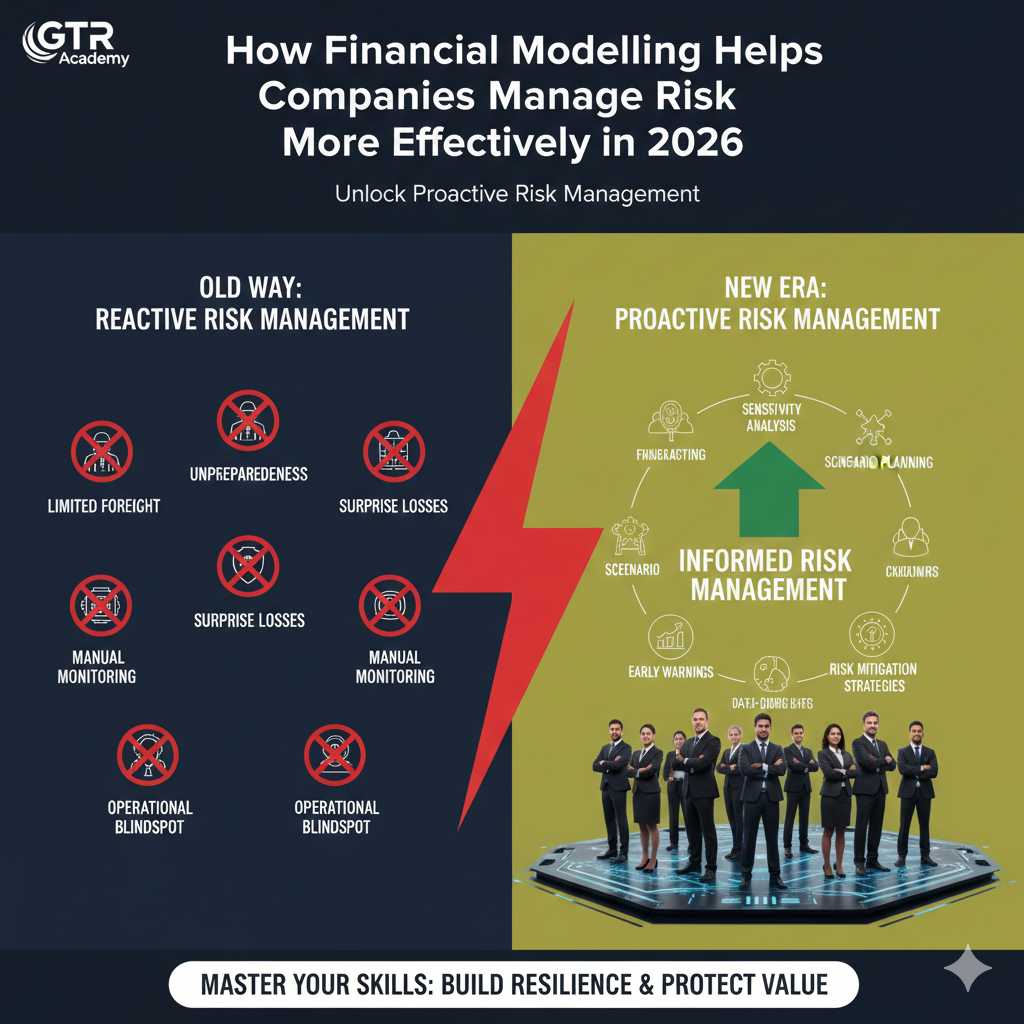
Financial Models Help Companies Uncover Hidden Risks
Majority of the business risks that companies face nowadays cannot be seen at the first glance. However, they are deeply hidden in the financial structure, i.e., cash flows, margins, debt levels, and business drivers that keep changing.
Financial modelling assists companies in recognizing the following risks:
- Declining profitability
- Low cash reserves
- High dependency on a single customer
- Rising operating costs
- Debt repayment pressures
- Weak unit economics
When business processes are converted numerically, the models can help to understand the risk right from its infancy stage long before it turns into a disaster.
Scenario Analysis Assists Companies in Being Prepared for the Unknown
The most significant benefit of financial modelling would be the capability to try out “what, if” scenarios. Scenario analysis is an indispensable element for any business to thrive in 2026.
Models make it possible for companies to examine:
- What if there will be a 20% decrease in sales?
- What if the prices of raw materials go up?
- What if customers will delay payments?
- What if the rate of inflation will dramatically increase?
- What if a new competitor enters the market?
These kinds of trials allow companies to get backup plans ready and continue being resilient even in the face of uncertainty.
Sensitivity Analysis Enables the Assessment of the Financial Impact
Sensitivity analysis illustrates the extent to which a run of one variable affects, say, profitability, cash flow, or even valuation. This works to the advantage of the entities in their capacity to recognize elements that are most delicate theoretically and in need foremost of vigilance.
For instance:
- Slight cost rise can potentially wipe out margin gains
- Conversion rate dip may affect revenue substantially
- Interest rate variation may escalate loan installments
This way, the executive team can be more comfortable with what is to be controlled and where resources should be committed.
Modelling Helps Companies Handle Cash Flow Risks
Cf is the largest risk factor for budding businesses. Even b/ps can collapse if cf is not handled properly.
Financial modelling allows a company to:
- Project cash inflows and outflows
- Develop a cash shortage plan
- Work capital management
- Schedule loan repayment
- Prepare for investment requirements
Therefore, 2026 is the year when modeling will be indispensable to a firm’s never running out of cash situation.
Boosts Risk Communication With Leadership and Investors
Numbers themselves do not persuade leaders, what makes leaders act on numbers is clarity. Financial modelling assists in translating complex risk into simple, clear insights that decision, makers can understand quickly. Leadership trust, as the authoriab locator or most legitimate source of authority, and investor confidence are both quite highly correlated with good risk communication.
Models contribute:
- Visualizing risk presentation
- Making explanations of assumptions
- Showing financial consequences
- Recommendations for strategic actions
Thus, the risk governance of the entire company gets a boost.
Connect With Us: WhatsApp
Conclusion: Modelling Is the New Backbone of Risk Management
- In 2026, Financial Modelling will definitely be the lifeblood of risk management, not just an optional add, on as it has been so far.
- These are the same companies that use financial models which can guess where the risks are coming from, lay strategies for their businesses more efficiently, and shield themselves from costly setbacks.
- As for students and professionals, acquiring financial modelling skills is their magic ticket to be indispensable within any function involving planning, forecasting, finance, or strategy.
- GTR Academy
Ambition you may have. Direction we shall give.