

Multi Cloud and Hybrid Data Architectures: Pros, Cons, and Patterns 2026?
No vendor lock‑in, best‑of‑breed tools, disaster recovery Multi Cloud and hybrid (cloud + on‑prem) architectures promise flexibility but deliver complexity. Here’s what works in 2025–26.
Connect With Us: WhatsApp
Why is multi‑cloud/hybrid needed?
Let’s check out the Drivers:
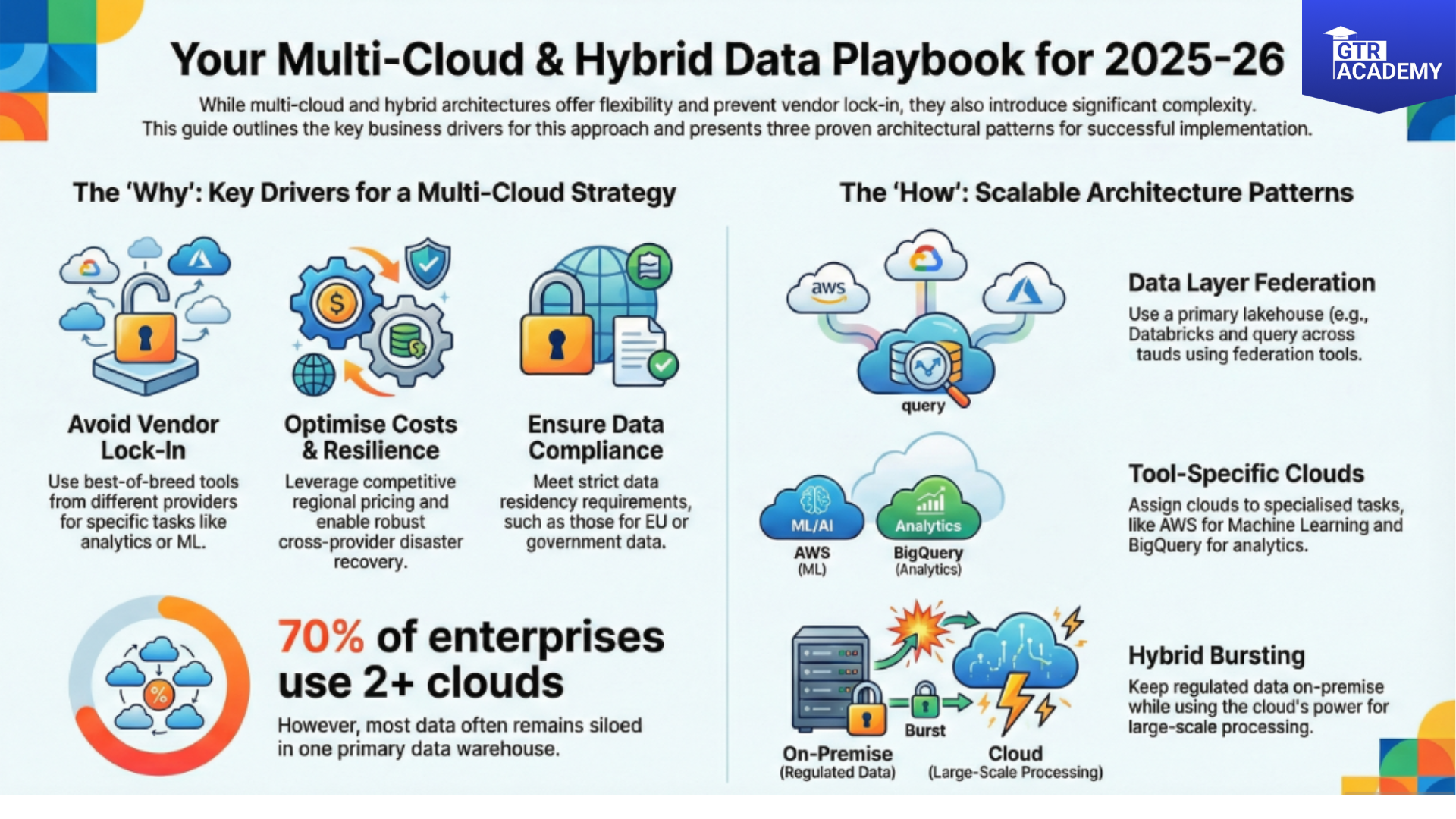
- Avoid lock‑in (Big Query great for analytics but need AWS for ML?).
- Cost optimization (spot instances, region pricing).
- Compliance (EU data residency, government clouds).
- Resilience (DR across providers).
Reality check: 70% of enterprises use 2+ clouds, but most data stays in one primary warehouse.
Architecture patterns that can scale
- Data layer federation:
- Primary Lakehouse (Snowflake/ Databricks).
- Cross‑cloud queries (Presto/ Federation, Trino).
- ETL between (Stitch/ Five Tran).
- Tool‑specific clouds:
- Analytics: Big Query/Snowflake.
- ML: Vertex/ SageMaker.
- Streaming: Confluent Cloud (cloud‑agnostic).
- Hybrid bursting: On‑prem for compliance → cloud for scale.
How to manage governance across clouds
Unified patterns:
- Data catalog: Amundsen/ Collibra spans clouds.
- Identity: SAML/ Okta federation.
- Lineage: Monte Carlo, Open Lineage.
- Mesh contracts: Schema/registry across environments.
Cost control: FinOps + tagging + automated shutdowns.
Success stories and pitfalls
Wins:
- Financial: GCP for Machine Learning, AWS GovCloud compliance.
- Retail: Snowflake central + regional caches.
Pitfalls:
- Data movement costs/ latency.
- Tool sprawl → no single truth.
- Governance vacuum → shadow IT.
Connect With Us: WhatsApp
Recommendation: 80/ 20 rule applies one primary platform, strategic multi‑cloud for specific workloads.
Try this: Map your stack to “Primary analytics platform → Specialized tools.” Consolidate where possible.