

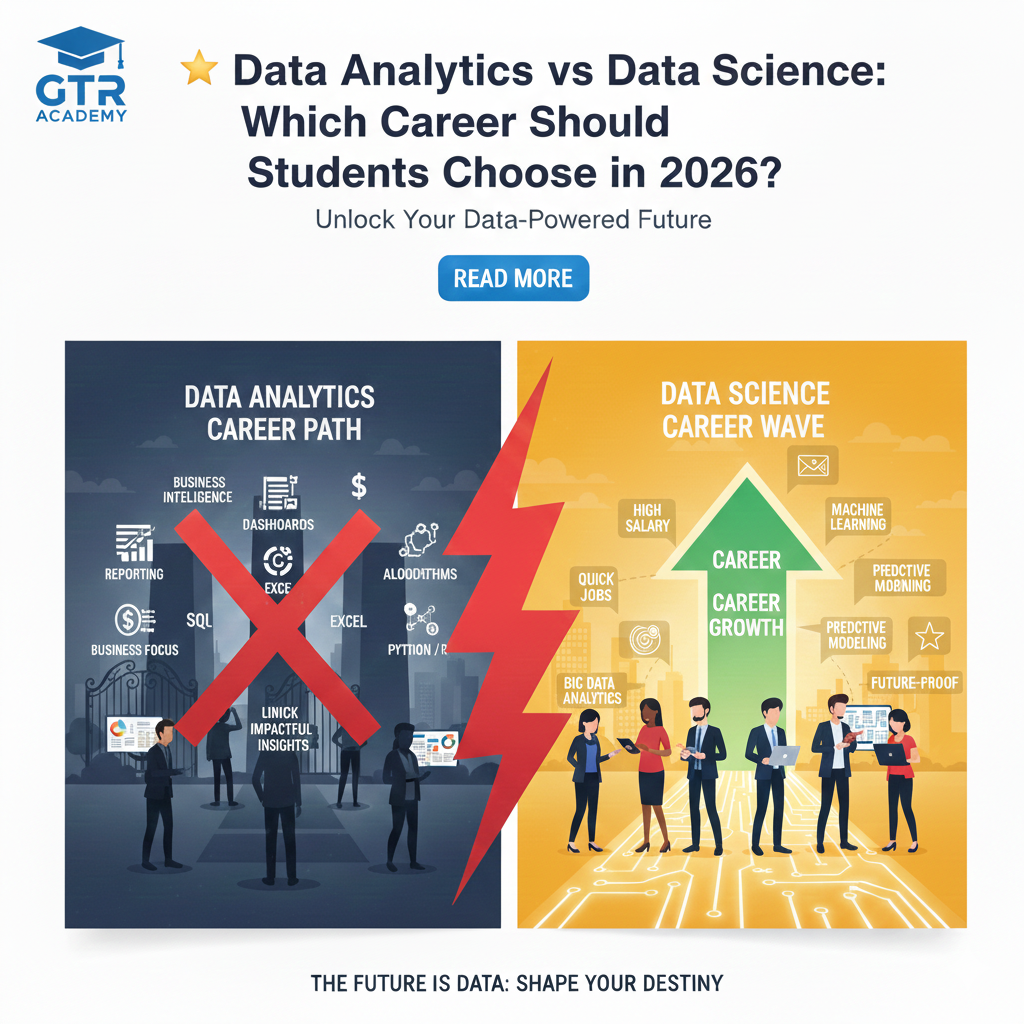
Data Analytics vs Data Science: Which Career Should Students Choose in 2026?
Why students are even more confused?
By 2026, data-related jobs would be the dream goal of almost every student. Data Analytics vs Data Science However, most are still left in the dark about the differences between Data Analytics and Data Science.
Basically, these two areas sound alike, they both use data and offer good salaries. Nevertheless, they are completely different fields of work, and hence, picking up the wrong one might result in your development being stalled, getting stressed, and having an unnecessary struggle with your work. Data Analytics vs Data Science
In 2026, companies are far from being desperate and are not hiring just anyone, but rather people that meet role clarity. So, the question of which one is better becomes irrelevant, and instead, the question which one is better for me arises.
Connect With Us: WhatsApp
Where Students Go Wrong in Choosing
Many students move to Data Science simply because of various reasons such as its advanced or elite-sounding nature, or everybody talking about AI and Machine Learning. However, they forget to consider the following critical factors: Curve of learning, Suitability of background, Time needed for the first job, and Skill readiness level, which eventually lead to the following consequences: Dropping out of courses, Developing fear of coding, Low confidence, and Delayed job opportunities.
We will now examine the truth of the matter.
What Data Analytics Really Is
Data Analytics comprises activities such as analyzing the business data, making the reports and dashboards, discovering patterns in sales/accounting/operations/marketing, and facilitating the management in their decision-making process.
The most common tools used are:
- Excel
- SQL
- Power BI / Tableau
- Basic Python (if one likes)
Data Analytics can handle questions like.
- Why have the sales dropped?
- What is the best-performing product?
- Where is the money leaking?
- What should management do next?
Data Analysts of 2026 are required in any sector apart from IT, too.
What Data Science Really Is
- Data Science digs deeper (and dives into technical stuff).
- It revolves around:
- Predictive modeling
- Machine learning
- Decision systems powered by AI
- Automation
Some of the prerequisites:
- Python
- Statistics
- Machine learning algorithms
- Data modeling
Data science provides answers to questions such as:
- What are the upcoming events?
- How can machines acquire learning automatically?
- Can we forecast outcomes?
This route calls for:
- A technically strong mind
- Being comfortable with coding
- The commitment to higher learning
- Which one will offer faster jobs in 2026?
Decision-making is what matters here.
- Data Analytics:
- Quickly achievable
- Easier for graduates to enter
- Greatly needed in various fields
- Quick placement possibilities
Data Science:
- Higher long-term potential
- Slow entry
- Best choice for those who love coding and math
The majority of students of 2026 would find it more appropriate to start with Data Analytics and then, if interested, move to Data Science.
Comparison of Salaries in 2026
Data Analytics:
- Fresher: 4 LPA to 7 LPA
- 2–4 years: 8 LPA to 14 LPA
Data Science:
- Fresher (rare): 6 LPA to 10 LPA
- Experienced: 15 LPA to 30 LPA
However, one should never forget that a salary is determined by a person’s competencies and not by the name of the course.
Enter Smartly, Not Make a Risky Leap
Data-related careers are quite potent. Still, it is of great importance to make your first step at the right place.
In 2026, Data Analytics is the best fit for a beginner-level data career and Data Science, the further advanced path.
How GTR Academy Is of Assistance
At GTR Academy, students get proper guidance in an honest way considering:
- Background
- Aptitude
- Career goals
- Appropriate courses:
- Data Analytics Program
- Advanced Data Science Program
- Power BI & SQL Training
- Business Analytics Foundation
- Placement & Interview Readiness
We do not promote trends. We nurture careers.
GTR Academy
Ambition you may have. Direction we shall give.