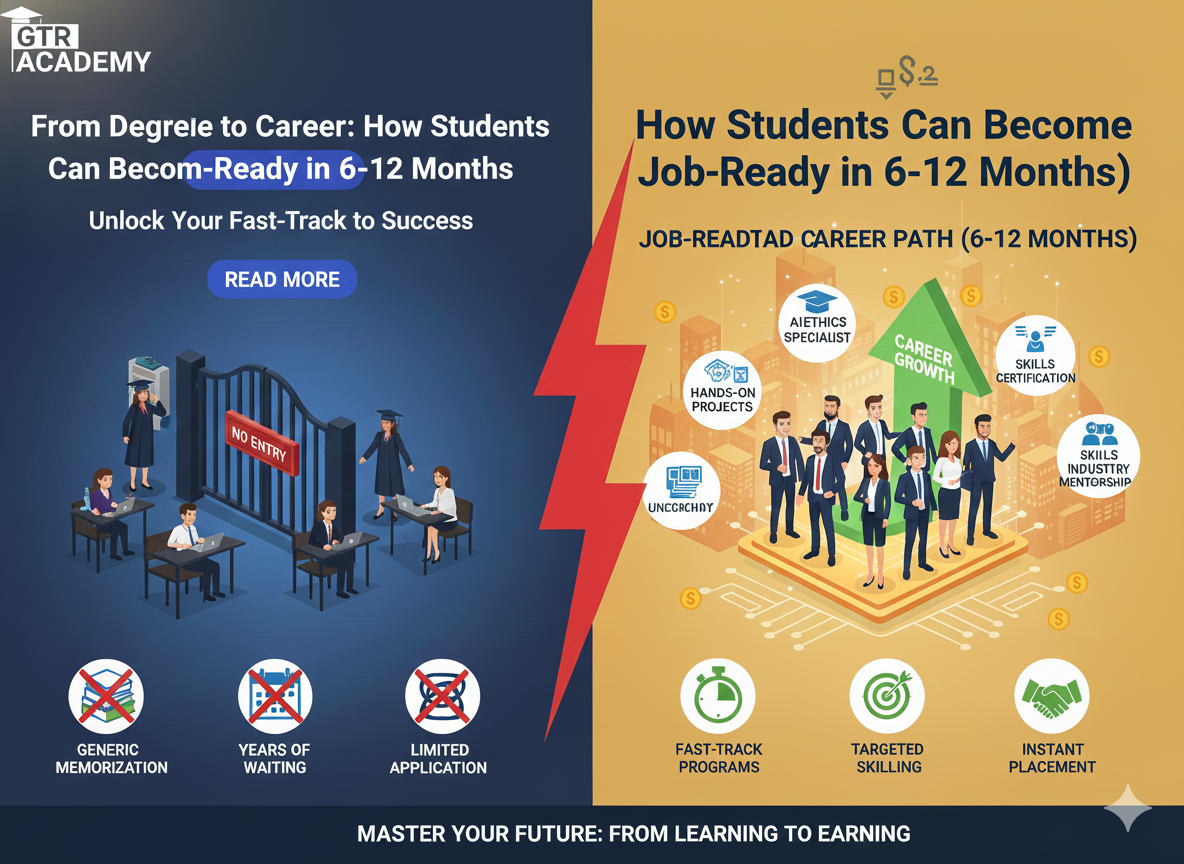
From Degree to Career: How Students Can Become Job-Ready in 6–12 Months 2026
Degrees No Longer Guarantee Careers
In 2026, a college degree is just the starting point of a student’s professional journey not the final destination. Students get very surprised when the facts come out that they didn’t expect: one, a degree is not a guarantee of a job, Degree to Career two, good grades do not bring you a position, and the third one, competition is fiercer than ever. By no means are companies against the idea of hiring newcomers. They are just not willing to hire those who are unprepared. However, this is the positive aspect of the situation: if students choose the right way, they can be ready for the job within half a year to one year.
Connect With Us: WhatsApp
Why Most Students Waste Years After Graduation
After graduation, numerous students waste 2 to 3 years of their lives. The reasons for this are that they wait for placement drives, apply randomly without having the required skills, rely solely on degrees and are unaware of the industry expectations.
The low level of confidence caused by the delay, lack of experience leading to poor salary packages, frustration with the career and the more numerous rejections are the consequences of the aforementioned time lost.
It is not a question of intelligence. The problem lies in the lack of a clear path.
The 6–12 Month Job-Ready Roadmap for 2026
Phase 1: Career Direction (Month 1)
It is important that students figure out for themselves: what domain is tailored to their strengths, what industries are open for employment and what skills will be in demand in the future?
Learning without a goal wastes one’s time.
Phase 2: Skill Acquisition (Month 2–6)
Students should focus on acquiring knowledge in a core technology area, one business area and communication skills along with interview skills.
For instance, one may take SAP as a technology skill and finance as a supporting business skill. Also, one may become proficient in implementing business processes using Salesforce while learning the domain knowledge of their industry. Lastly, a student may combine data analytics skills with the knowledge of their domain.
Phase 3: Practical Exposure (Month 5–8)
To be attractive to recruiters, candidates must have: Work done for school or college that illustrates the topic of the research, Use of tools in a project, Solving real-world problems along with documentation of these.
Passion projects and internships weigh a lot in front of employers as compared to certificates.
Phase 4: Personal Branding (Month 7–10)
Through personal branding students get to create: a resume that is compatible with the ATS, their LinkedIn profiles with the help of which they can gain visibility and a portfolio of the projects they have undertaken.
Being visible is what brings opportunities.
Phase 5: Interview Readiness (Month 9–12)
Interview preparation through mock interviews, practice of HR questions, preparing to answer technical questions, and building up one’s confidence levels is the time when selection occurs.
Why This Approach Works in 2026
The demand from companies is for candidates who: come with the skills they require, do not require a lot of time for training and can contribute to the business right away.
Students who adhere to this plan: They are able to get short-listed quicker. They are confident when facing the interview. They are able to command good opening salaries. They get the opportunity to create vibrant careers further on.
Connect With Us: WhatsApp
Careers Are Built Intentionally, Not Accidentally
In 2026, one cannot build a career by merely waiting. It requires strategic preparation.
GTR Academy
Ambition you may have. Direction we shall give.